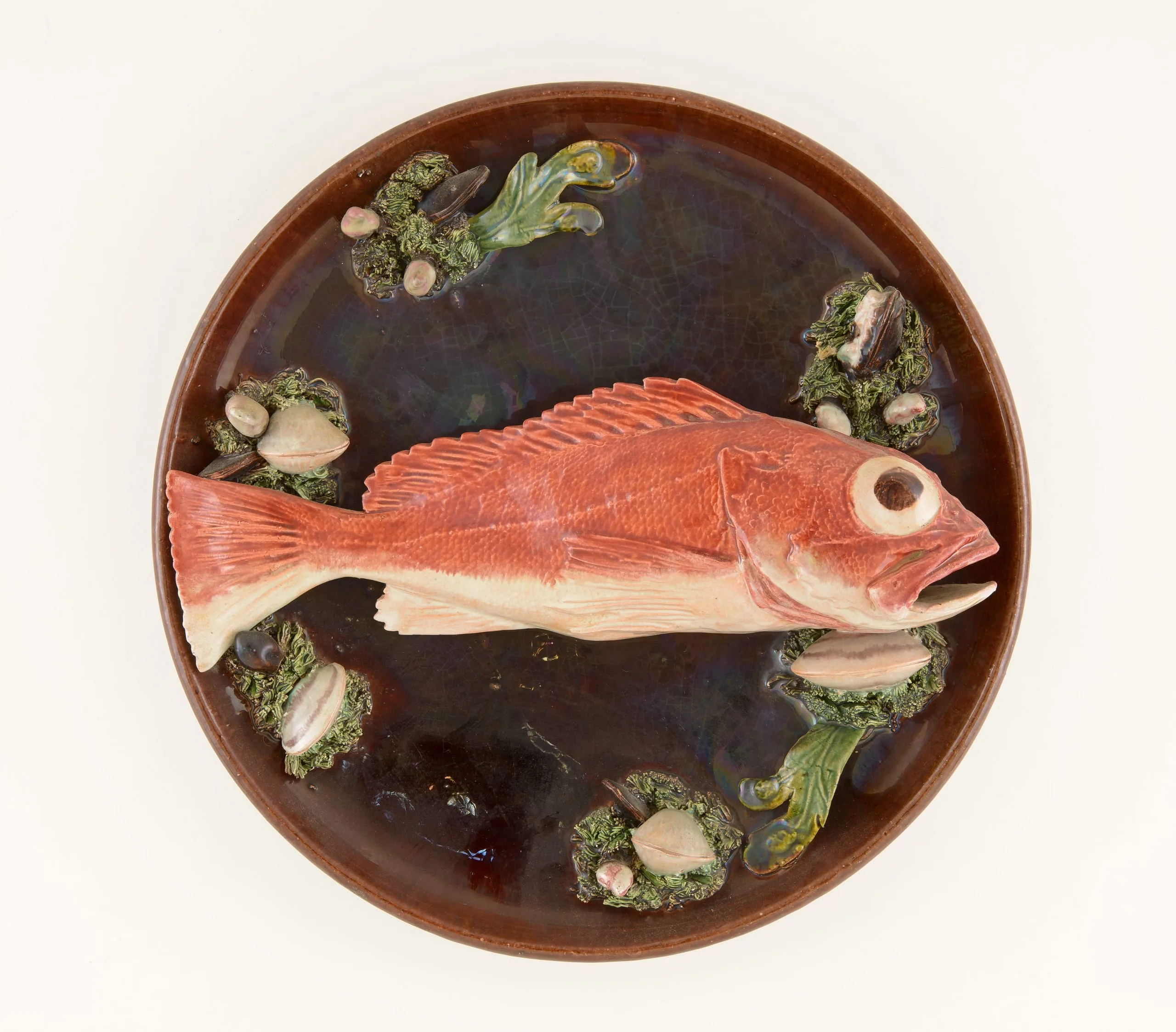
During the 19th century, there was a craze for work by the Renaissance potter Bernard Palissy (1510-1590) in both France and Portugal, inspiring interest in the originals, and the development of revival pieces in the same style.
In Portugal, manufacturing was concentrated in the town of Caldas da Rainha, where, in the 1850s, Manuel Cipriano Gomes Mafra (1830-1905) began to adapt Palissy’s style in a strikingly different direction, quite unlike that of his French counterparts. He incorporated the technique of pressing wet clay through a sieve to create the effect of moss as his principal background and expanded the subject matter, introducing narrative elements and extending the nature morte metaphor. José Alvez Cunha (active 1860-ca. 1885), whose output is almost indistinguishable from that of Mafra, may have worked for Mafra at some point. João Arroja was the successor to Cunha’s business, and likely made this plate between 1900 and 1920.