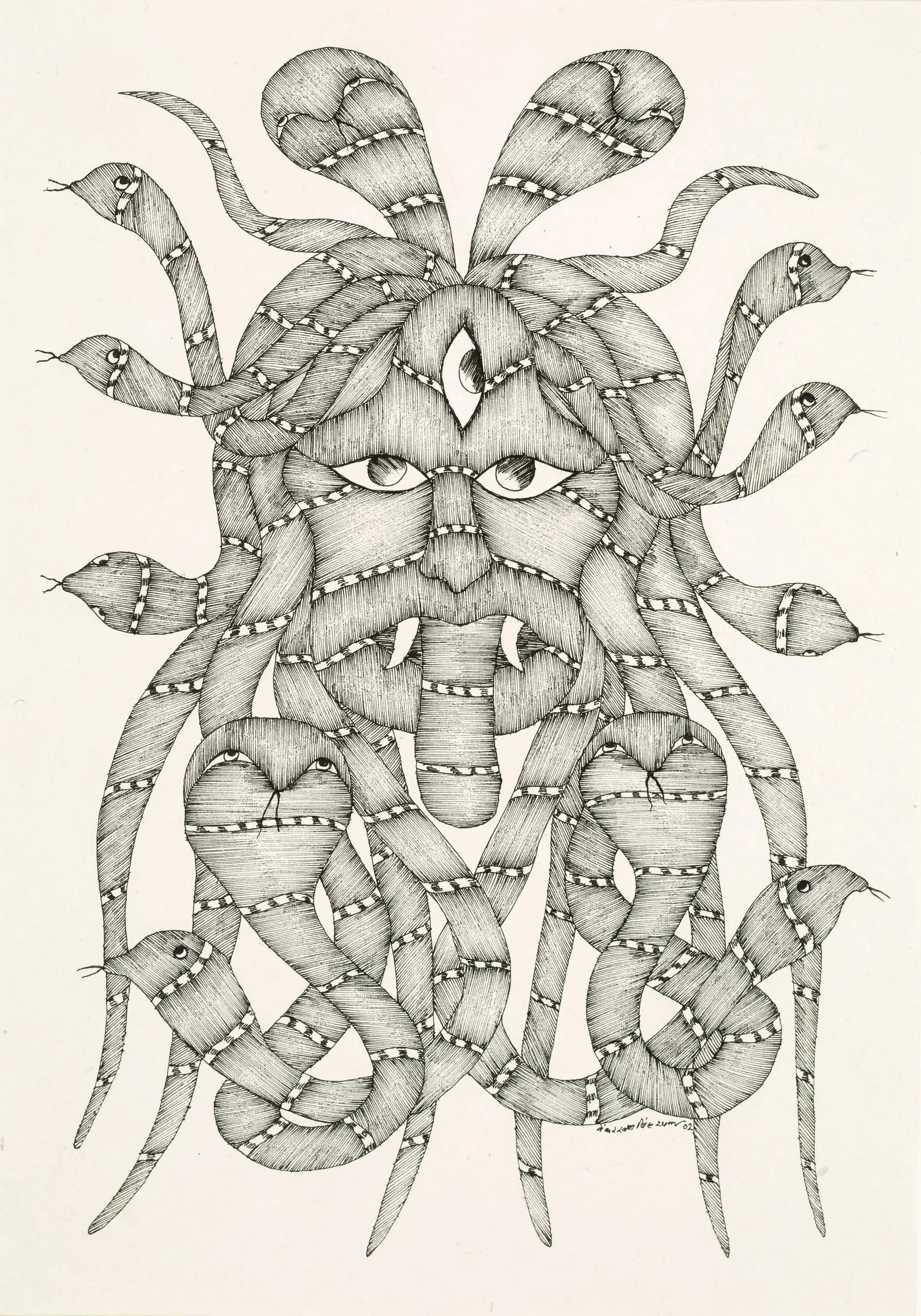
The Gonds are one of India’s largest adivasi (indigenous) communities. They are spread across a central swath of India encompassing several modern states, with a concentration in Madhya Pradesh. The Gonds are comprised of various subgroups, including the Pardhan Gonds whose priests perform important rituals and serve as the chief sustainers of the Gonds’ religious and mythological narratives, histories, and genealogies. In the early 1980s, Jangarh Singh Shyam (1960-2001) became the one of first Pardhan Gond contemporary artists to shift from painting murals to working on paper and canvas (see M.2013.56.1). He established a studio in Bhopal where he trained other Pardhan Gond artists, including his nephew Venkat Raman Singh Shyam (born 1970), a second-generation Gond artist who created the present work. Venkat Raman Singh Shyam developed his own figural style called chakmak (flint stone) featuring bands of fine shading bound by narrow stripes.
This drawing of Kali Mata (the dark mother) represents a fierce goddess associated with Mahakali, the primeval Hindu goddess of destruction. Images of Kali Mata, Mahakali, and the Hindu goddess Kali all share the horrific iconography of bulging eyes, fangs, a lolling tongue, and Shiva’s third eye of wisdom. Here, Kali Mata’s head is dramatically envisioned in a composite form comprised of writhing cobras, a primary iconographic attribute of the affiliated Hindu god Shiva.