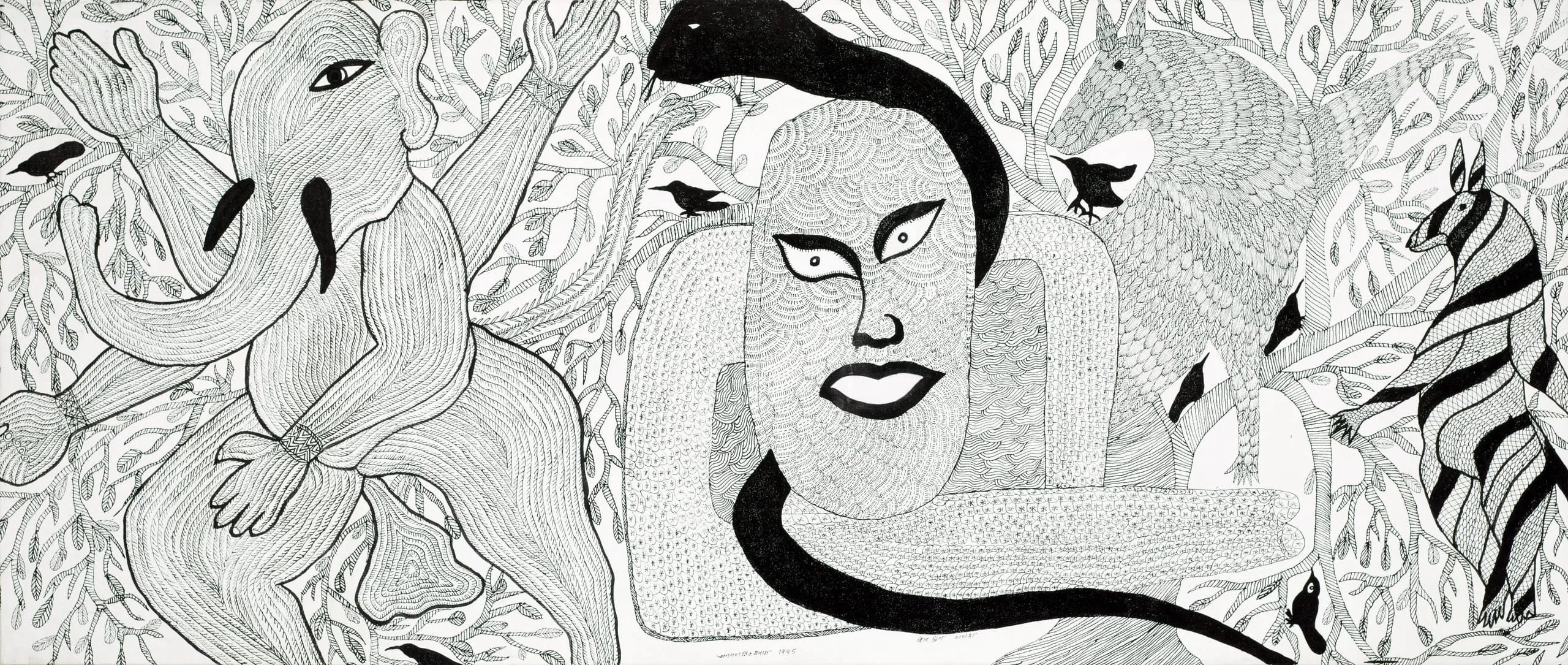
The Gonds are one of India’s largest adivasi (indigenous) communities. They are spread across a central swath of India encompassing several modern states, with a concentration in Madhya Pradesh. The Gonds are comprised of various subgroups, clans, and lineages, including the Pardhan Gonds whose priests perform recitations at important rituals and serve as the chief sustainers of the Gonds’ religious and mythological narratives, histories, and genealogies. Traditionally, Gonds painted auspicious designs on the floors and walls of their homes. In the early 1980s, Jangarh Singh Shyam (1960-2001) became the one of first Pardhan Gond contemporary artists to paint Gond imagery on paper and canvas. His subject matter includes Gond deities and cosmology, gods and goddesses assimilated from Sanskritic traditions as well as folk deities and village guardians, and lush scenes of jungle animals and the natural world.
The painting depicts a Shivalinga, an aniconic/phallic symbol of the Hindu god Shiva that is often anthropomorphized by the addition of Shiva’s head (see M.2010.131). The linga is set into a platform known as a yoni pitha (vulva pedestal). The cobra wrapped around the linga is one of Shiva’s primary iconographic attributes. Ganesha, the elephant-headed son of Shiva, stands energetically beside the linga. The background is a dense forest populated by animated equine creatures and birds. See also M.2013.56.2.