- Title
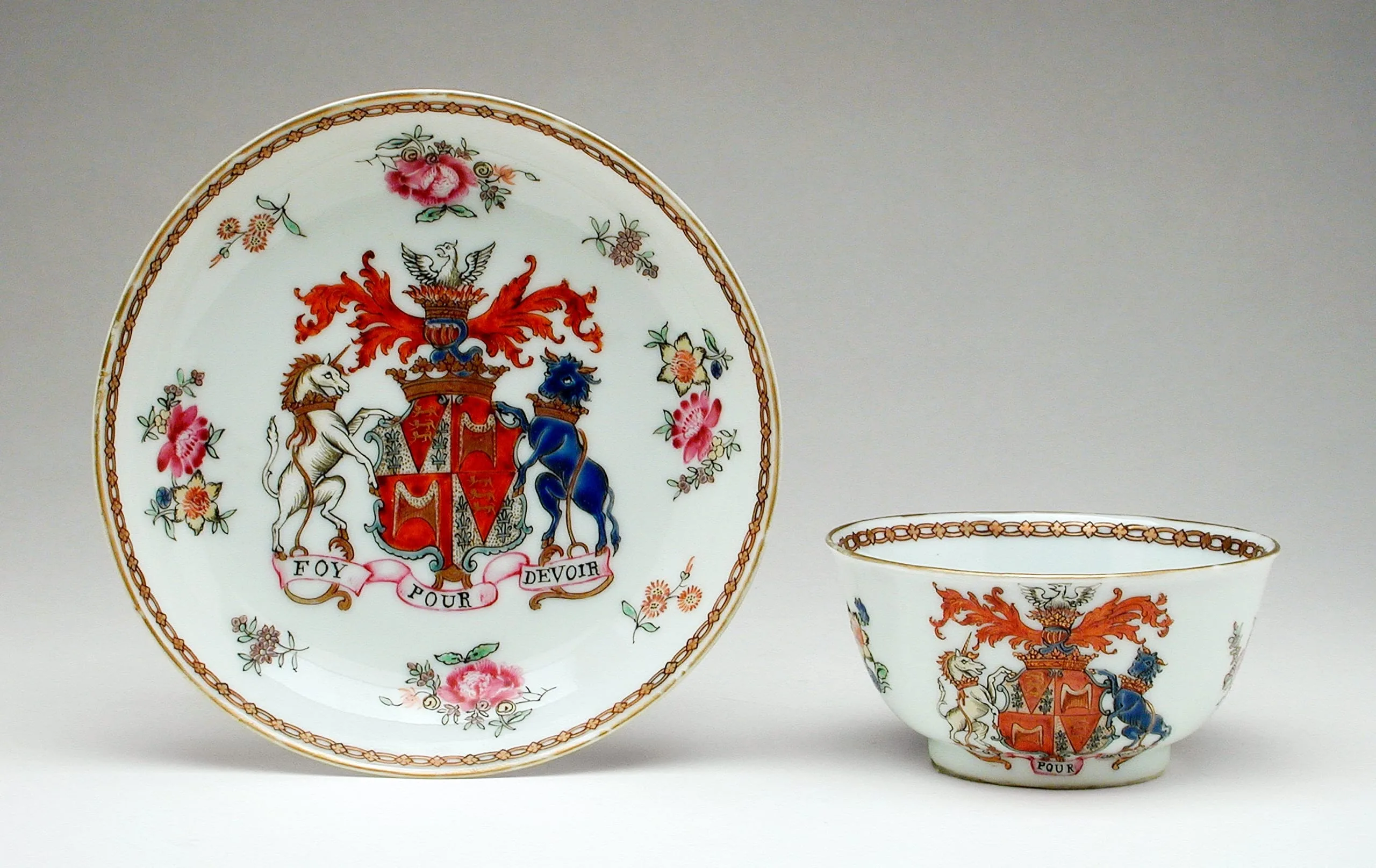
- Tea Bowl and Saucer
- Date Made
- Qianlong period, circa 1750-1755
- Medium
- Porcelain
- Dimensions
- Cup: Diameter: 3 1/8 in. (7.94 cm); Saucer: Diameter: 4 5/8 in. (11.75 cm)
- Accession Number
- 55.36.19a-b
- Curatorial Notes
This tea bowl and saucer were originally part of a larger tea service made in China specifically for export to England. Whereas the porcelain “blanks” were produced at inland kilns in Jingdezhen, each piece was custom-decorated by enamel painters in the port city of Guangzhou. There, European merchants placed orders during the trading season and assembled cargoes of tea, silk, and other luxury goods such as porcelain for export to British and European markets. These pieces are decorated with the coat of arms of the Seymour family below a ducal coronet as worn by the dukes of Somerset. The family motto, “Foy Pour Devoir” (Faith for Duty), a suitably noble sentiment, appears below in a fluttering pink ribbon. The service was probably commissioned by Edward Seymour, the eighth duke of Somerset, and imported by the East India Company, the powerful global trading firm at the heart of the British empire in South, Southeast, and East Asia. Teacups without handles followed Chinese models but later developed handles more in keeping with Western customs. Now dispersed, pieces from this service are in many different private and museum collections.