LACMA

ShopMembershipMyLACMATickets
LACMA
Los Angeles County Museum of Art
5905 Wilshire Blvd.
Los Angeles, CA 90036
info@lacma.org
(323) 857-6000
Sign up to receive emails
Subscribe
© Museum Associates 2025

Museum Hours

Monday

11 am–6 pm

Tuesday

11 am–6 pm

Wednesday

Closed

Thursday

11 am–6 pm

Friday

11 am–8 pm

Saturday

10 am–7 pm

Sunday

10 am–7 pm


  • About LACMA
  • Jobs
  • Building LACMA
  • Host An Event
  • Unframed
  • Press
  • FAQs
  • Log in to MyLACMA
  • Privacy Policy
© Museum Associates 2025
Collections

James Couper Wright
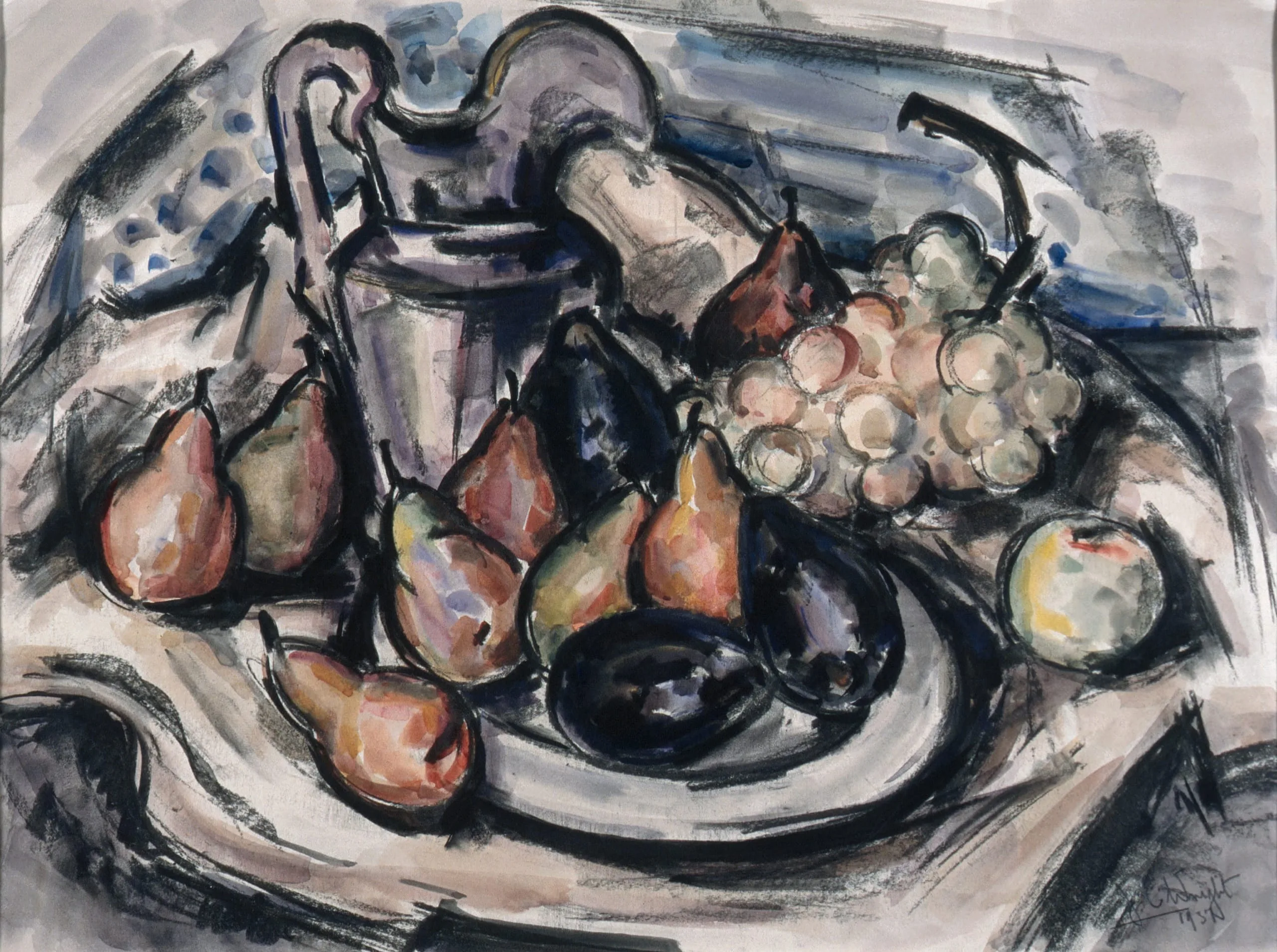
Still Life with Brown Pears1937

Not on view
Watercolor and ink still life with pears, plums, grapes, and a tall metal vessel on a table, rendered in loose brushwork with slate gray, rust-red, and deep navy tones
Artist or Maker
James Couper Wright
Scotland, active United States, 1906-1969
Title
Still Life with Brown Pears
Place Made
United States
Date Made
1937
Medium
Watercolor and charcoal
Dimensions
Sheet: 18 5/8 × 24 3/4 in. (47.31 × 62.87 cm) Image: 18 5/8 × 24 3/4 in. (47.31 × 62.87 cm)
Credit Line
The California Watercolor Society Collection of Watercolor Paintings
Accession Number
55.34.2
Classification
Drawings
Collecting Area
Prints and Drawings
Curatorial Notes
Wright was fascinated with California’s indigenous vegetation. He studied the shape, color, and texture of what he called "inexpensive objects of beauty" and learned to capture in his art the subtle golds and tans of the California countryside.
In this still life pears are presented in all their chromatic glory of muted oranges, reds, browns, yellows, and greens and are contrasted with the darker, black eggplants and delicate green and terra-cotta colored grapes. The subject and the treatment of the fruit as simple geometric shapes reveal Wright’s familiarity with the work of Paul Cézanne (1839-1906).
Wright luxuriated in the wetness and transparency of the watercolor medium and worked quickly with very wet pigment. The vigorous black strokes outlining the objects are typical of his watercolors of this period, inspired by the paintings of Georges Rouault (1871-1958) and Wright’s own work in stained glass. He considered line to be a means to organize a composition by fitting together the shapes of objects as if they were pieces of stained glass. He thought that these lines would not be solid or static because "there was nothing static in the brilliant light of California." As did JOHN MARIN, whom he greatly admired, Wright framed his composition with strong, broken lines.
Selected Bibliography
  • Fort, Ilene Susan and Michael Quick. American Art: a Catalogue of the Los Angeles County Museum of Art Collection. Los Angeles: Los Angeles County Museum of Art, 1991.