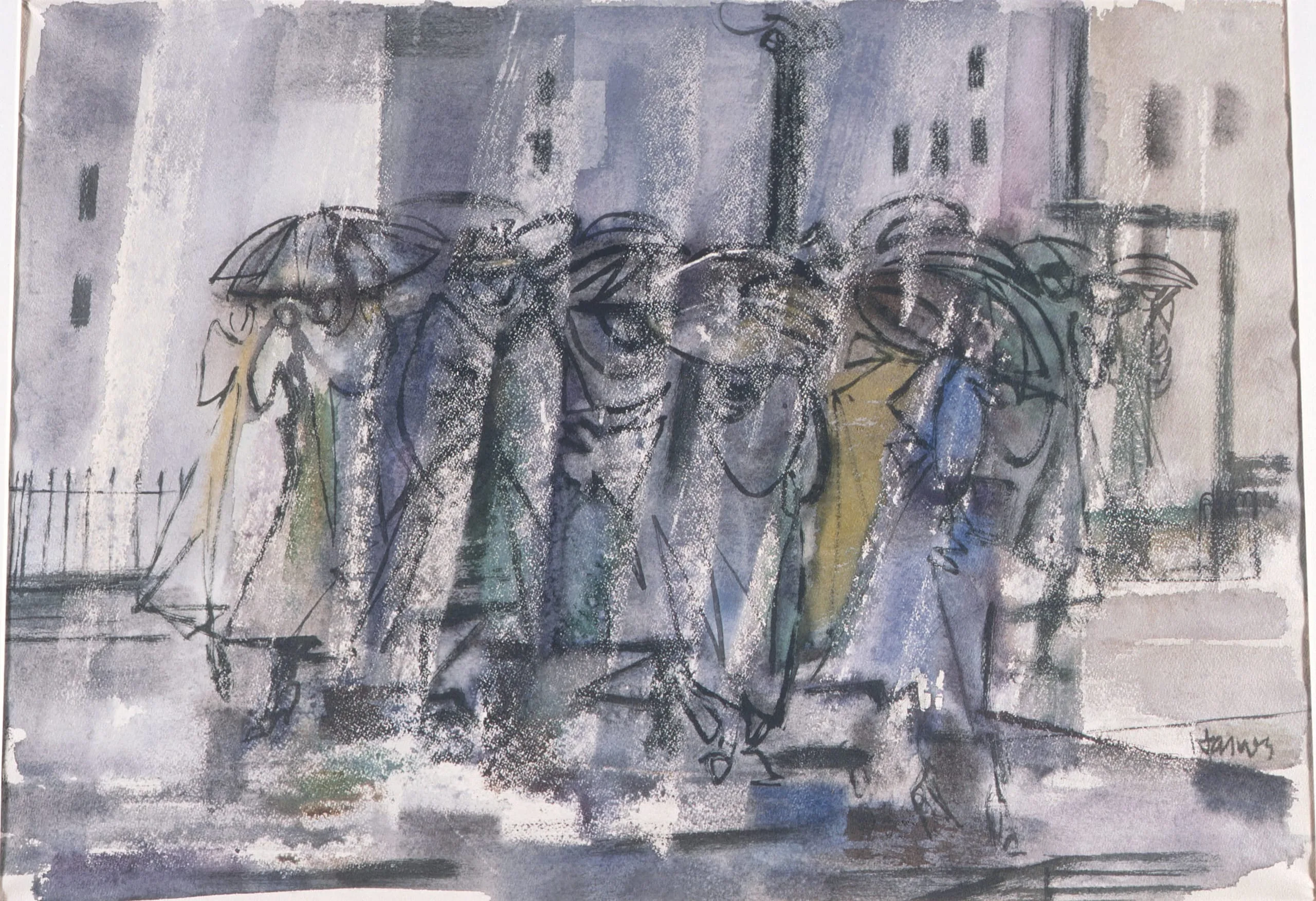
Haines sought to express in his art the essence of an experience. In this silvery watercolor he captured the feel of cold, wet rain falling on a crowded city street. In broad sweeps of fluid, overlapping washes, Haines applied a rainbow of cool blues, purples, grays, and greens to suggest a downpour. Sharper vertical black accents describe the quick movement of the mass of figures scurrying for shelter. This emphasis on abstract patterning, while retaining representational elements, reflects the general trend in the paintings exhibited at the California Water Color Society annuals after the war.
Haines was extremely imaginative in his technique, experimenting with combinations of mediums. He described how he created Winter Rain: "I used charcoal lines to indicate the large color planes. Next a few sweeps of wax across the paper at the angle of falling rain. Then I dampened the paper and applied the color in large washes, darkening it here, intensifying an area there using the line to suggest form and motion. As the paper became less moist, the darker, sharper lines were added."
Haines later removed the excess wax to achieve a soft, almost pastel effect.