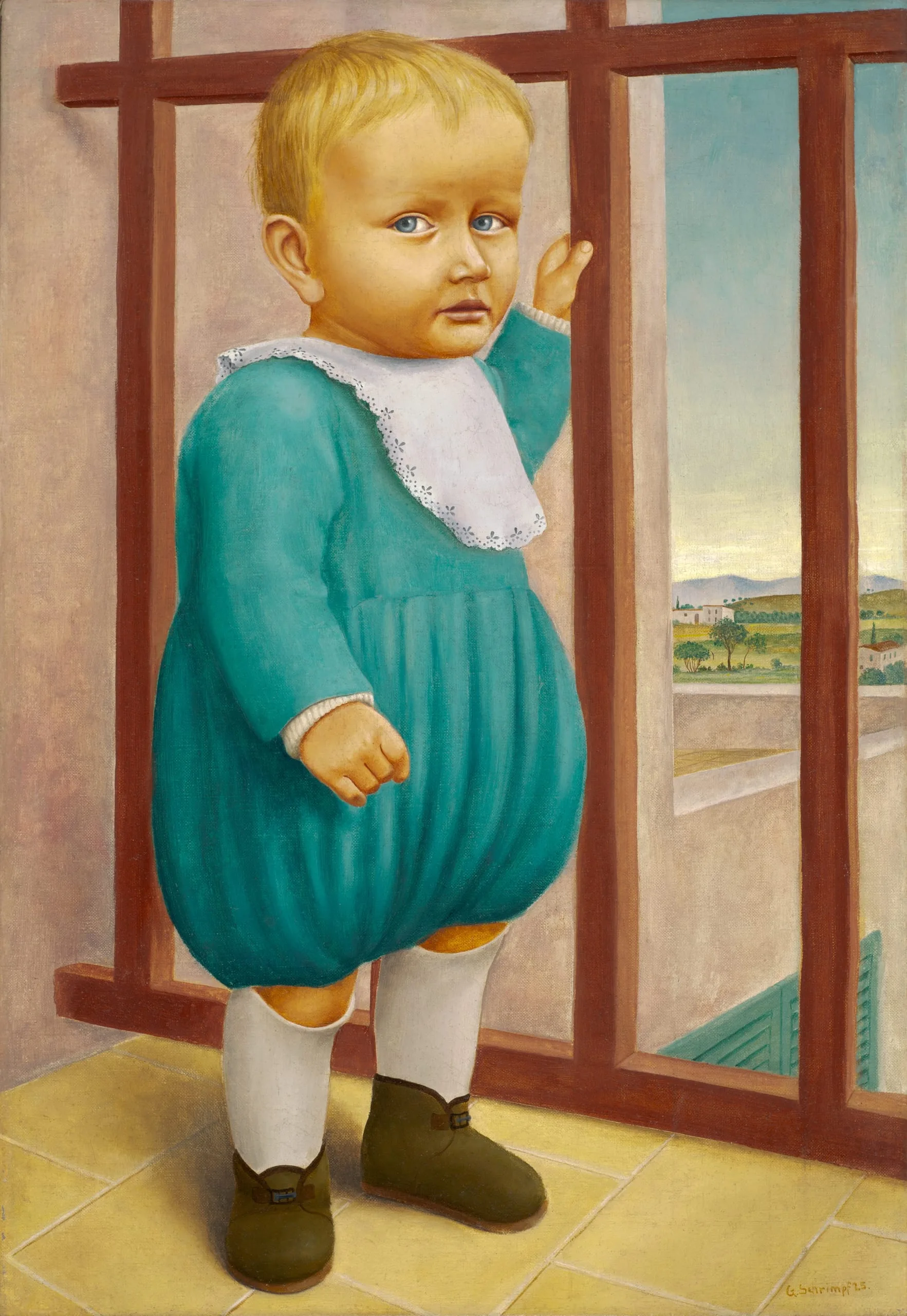
Provenance: Purchase from Christie's London, February 2013. Anonymous sale to the Scheringa Museum of Realist Art, Spanbroek, Christie's London, February 7, 2006, lot 312.
Exhibition History: Stuttgart, Kunstverein, no. 843; (probably) Munich, Deutsches Museum, "Munchener Neue Secession," June-October 1932, no.6 (titled 'Kinderbildnis P.'); (probably) Hanover, kestner-Gesellschaft, "Neue deutsche Romantik," March-April 1933, no.7 (titled 'Kind auf dem Balkon').
Publication: J. Adamiak, "Gerog Schrimpf, Ein Beitrag zum Problem der Malerei der 'Neuen Sachlichkeit'," Berlin, 1961, p.38 (illustrated pl.52); Wolfgang Storch, "Georg Schrimpf und Maria Uhden, Leben und Werk," Berlin, 1985, no.1925/9 (illustrated pp.138 and 219); E. Ansenk (ed.), "Schilders van een andere werkflijkheid: in de collective van het Scheringa Museum voor Realisma, Zwolle, 2006, p.243 (illustrated); P.van der Lugt (ed.), "Nieuw Realisme: 159 werken uit de collective van het voormalige Scheringa Museum voor Realisme," Zwolle, 2010, p.86 (illustrated).
The artist (1889). [Sold at Christie's London, February 7, 2006, lot 312]; to the Scheringa Museum of Realist Art, Spanbroek; [sold at Christie's London]; in 2013 to LACMA.