LACMA

ShopMembershipMyLACMATickets
LACMA
Los Angeles County Museum of Art
5905 Wilshire Blvd.
Los Angeles, CA 90036
info@lacma.org
(323) 857-6000
Sign up to receive emails
Subscribe
© Museum Associates 2026
  • About LACMA
  • Jobs
  • Building LACMA
  • Host An Event
  • Unframed
  • Press
  • FAQs
  • Log in to MyLACMA
  • Privacy Policy
© Museum Associates 2026
Collections

William Spratling
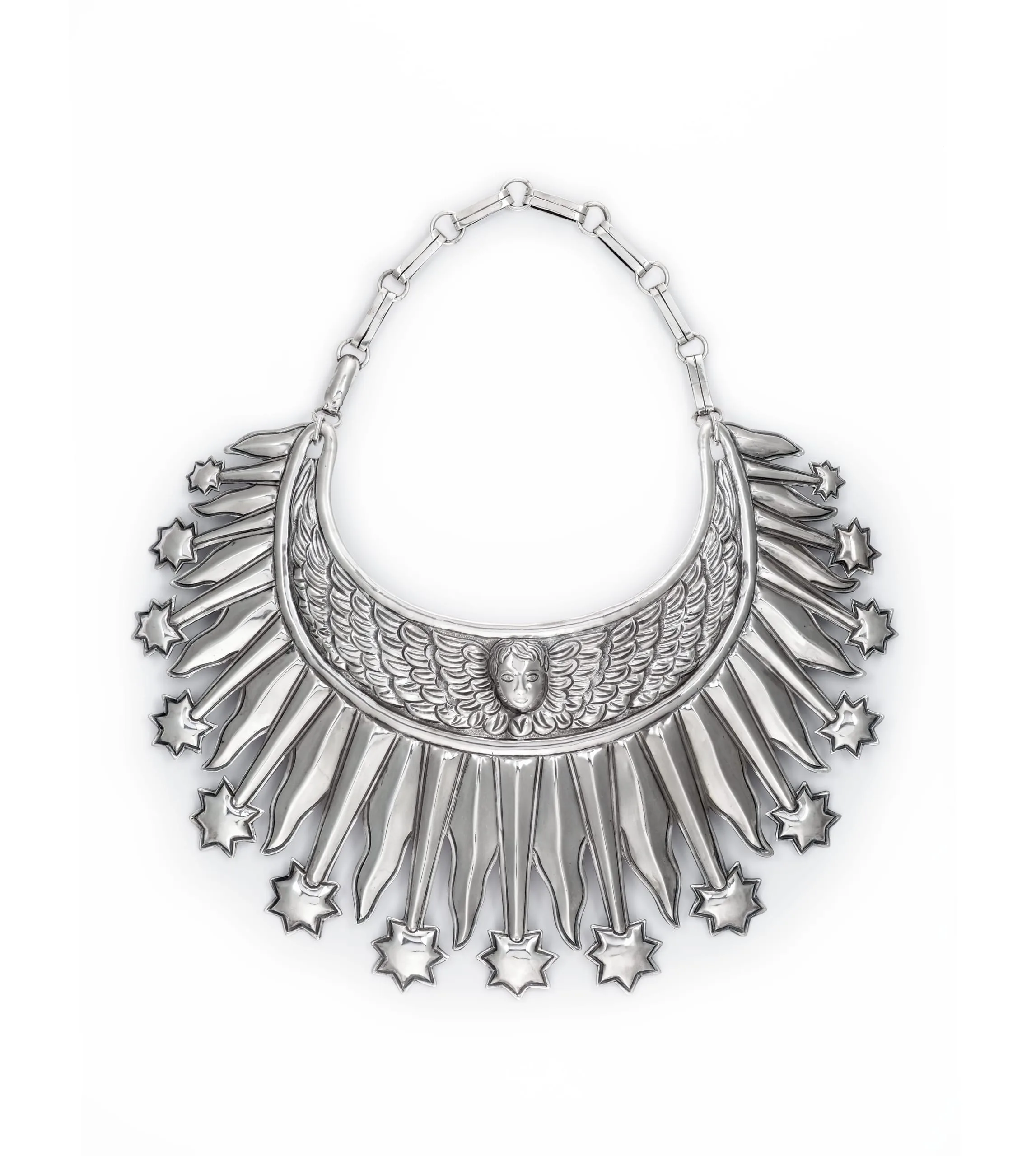
Helena Rubinstein Necklace (Gargantilla de Helena Rubinstein)circa 1940

Not on view
Large polished silver pectoral necklace with a crescent-shaped collar, radiating blade forms, winged face relief at center, and star-shaped terminals
Artist or Maker
William Spratling
United States, active Mexico, 1900-1967
Title
Helena Rubinstein Necklace (Gargantilla de Helena Rubinstein)
Place Made
Mexico, Taxco
Date Made
circa 1940
Medium
Silver
Dimensions
Pectoral: 7 × 9 in. (17.78 × 22.86 cm); chain length: 8 in. (20.32 cm)
Credit Line
Gift of Goddard Family in Memory of Phyllis Goddard
Accession Number
M.2012.189.1
Classification
Jewelry and Adornments
Collecting Area
Latin American Art
Curatorial Notes

Founder of her own cosmetics empire, Polish American business magnate Helena Rubinstein (1872–1965) exemplified the height of modern fashion in her public persona. A noted philanthropist and art collector, she was a patron of Latin American art and continued to build her collection during annual trips to Mexico. This necklace, created specifically for Rubinstein by celebrated silver designer William Spratling, combines her public and personal interests. The form is borrowed from a gold halo—the original of which was in Rubinstein’s own collection—that would have been worn by an image of the Virgin Mary. Rubinstein was so fond of this necklace that she wore it while sitting for a portrait by the Mexican artist Roberto Montenegro (https://www.si.edu/object/helena-rubinstein%3Anpg_NPG.2011.141) in 1941.

Trained as an architect, Spratling moved from New Orleans to Taxco, Mexico, where he established his first silver workshop in 1931. Working alongside master silversmiths and local apprentices, in 1935 he opened his famed Taller de Las Delicias, which attracted a cohort of international artists, intellectuals, and Hollywood celebrities. Spratling’s emphasis on craftsmanship and his experimentation with different sources, including Mesoamerican art, Art Deco, and modernism, contributed to his great success and helped revitalize the Mexican silver industry.

Rachel Kaplan

2024
Selected Bibliography
  • Klein, Mason. Helena Rubinstein: Beauty is Power. New York: Jewish Museum, 2014.
  • Kaplan, Wendy, ed. Found in Translation: Design in California and Mexico, 1915-1985. Los Angeles: Los Angeles County Museum of Art; Munich: DelMonico Books-Prestel, 2017.
  • Craft in America: Borders & Neighbors. DVD. PBS, 2017.
Copyright
© artist or artist's estate