- Title
- Side Chair
- Date Made
- circa 1680-1700
- Medium
- Ebony, rosewood, cane, and brass fittings; velvet cushion
- Dimensions
- 37 × 21 × 18 1/4 in. (93.98 × 53.34 × 46.36 cm)
- Accession Number
- 56.27.1a-b
- Curatorial Notes
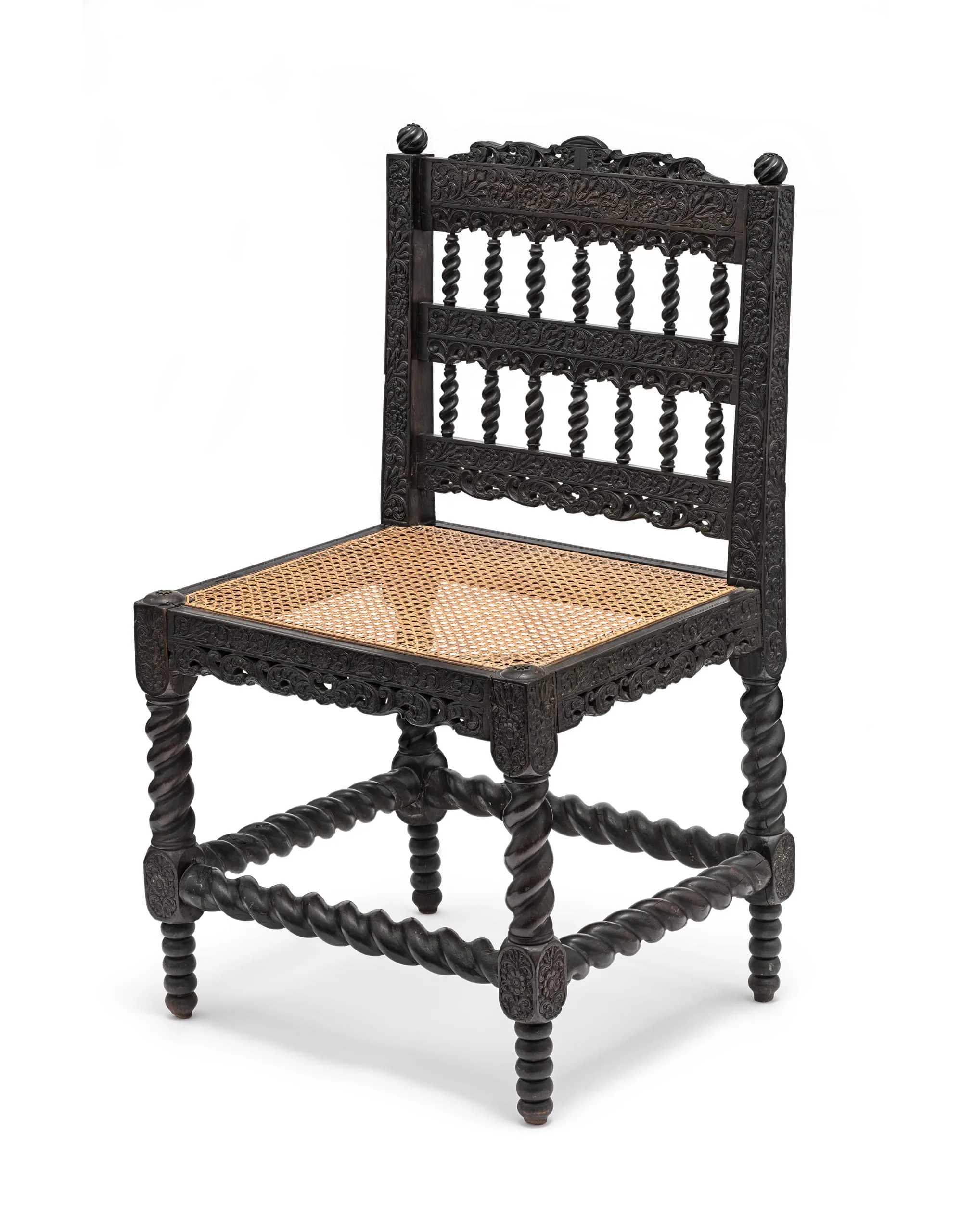
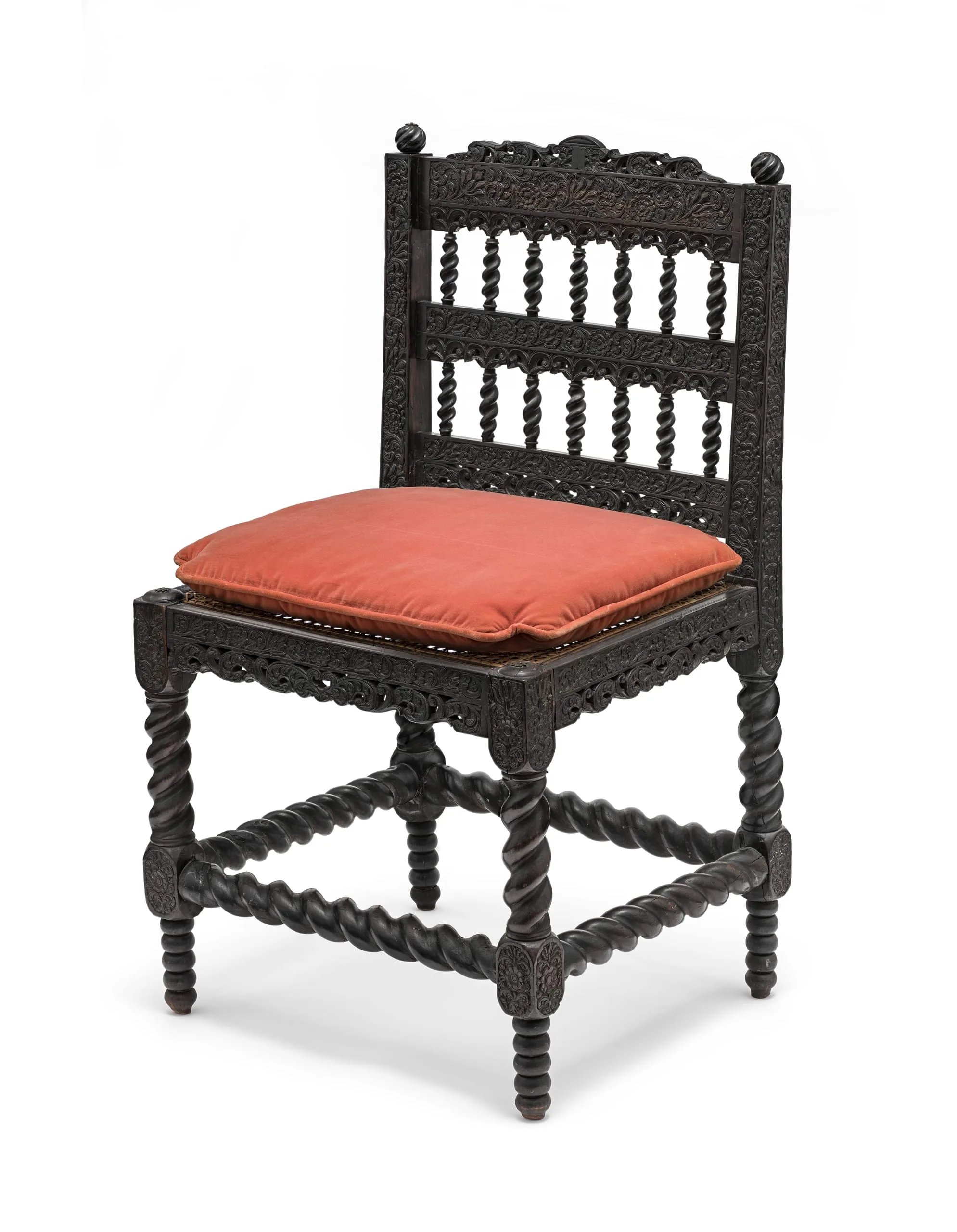
This rectilinear side chair is made of ebony and rosewood with a drop-in caned seat and brass fittings. The chair back is open with two tiers of arcading, each with seven twist-turned balusters or spindles, and a pierced crest rail, pierced aprons, and twisted ball finials. The back or cross rails, back posts or stiles, and the seat frame are carved with lush scrolling vines with lyrical tendrils and large open blossoms, all set against a matted background. The seat frame has pierced aprons. The legs are twist-turned with rectangular blocks embellished with floral cartouches at the junctions of the seat rails and twist-turned stretchers. There is a separate cushion of persimmon velvet.
Ebony side chairs of this general form were produced in Tamil Nadu, India; Sri Lanka: and the Dutch East Indies. In Western scholarly literature they were previously first attributed to the English Tudor dynasty (1485-1603), then as 17th-century Indo-Portuguese from Goa, India. Current scholarship considers their place of origin to be the Coromandel Coast region of Tamil Nadu
- Selected Bibliography
- Markel, Stephen. Mughal and Early Modern Metalware from South Asia at LACMA: An Online Scholarly Catalogue. Los Angeles: Los Angeles County Museum of Art, 2020. https://archive.org/details/mughal-metalware (accessed September 7, 2021).