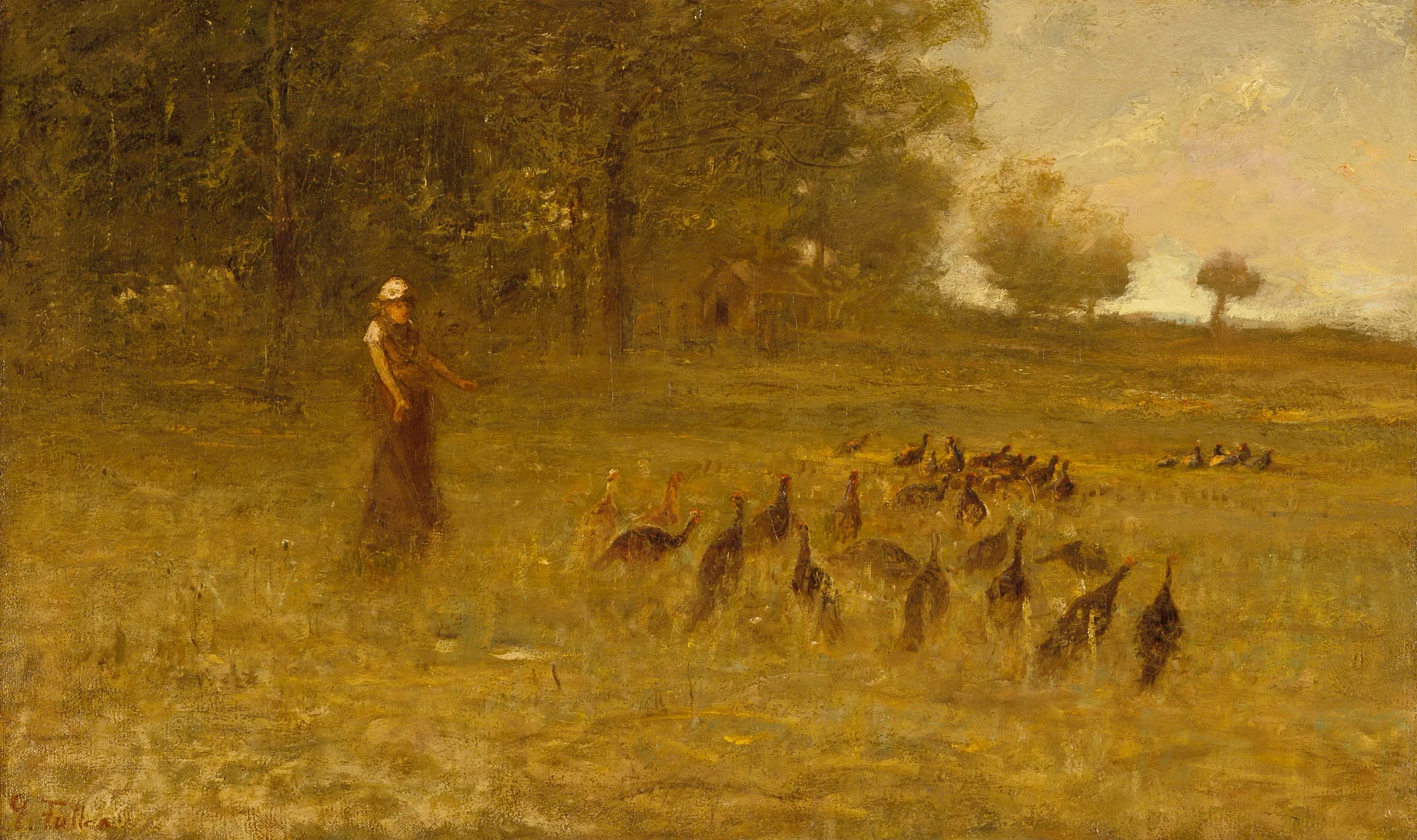
Rustic farm life not only furnished financial support for Fuller during the 1860s but also served as the main inspiration for his late landscapes. Even more than Millet and the other Barbizon painters he admired, Fuller viewed farm life in idyllic terms. His pastorals often consist of a small figure standing to the extreme side of a broad, open field. Girl with Turkeys is similar to Turkey Pasture in Kentucky, 1878 (Chrysler Museum, Norfolk, Va.) in which a single female stands to the left in the foreground near the flock of turkeys she is tending. During the last several years of his life Fuller created a number of such farm scenes, which reveal his rural New England heritage. As with all his pastorals, the activity depicted is of minor importance, for the open field with its light and air provide the vehicle for the artist to express the harmony of an idyllic rustic life.
Fuller painted the entire scene in his typical earthy, but nuanced palette of muted brown, beige, ocher, and khaki green. His handling of the paint was equally suggestive; the strokes, often applied one layer over another, and the scribbled effect of his brush handle drawn over the wet paint in the foliage suggest the activity of the trees, but the rest of the scene is enveloped in a delicate haze as the soft strokes of the atmosphere blur all outlines. Like other advanced artists of the period, Fuller was as much interested in paint manipulation as in representation.
Contemporary critics recognized Fuller’s poetic nature and his place in American culture. When this painting was exhibited at Doll and Richards an unidentified reviewer astutely noted:
It is with the work of Fuller as it is with the work of Ralph Waldo Emerson. It matters little what one reads of Emerson ... its influence is an indefinite exhilaration-or, rather, inspiration; the definite things he says are secondary in their value. So it is with Fuller. His pictures are impossible as nature but beyond value as dignifying and ennobling impulses. In the present instance the vague, phantasmal girl and her wandering turkeys, the shadowy hut close under the thick deep forest, the hazy shapes of trees ... and the dull yellow sky, while none of them could be considered possible in the smallest degree, are yet details of a whole which is singularly impressive.
In the Fuller memorial volume Girl with Turkeys was dated to the artist’s last year. The painting has a label from A. A. Walker of 594 Washington Street, who was a colorman located at such an address in Boston from 1877 to 1880. When it was sold at auction less than thirty years after its creation, the painting received a record price for a Fuller painting and the second highest price ever brought by a contemporary American picture at auction.