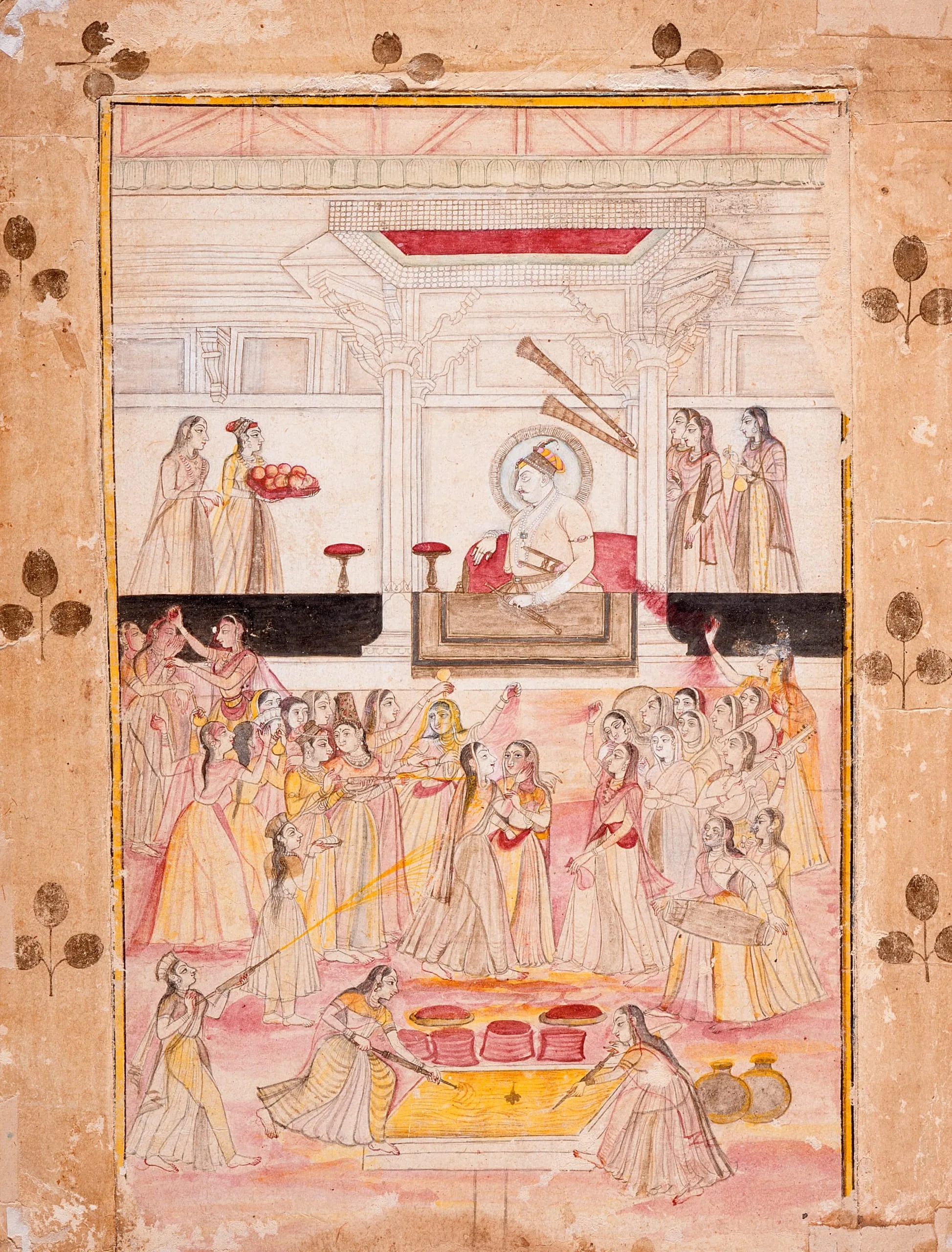
Emperor Muhammad Shah (r. 1719-48) was born in 1702. He was an ardent patron of the arts and fostered the revival of a refined aesthetic style throughout the humanities, particularly music, dance, poetry, and painting. He perpetuated traditional Mughal subjects of paintings, such as portraits, formal receptions, court entertainment, and the hunt, but eschewed conventional botanical, historical, and military subjects. In this nim qalam (half-pen) lightly tinted drawing, Muhammad Shah is depicted presiding over a raucous celebration by his harem of the Holi Festival. Celebrated in the Hindu month of Phalguna (February-March), it heralds the arrival of spring and the end of winter. The popular festival engenders communal revelry with celebrators in a joyous frenzy spraying everyone with red-colored water shot from oversize syringes, throwing balloons filled with colored water at each other, and pelting each other with colored powder. Merrymakers carrying drums and other musical instruments wander the streets singing, dancing, and enjoying delicacies. Although at first glance the nimbate Muhammad Shah seems to be merely watching the Holi festivities while being fanned by female attendants waiving honorific fly whisks with peacock feathers, close observation reveals he is holding a water syringe, thus suggesting that he was also an active participant in the merriment. Another painting of Muhammad Shah celebrating Holi is in the Bodleian Library, Oxford (MS Douce Or.b.3, no. 22).