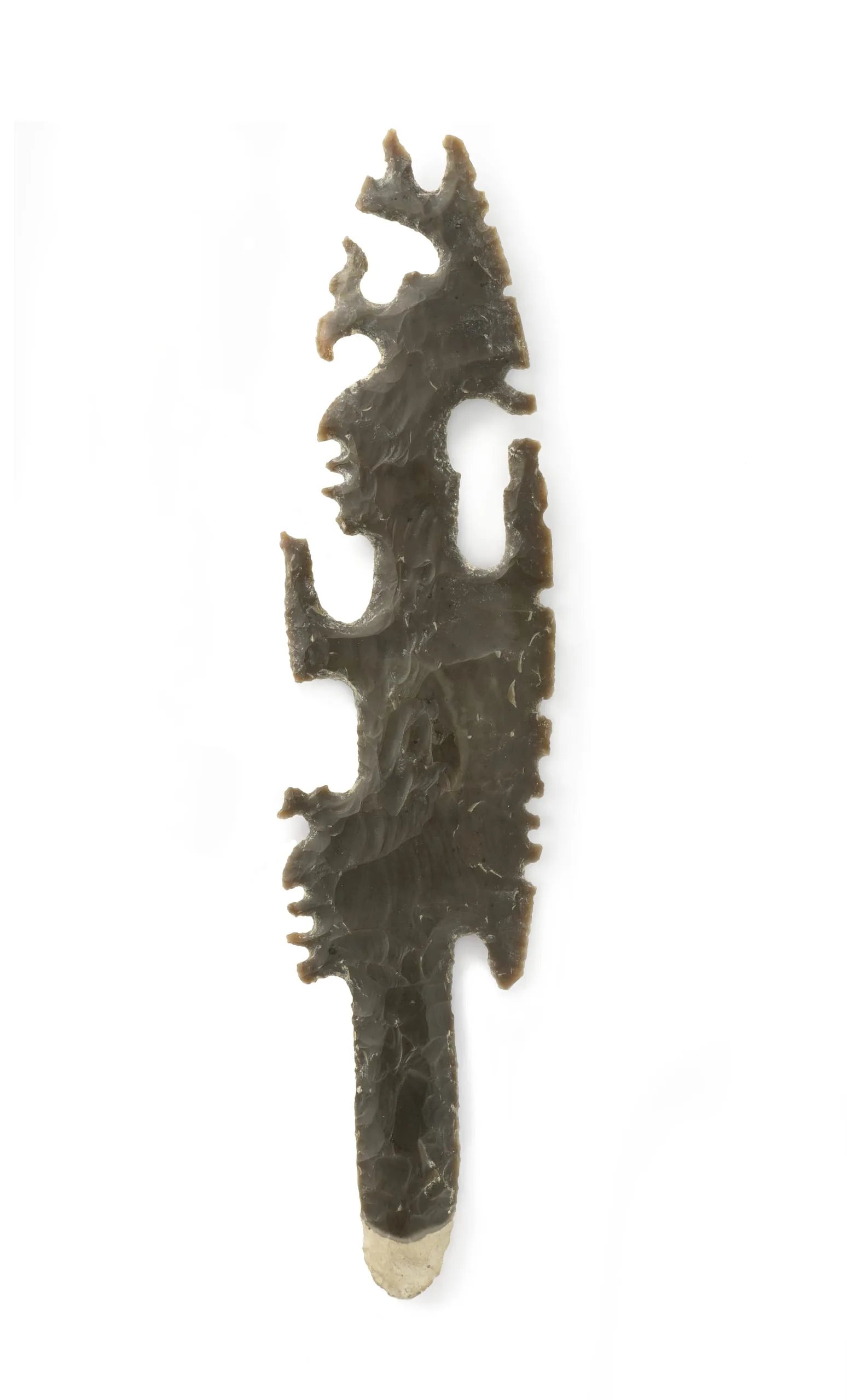
The most sophisticated of Classic Maya knappers, makers skilled in the chipping of chert and obsidian to produce stone tools, could create so-called “eccentric” forms—that is, blades with irregular and elaborate shapes used for ceremonial purposes. These artists used a process called pressure flaking, where minuscule pieces of stone could be chipped off the main core with a soft, sturdy material like deer antler to produce intricate shapes at the flint’s edge. A pair of anthropomorphic faces in profile have been chipped into this flint point. Each profile bears a flaming torch on his forehead, a signature attribute of the deity K’awiil. Associated with lightning, agriculture, and political power, K’awiil was present for the creation of the cosmos, providing the creative spark at the beginning of all things (see M.2010.115.3). For Classic Maya rulers, he undergirded their authority and allowed them to communicate with the realm of deities and ancestors. Flint embodies K’awiil’s essences as a manifestation of lightning—Classic Maya peoples believed that flint forms where lightning strikes. Eccentric flints knapped in his likeness emphasize this connection in both material and image.
Archaeologists have excavated caches of eccentric flints from dedicatory deposits at numerous Classic Maya sites; in these contexts, they likely comprised protective offerings that linked civic-ceremonial spaces with the primordial sea. This example pertains to a group of sixteen flints that may have formed a similar cache.
Alyce de Carteret
2025
Further reading
Agurcia Fasquelle, Ricardo, Payson Sheets, and Karl Andreas Taube. Protecting Sacred Space: Rosalila’s Eccentric Chert Cache at Copan and Eccentrics among the Classic Maya. Precolumbia Mesoweb Press, 2020.