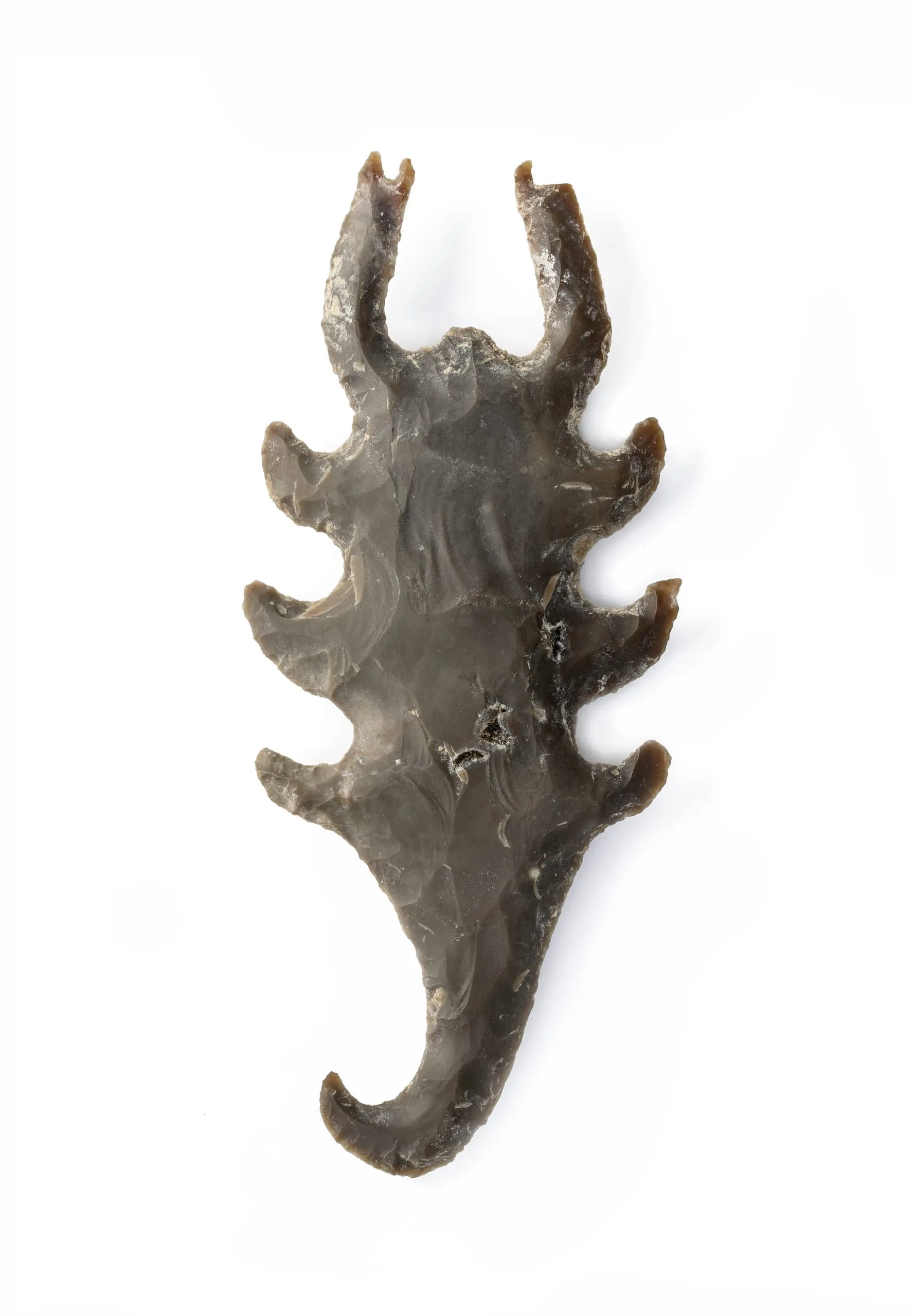
The most sophisticated of Classic Maya knappers, makers skilled in the chipping of chert and obsidian to produce stone tools, could create so-called “eccentric” forms—that is, blades with irregular and elaborate shapes used for ceremonial purposes. These artists used a process called pressure flaking, where minuscule pieces of stone could be chipped off the main core with a soft, sturdy material like deer antler to produce intricate shapes at the flint’s edge. This eccentric flint takes the form of a scorpion.
Archaeologists have excavated caches of eccentric flints from dedicatory deposits at numerous Classic Maya sites; in these contexts, they likely comprised protective offerings that linked civic-ceremonial spaces with the primordial sea. This example pertains to a group of sixteen flints that may have formed a similar cache.
Alyce de Carteret
2025
Further reading
Agurcia Fasquelle, Ricardo, Payson Sheets, and Karl Andreas Taube. Protecting Sacred Space: Rosalila’s Eccentric Chert Cache at Copan and Eccentrics among the Classic Maya. Precolumbia Mesoweb Press, 2020.