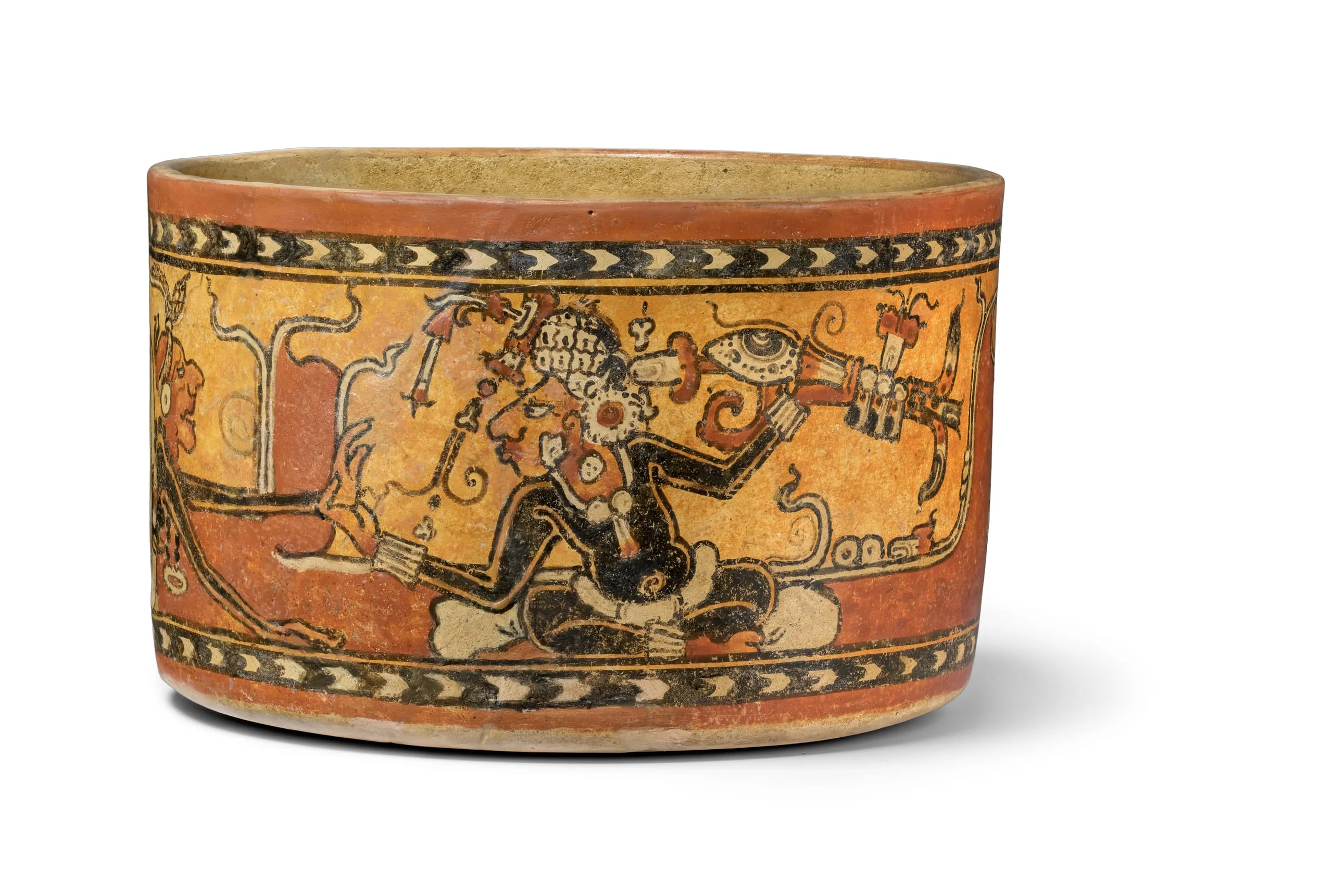
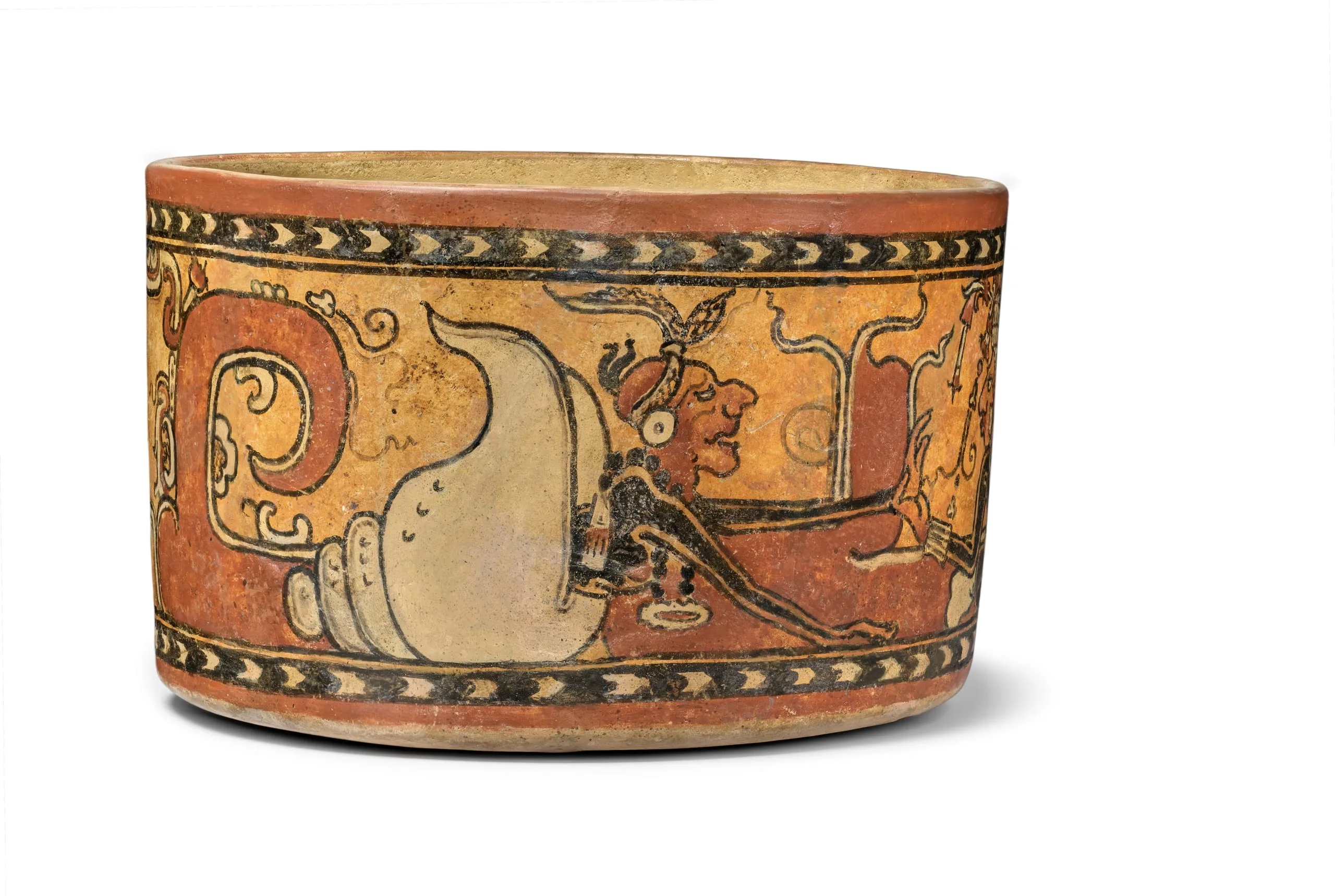
Painted in bold contour lines amid a swirling red scroll, two figures encounter one another on the surface of this cylinder vessel. On the left, an aged man wearing a netted headscarf and a shell necklace emerges from the aperture of a conch shell. To the viewer’s right, a second personage sits cross-legged, grasping the wrist of the first with one hand while readying a flint blade in the other. Both figures are well known in Maya art. The first, a wizened deity with awesome creative powers named Itzam (also referred to as “God N”) plays a major role in the creation of space-time in the Maya worldview. He inhabits the primordial sea, hence his association with marine shells. In quadripartite form, he forms the stony pillars that sustain the sky and stewards the cycle of years. Without his efforts, the sky and sea would collapse and swallow the earth, returning the cosmos to the timeless, chaotic pool of his origins. The second figure is a rare youthful version of the deity known as Itzamna or Itzam Kokaaj (also referred to as “God D”). Itzamna is the principal celestial deity to which many other deities and culture heroes pay tribute. Elsewhere in Maya art, these two deities share many attributes—including an aged appearance—and in some cases they can even be fused into a single being. It is unusual to see the two paired in this way, especially with Itzamna’s youthful countenance. The scene perhaps depicts a pivotal altercation early in the creation of the cosmos that sets the foundation for all that follows.
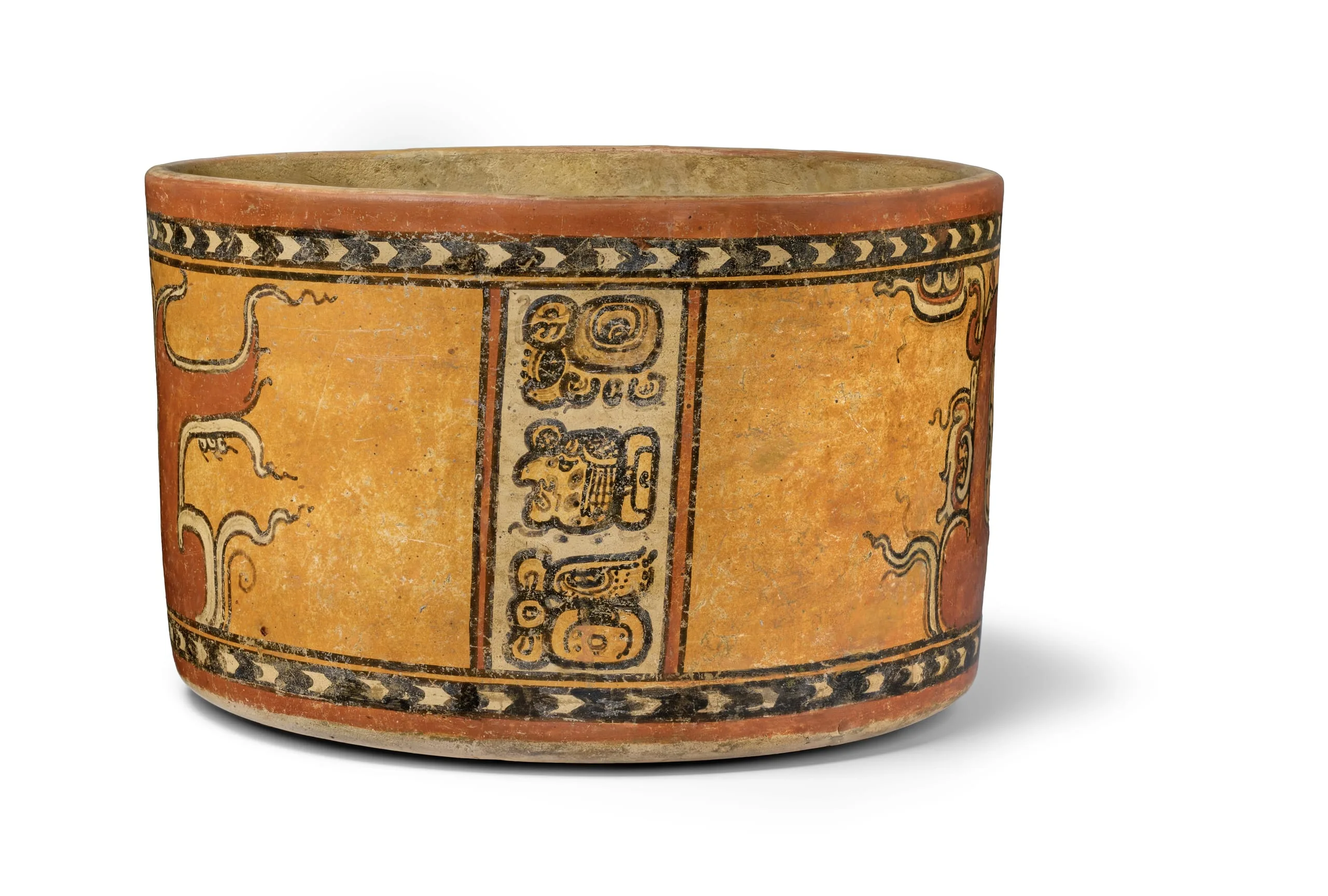
The cylinder vessel reflects an artistic style known as Chama, named after the site in the Alta Verapaz region of Guatemala. The style is known for its vibrant palette of white, black, and red against an orangey-yellow backdrop, and characteristic bands of black-and-white chevrons that encircle the vessels’ rims and bases. A short dedicatory text opposite the encounter names the vessel as a yuk’ib’, a drinking cup.
Alyce de Carteret
2025
Further Reading
Martin, Simon. “The Old Man of the Maya Universe: A Unitary Dimension to Ancient Maya Religion.” In Maya Archaeology 3, ed. Charles Golden, Stephen Houston, and Joel Skidmore, 186–227. Precolumbia Mesoweb Press, 2015.