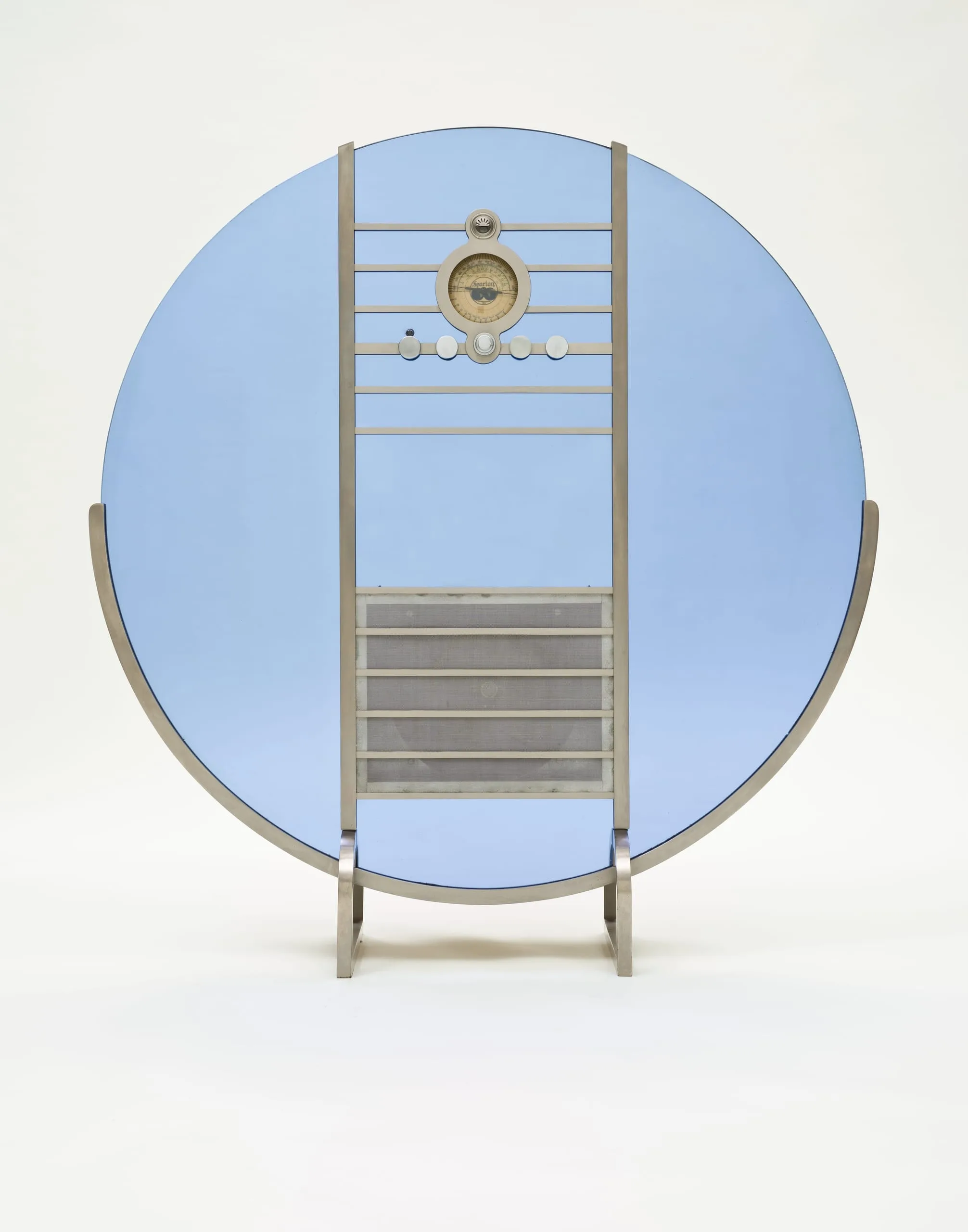
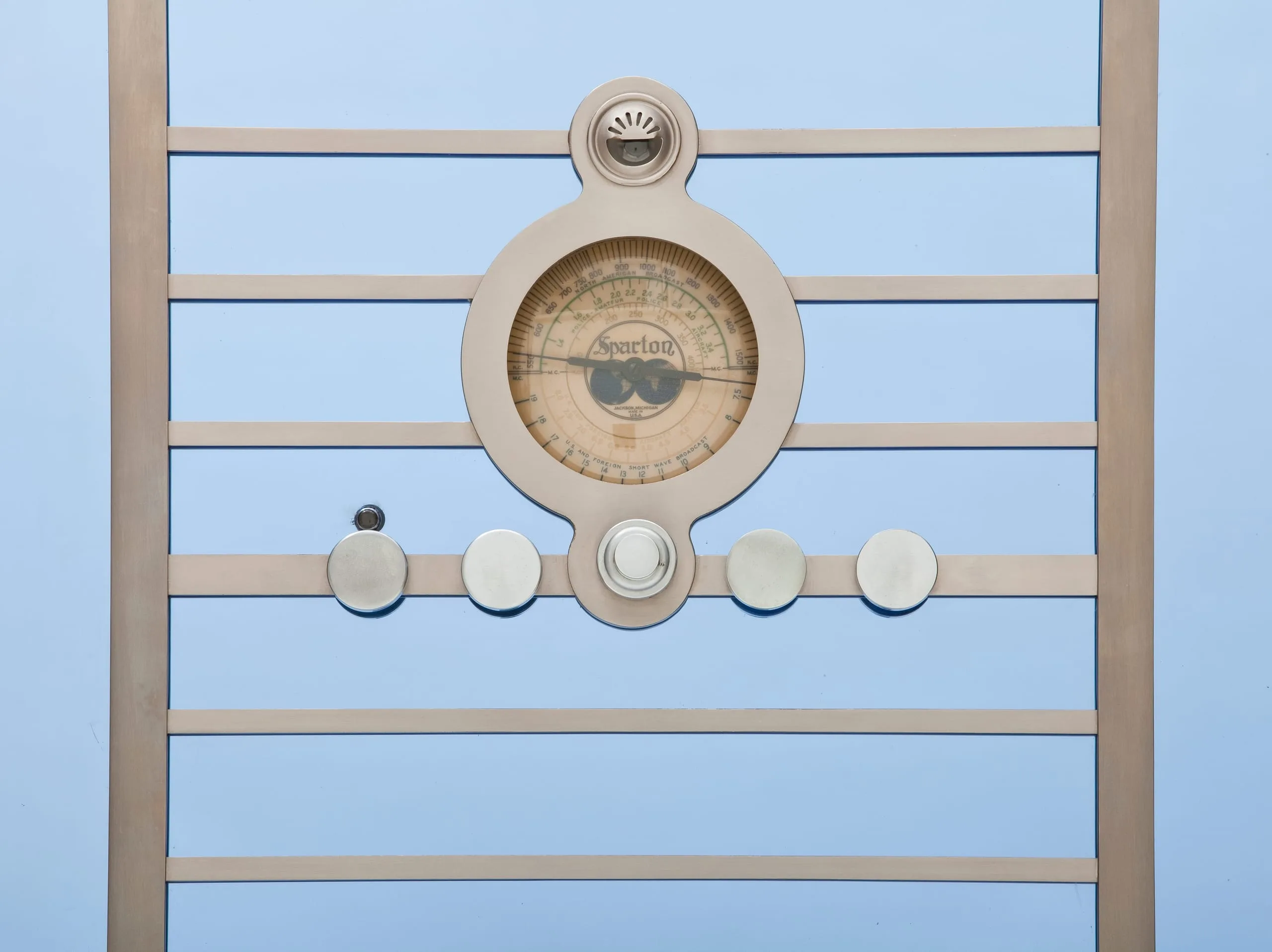
This towering console of satin chrome and mirrored cobalt glass is a rare example of industrial designer Walter Dorwin Teague’s work for the Sparton Corporation in Michigan. Introduced in 1935 as the “Nocturne,” the radio was intended to dazzle with its bold circular design. As a company brochure explained, “So out of the ordinary, so daringly distinctive was Sparton’s midnight blue ‘Nocturne’ that the desire to own was immediate. Size and price, however, outweighed immediate action on that desire.” Since the radio is almost four feet high, and cost $350 when it was introduced in 1935 (about $7,000 in 2025), not many were sold, unlike Sparton’s much smaller version, the “Bluebird.”
The “Nocturne” embodies the machine aesthetic of the 1930s, which, in the depths of a worldwide depression, became a comforting metaphor for speed, control, and progress. This rigorous geometry was considered to be the appropriate aesthetic for the new forms of home entertainment made possible by the advent of electricity. Radios were not supposed to look like pieces of furniture: according to design arbiters like Domus magazine, “The radio set must be above all a piece of ‘equipment,’ a machine or, if you will, an instrument.” Where stylists like Teague differed from International Style purists, however, was in their embrace of machine imagery rather than machine form. Rather than the design relating to the function of the radio, the great disk of a mirror resting on sled feet presents a stunning facade concealing an otherwise ordinary wood case that houses the receiver and its components.
A classicist by training, Teague studied at the Art Students’ League of New York and worked for an advertising agency before opening a graphic design studio in 1912. It was not until 1926 and a trip to Paris that he began to explore industrial design and embrace a modernist aesthetic, leaving graphic design behind. Early clients included Eastman Kodak, Corning Glass Works, and Sparton. Through his designs for cameras, tableware, and radios as well as architecture and transportation projects, Teague became one of the country’s most renowned industrial designers. And through books such as Design This Day: The Technique of Order in the Machine Age (1940), he also became one of the leading proselytizers of a formal geometric design vocabulary for the modern world.
Wendy Kaplan, Department Head and Curator, Decorative Arts and Design