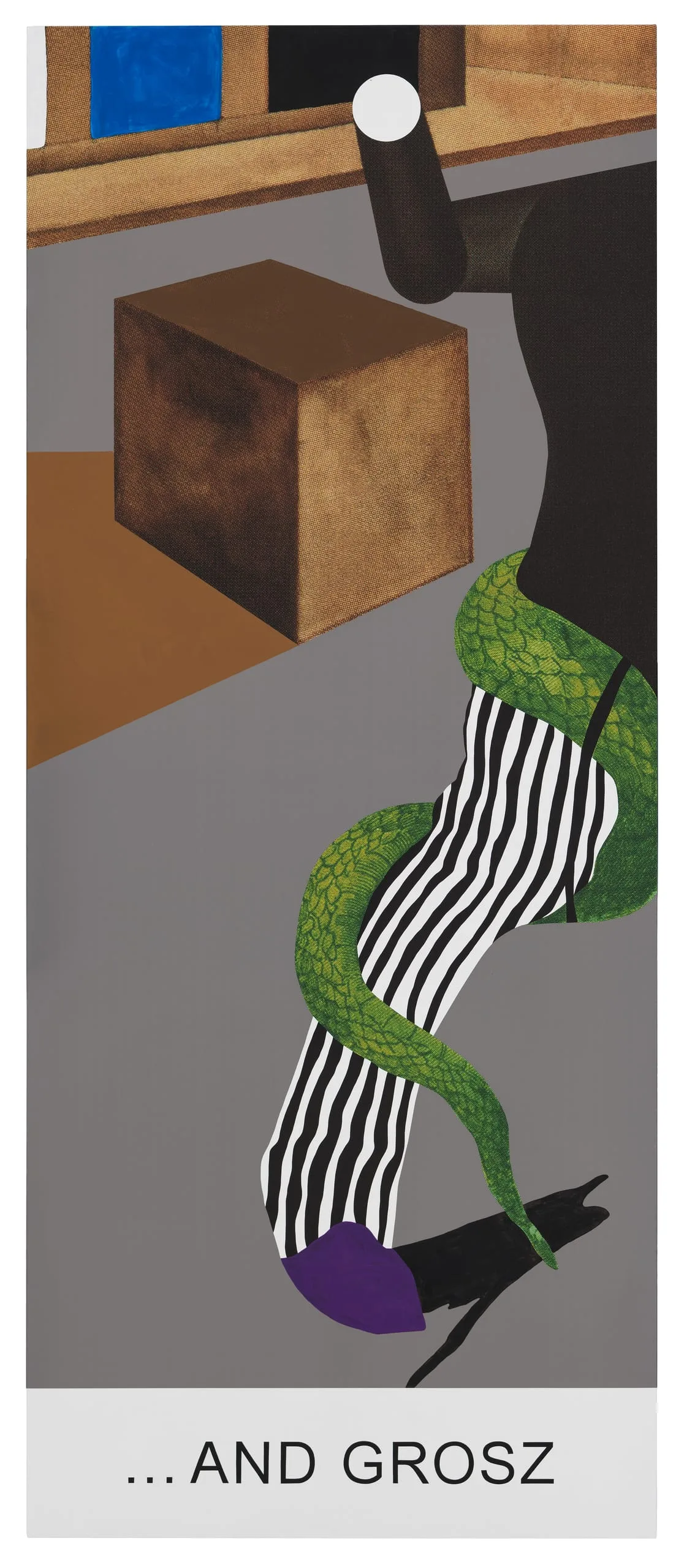
“My goal,” wrote John Baldessari in 2011, “has always been to attack conventions of seeing.” The Double Bill series patently puts this ethos into practice. Baldessari borrows motifs from the works of two canonical artists and combines them to the effect of creating a visual riddle. Only one of the artists is identified in the painted caption below the image; the other one is for the viewer to uncover. Yet even for the most initiated Baldessari’s stylistic or thematic cues can remain obscure. The Double Bill works encourage dwelling on details that rarely get noticed in the broader context of the original works.
In Double Bill (Part 2):... and Grosz Baldessari reproduces the bottom left corner of George Grosz’s 1920 painting Construction (Untitled), taking its square pedestal and mannequin torso, to which he then adds a leg ensnared by a snake, sourced from Max Ernst’s Untitled (ca.1920). Indeed, neither work perfectly conforms to the styles and subject-matter each artist is primarily known for, and in the case of Grosz, represents a very brief—even atypical—but important period during which the artist made a series of austere, utopian cityscapes variously influenced by constructivism, purism, and Pittura Metafisica. Although, at a first glance, the work seemingly panders to the commonplace understanding of art appreciation as the mastery of artists’ names and their “signature” styles, it ultimately parodies this view through idiosyncratic choices and the playful superimposition of art historical references. Double Bill (Part 2): ... and Grosz is therefore also an invitation to invest time in the act of seeing and to study the overlooked aspects of an artist’s work or career, providing the opportunity to rethink how we relate to art and how artists relate to the rest of the world.