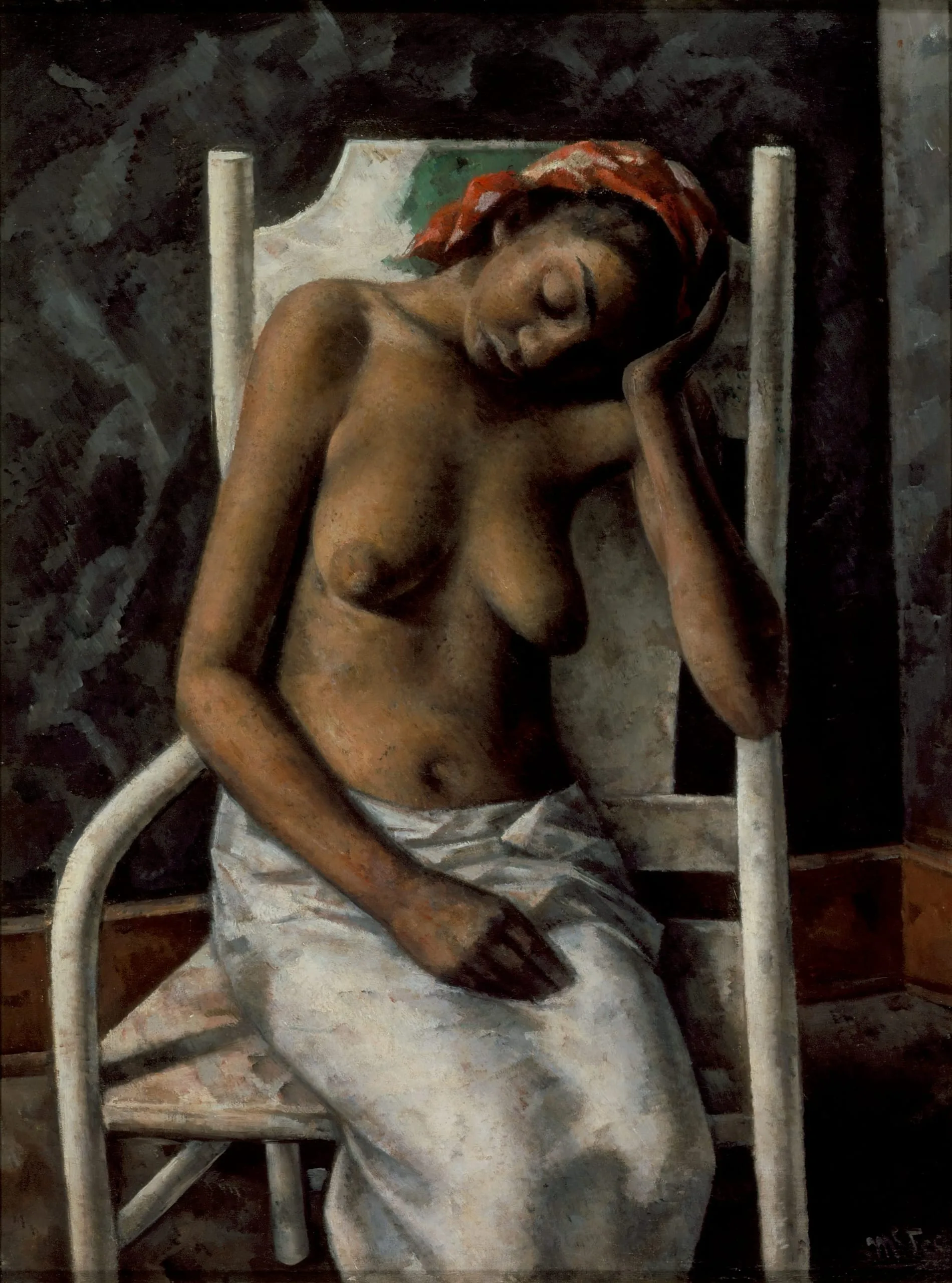
Beginning in the late 1920s and continuing for some eight or ten years, McFee wintered at Bellevue, a former plantation in Bedford County, Virginia, where he devoted much of his energy to painting black farm workers. McFee found them to be much more interesting than professional models, and he empathized with them. As he explained, "I think I came closer to painting something of their life and my life with understanding" (quoted in Ernest W. Watson, "Still Life Paintings by Henry Lee McFee," American Artist 12 [February 1948]: 20). A maid at the plantation named Gertrude posed for Sleeping Black Girl. In it McFee succeeded in conveying the young woman’s total exhaustion through her posture. He carefully drew, corrected, and changed the figure before he began to paint "to make clear the stress and sag of the figure." McFee’s mellow palette, which gives a deep resonance to the painting, further underscores the mood of quiet sympathy. The girl’s tawny skin and the white drape determined the palette, with the greenish black wallpaper, gray head scarf, and white chair repeating the color tones.
Typical of McFee’s painting technique is the delicate layering of the paint in thin, transparent layers to model the forms. Despite the solid rendering, McFee has perceived the figure and chair as large geometric shapes, and consequently the painting is at once academic and modern.
Critic Arthur Millier dated the painting to 1930, which is probably too early. It was first exhibited in late 1934. As it was not shown with other pictures of similar subjects in McFee’s January 1933 exhibition at Frank K. M. Rehn Galleries in New York, it was probably painted during the following winter of 1933-34. The images of blacks exhibited in 1933 were praised for their "grave dignity and unity of effect" (Sun [New York], January 7, 1933, p. 10), and Sleeping Black Girl has these qualities.
McFee considered it to be his best, if not most important, work, and was bewildered by his inability to sell it. Millier seems to have agreed with the artist, for he ranked Sleeping Black Girl the greatest American painting created in the 1930s.