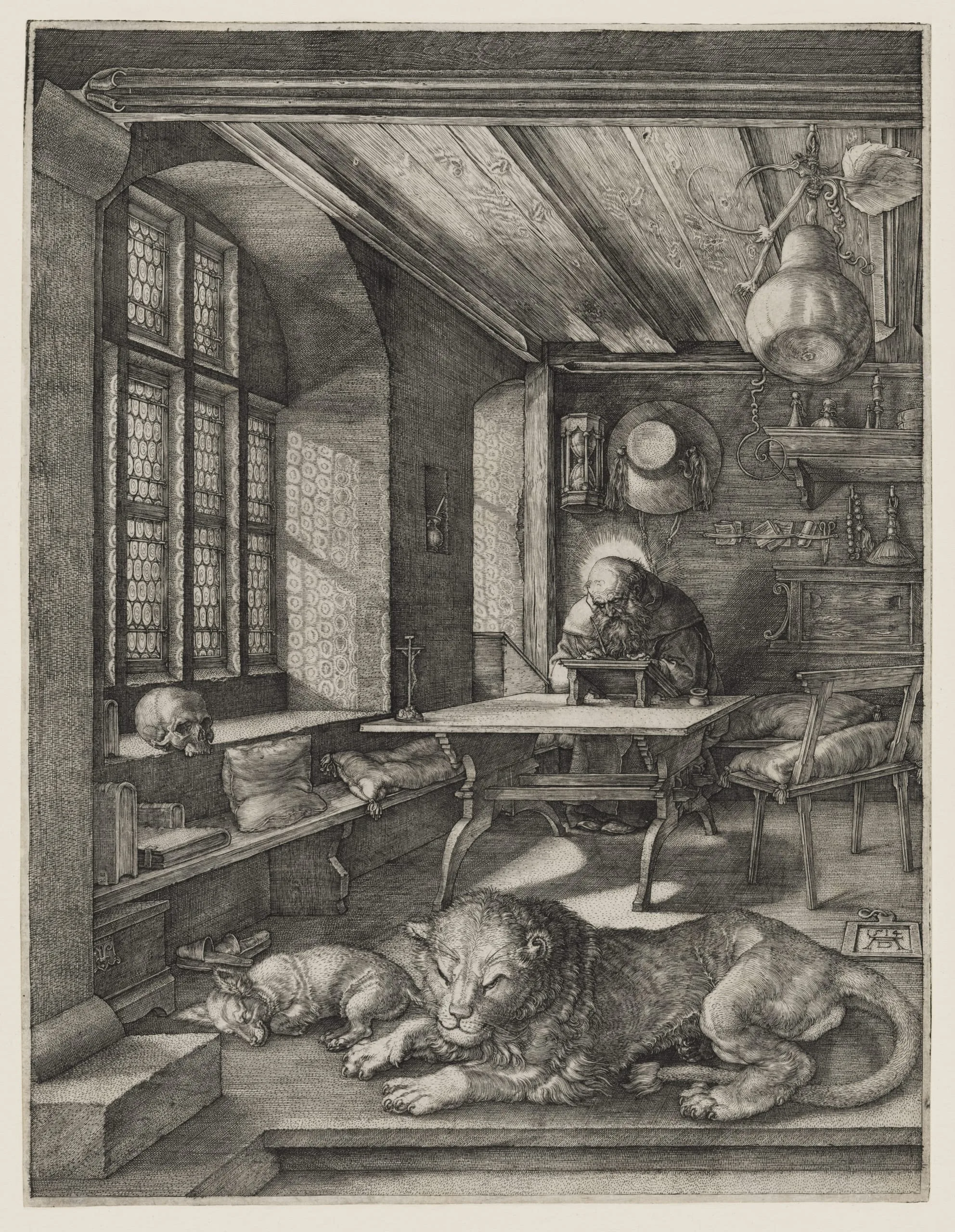
The foremost artistic personality of the German Renaissance, Albrecht Dürer was an accomplished painter, art theorist, draftsman, and printmaker. His pictorial innovation and technical bravura transformed the arts of woodcut and engraving, elevating their status to transcend their medieval craft origins and setting standards rarely matched in the history of printmaking. Three works dating to 1513−14 are singled out as the crowning achievements of Dürer’s illustrious career as an engraver: Knight, Death, and the Devil; Melancholia; and Saint Jerome in His Study. Closely related in size and complexity of execution, these prints are known as Dürer’s Meisterstiche, or Master Engravings.
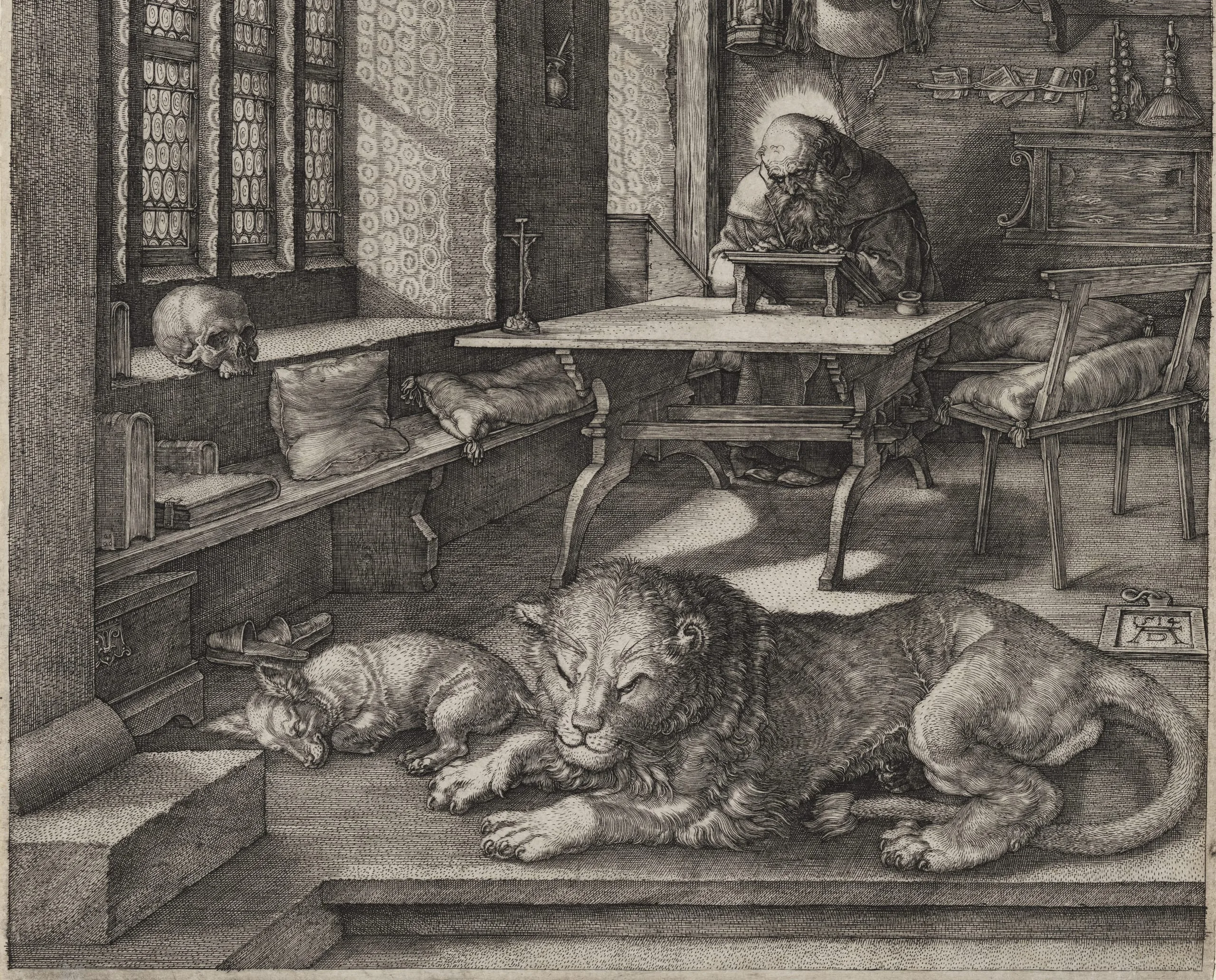
Saint Jerome in His Study evokes an ideal of scholarly and spiritual reflection. Set in the ordered interior of a monastic cell, the learned saint is seen at his writing table guided divinely in his work. The lion, Jerome’s legendary companion, and the dog sleeping at his feet contribute an undeniably sympathetic appeal to the tranquil scene. The light-infused setting, cast in a carefully rendered mathematical perspective, has been greatly admired by collectors, scholars, and artists since the sixteenth century. In his 1568 Lives of the Artists, Giorgio Vasari praised the depiction of sun streaming through the bull’s-eye glass windows as having “an effect so natural, it is a marvel,” furthermore claiming that “nothing more and nothing better could be done in this field of art.” Indeed, in its virtuoso handling of light and meticulous description of textures, this engraving is a demonstration of Dürer’s supreme mastery of the pictorial possibilities of the medium.
Naoko Takahatake
2012