LACMA

ShopMembershipMyLACMATickets
LACMA
Los Angeles County Museum of Art
5905 Wilshire Blvd.
Los Angeles, CA 90036
info@lacma.org
(323) 857-6000
Sign up to receive emails
Subscribe
© Museum Associates 2025

Museum Hours

Monday

11 am–6 pm

Tuesday

11 am–6 pm

Wednesday

Closed

Thursday

11 am–6 pm

Friday

11 am–8 pm

Saturday

10 am–7 pm

Sunday

10 am–7 pm


  • About LACMA
  • Jobs
  • Building LACMA
  • Host An Event
  • Unframed
  • Press
  • FAQs
  • Log in to MyLACMA
  • Privacy Policy
© Museum Associates 2025
Collections

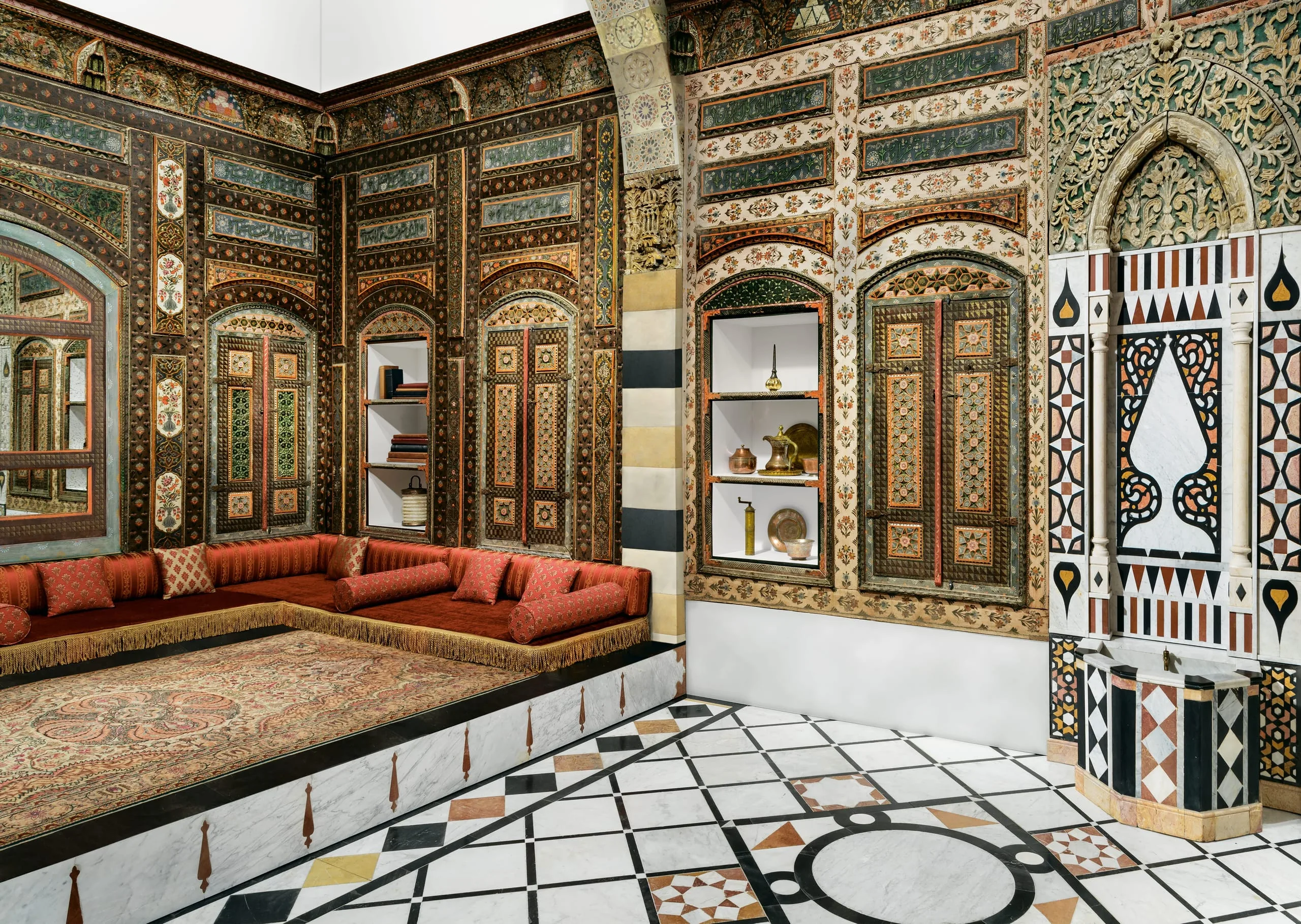
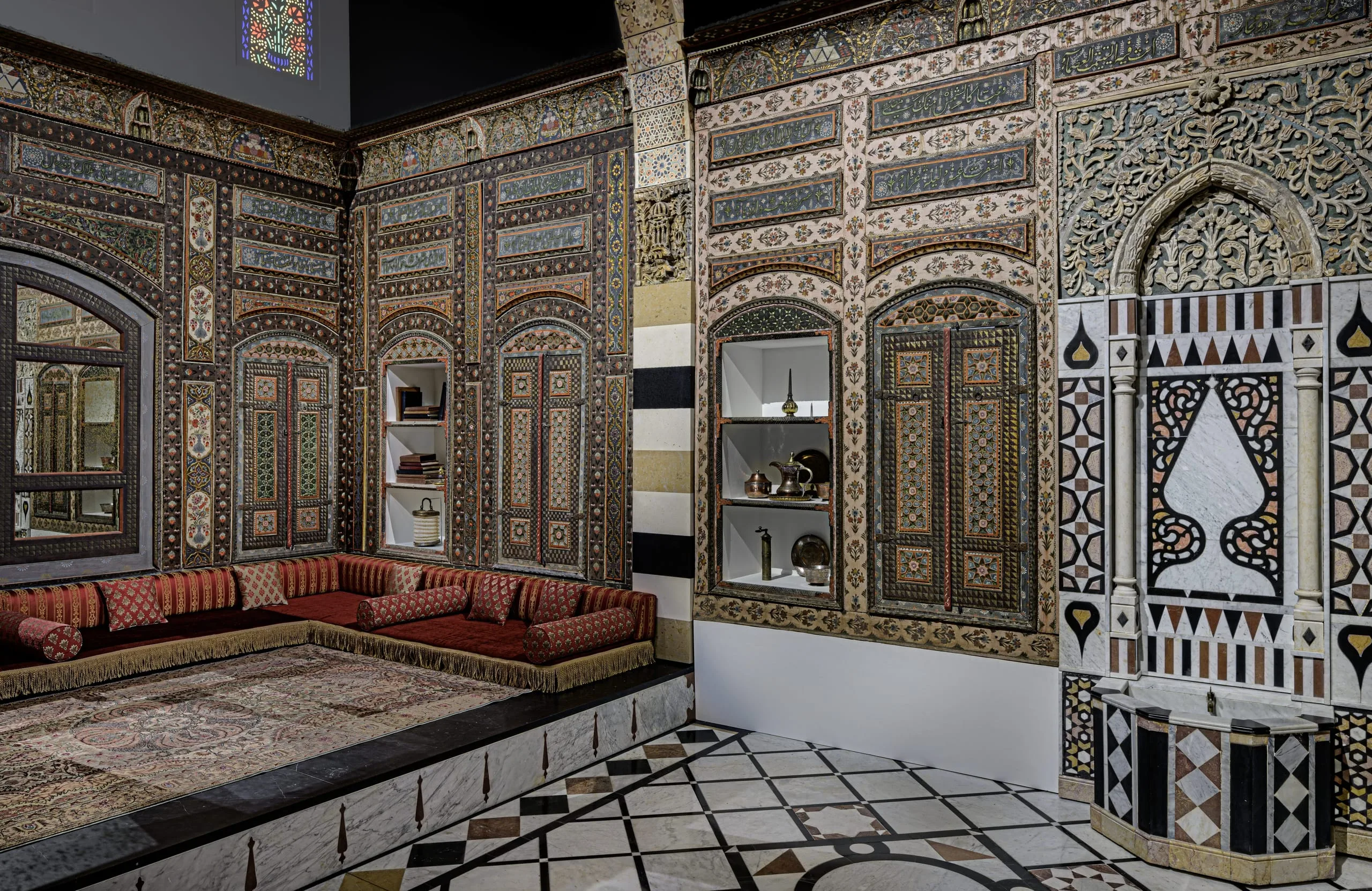
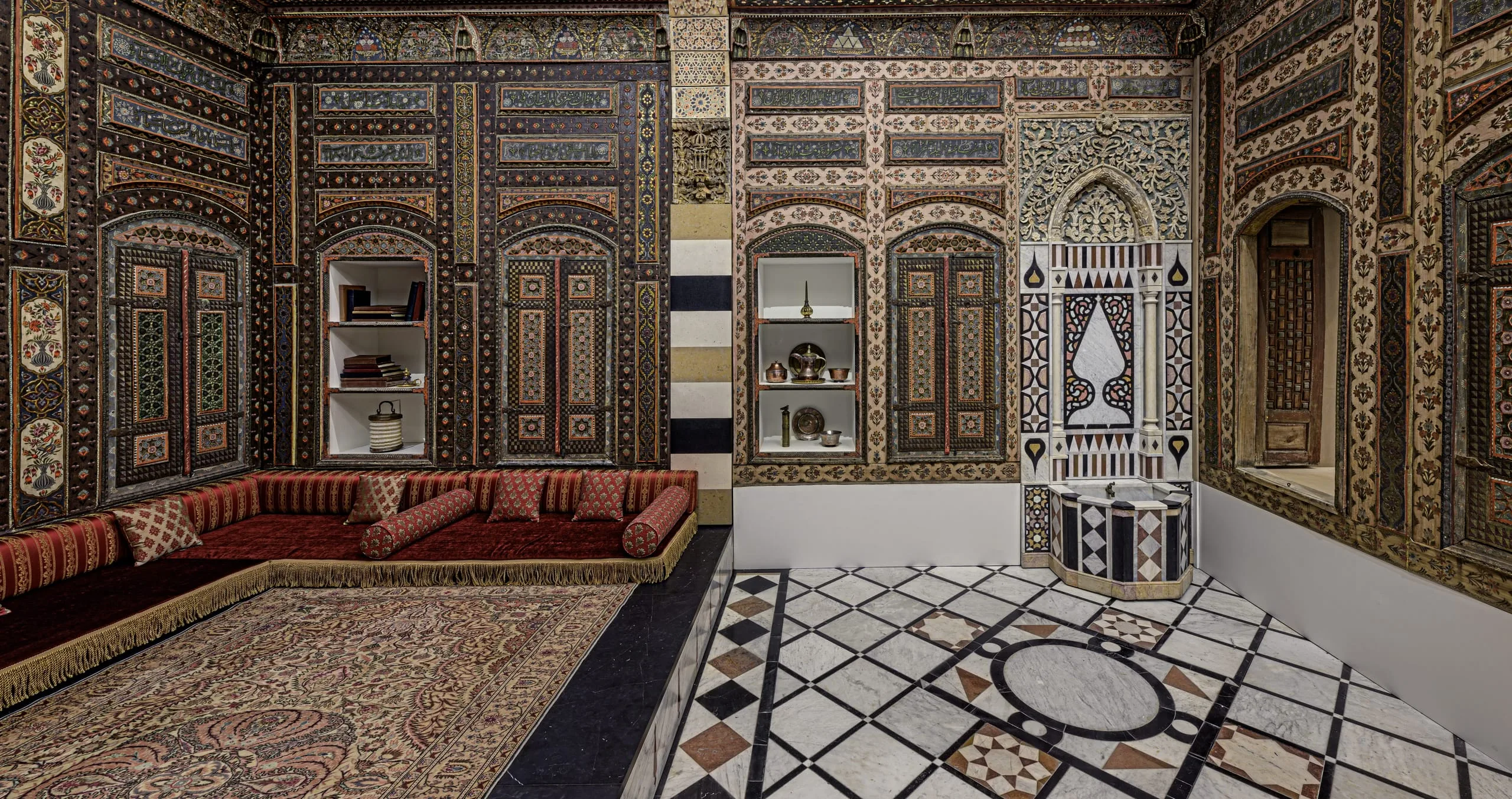
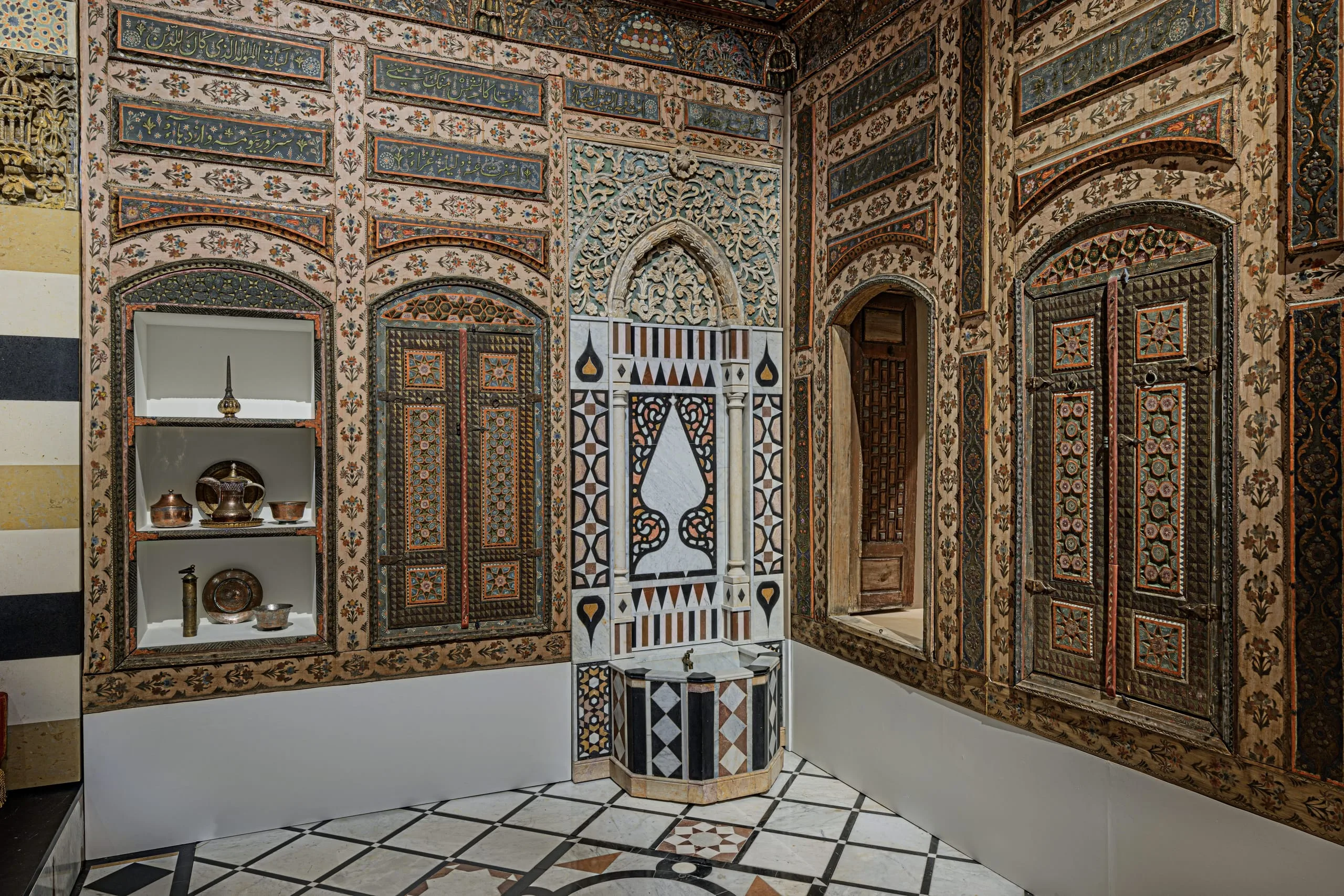
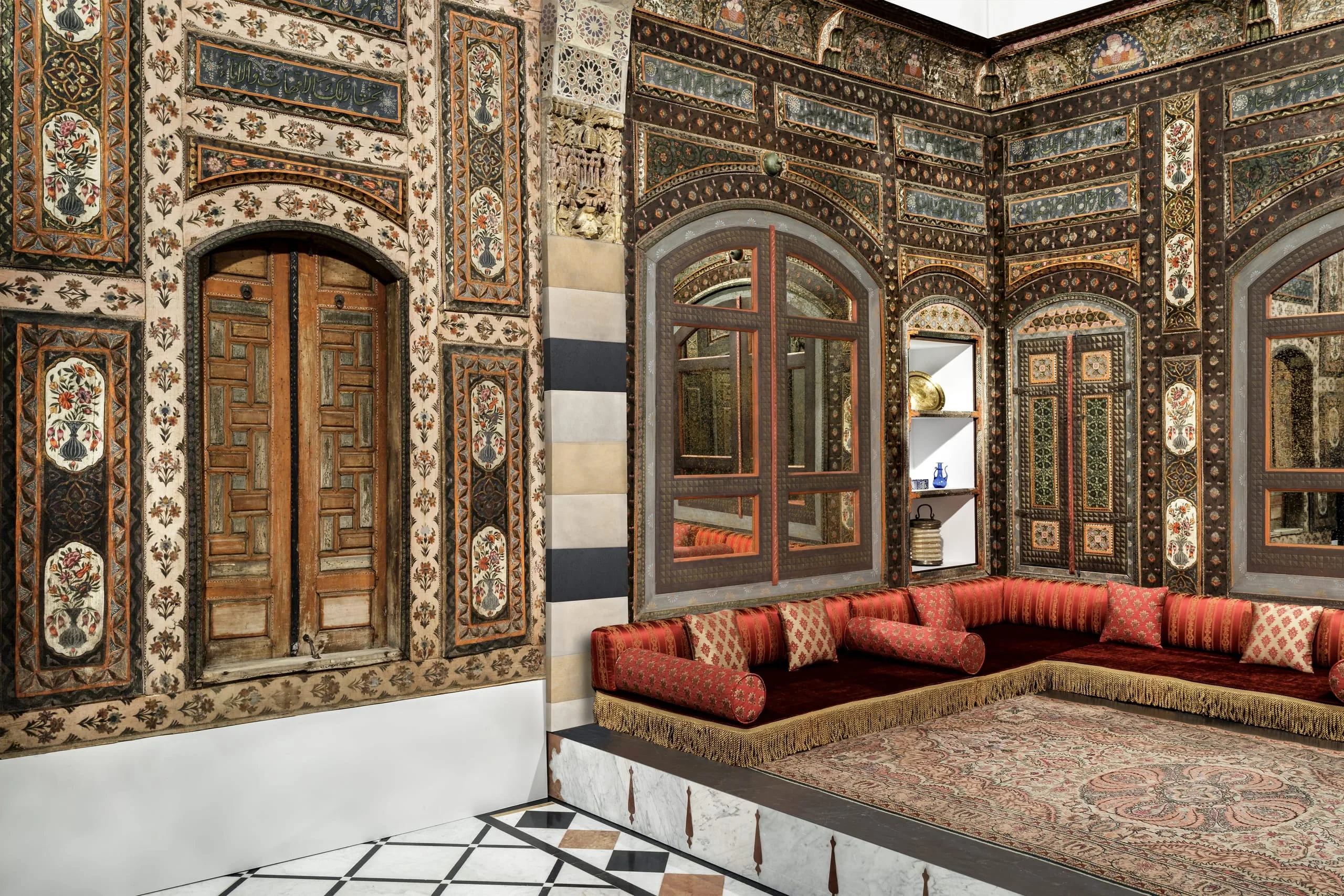
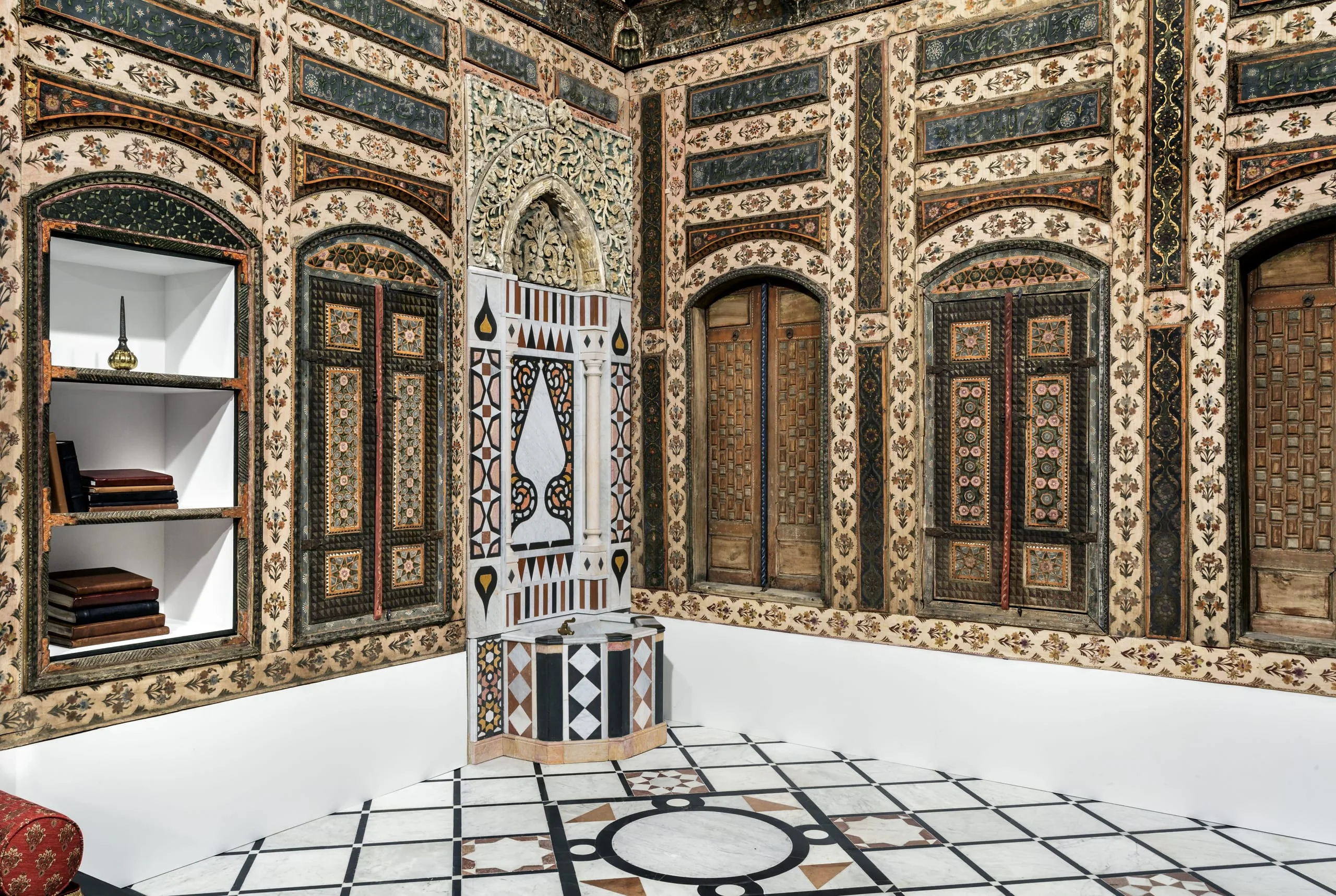
Damascus RoomAD 1766–67/ AH 1180

On view:
Geffen Galleries, Mediterranean Crossings
Photograph of a fully installed Syrian-style reception room with painted wood-paneled walls covered in dense arabesque and floral patterns, arched niches, geometric marble floors, and a low red upholstered bench
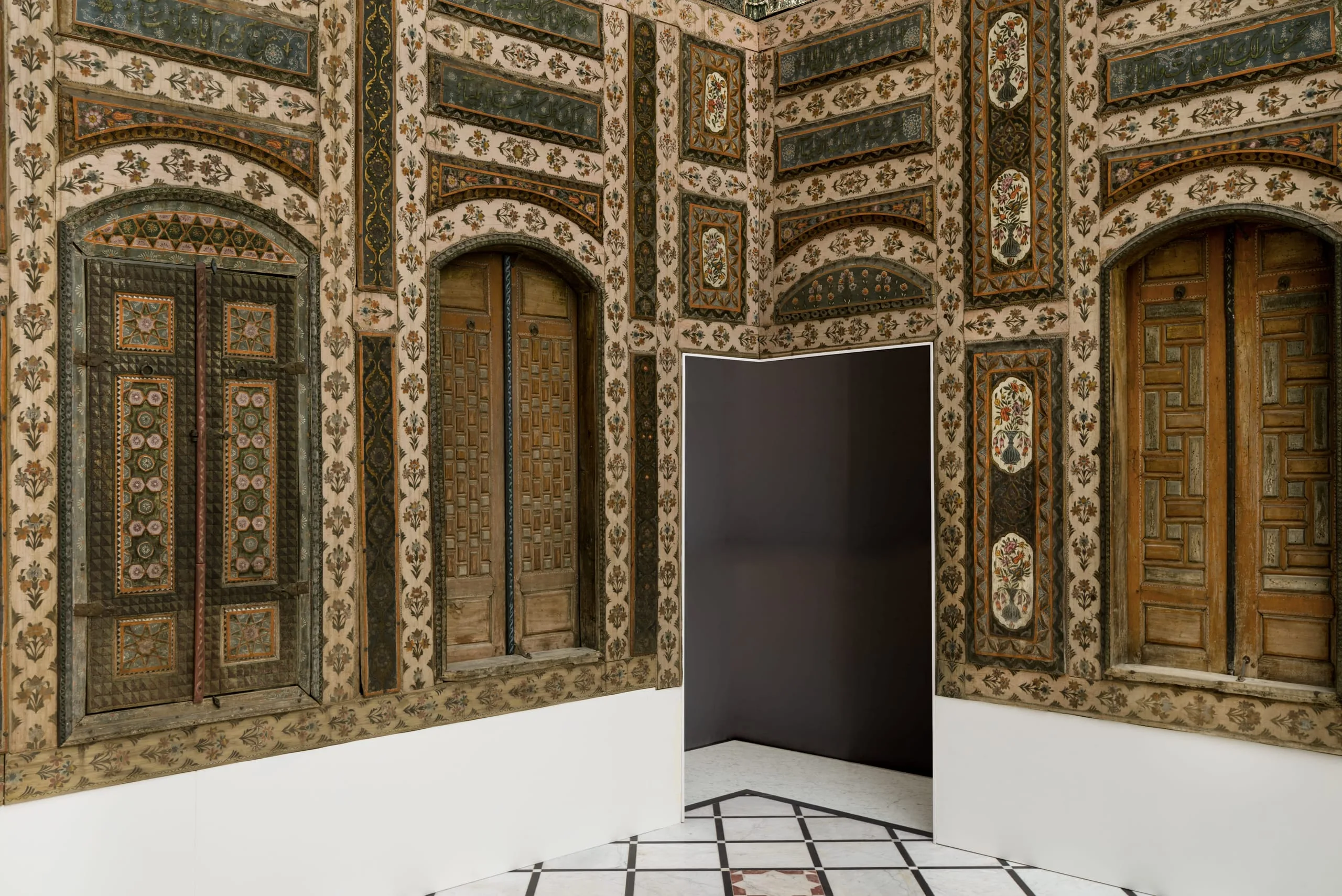
Architectural installation featuring elaborately painted wooden wall panels with dense floral and arabesque patterns in muted greens, ochres, and whites, framing three carved wooden doors with geometric lattice designs; a freestanding black partition stands before a central doorway on a geometric tiled floor.
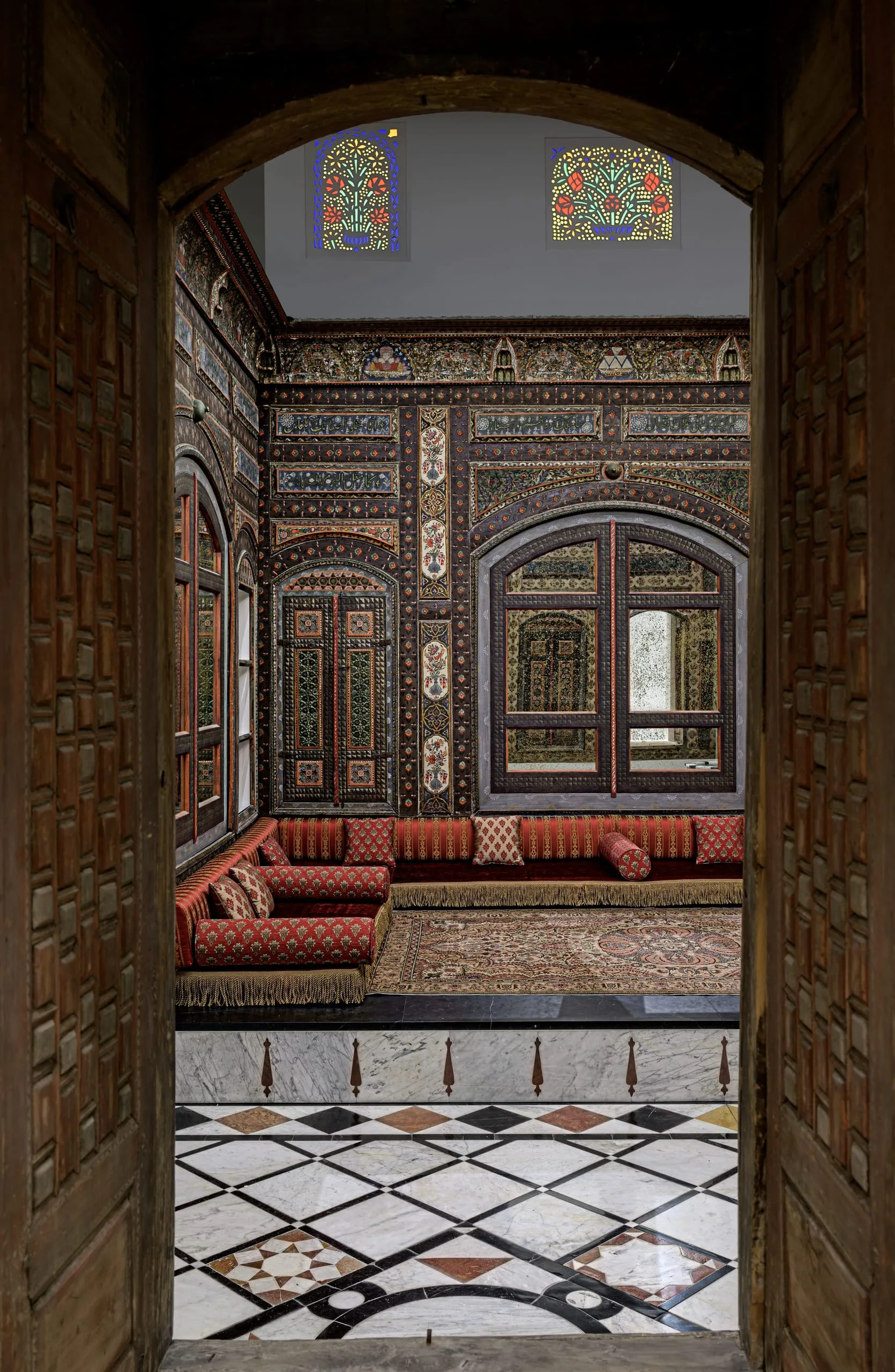
Photograph of a Syrian reception room interior viewed through a carved wooden doorway, featuring densely painted and gilded wooden paneling with geometric and floral patterns covering the walls, low red upholstered seating along the perimeter, a patterned carpet, inlaid marble floor with diamond motifs, and two colorful stained glass windows above.
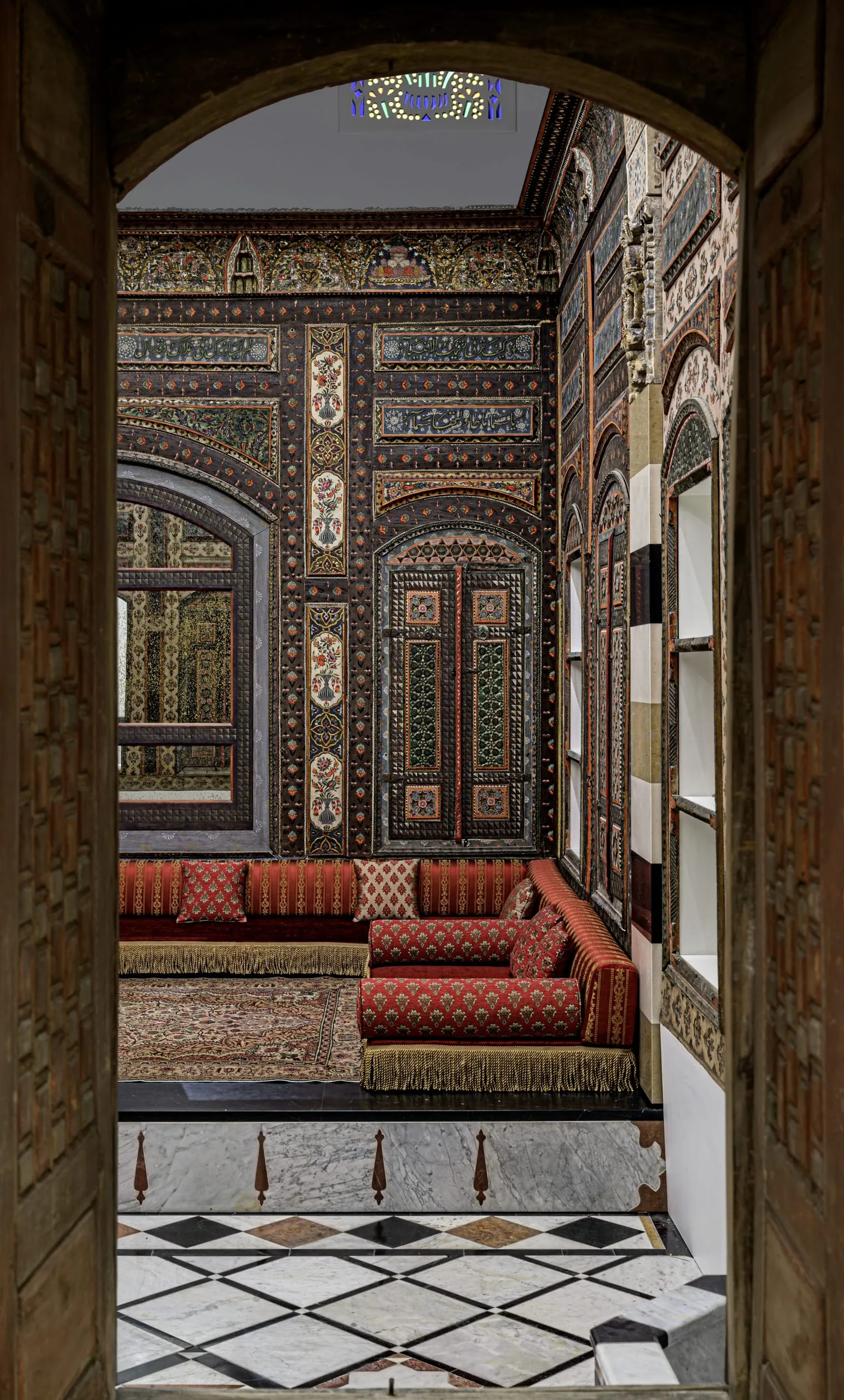
Photograph of an ornate Syrian reception room (qa'a) viewed through a carved wooden doorway, with walls and ceiling densely covered in polychrome painted and gilded geometric and floral woodwork panels, Arabic calligraphic friezes, and arched niches; low red and gold textile divans line the walls above a black-and-white marble tile floor.
Reconstructed Syrian reception room with densely painted and inlaid wooden wall panels featuring polychrome geometric and arabesque ornament, arched niches displaying metalwork, a raised platform with red cushioned seating and fringed textiles, marble mosaic floor in black and white geometric patterns, and a carved marble fountain niche with inlaid colored stone at right.
Reconstructed Syrian reception room (qa'a) with densely painted and gilded wooden paneling in floral and geometric patterns, built-in niches displaying metalwork objects, a low red cushioned seating platform with patterned carpet, and a marble-inlaid floor with black-and-white checkerboard and medallion design. A muqarnas-carved fountain niche with black-and-white striped masonry anchors the right wall.
Reconstructed Syrian reception room interior with floor-to-ceiling painted and gilded wood paneling densely covered in floral arabesque patterns and bands of Arabic calligraphy. Central pointed-arch niche with polychrome marble mosaic fountain below; flanking arched wooden shutters with geometric inlay. Black-and-white marble checkerboard floor; display niche at left holds copper and brass vessels.
Reconstructed Syrian reception room interior with densely painted and gilded wooden wall panels featuring interlacing floral and geometric patterns in red, gold, green, and ivory. Arched doorways and mirrored niches line the walls, with Arabic calligraphy frieze near the ceiling. A low raised seating platform with red cushions and gold fringe runs along two walls, set above a patterned carpet and black-and-white marble floor.
Reconstructed Syrian reception room with densely painted and carved wooden wall panels featuring repeated floral and geometric arabesques in cream, green, red, and black; pointed arch niches, heavy wooden doors, and a central marble fountain with inlaid geometric mosaic floor.
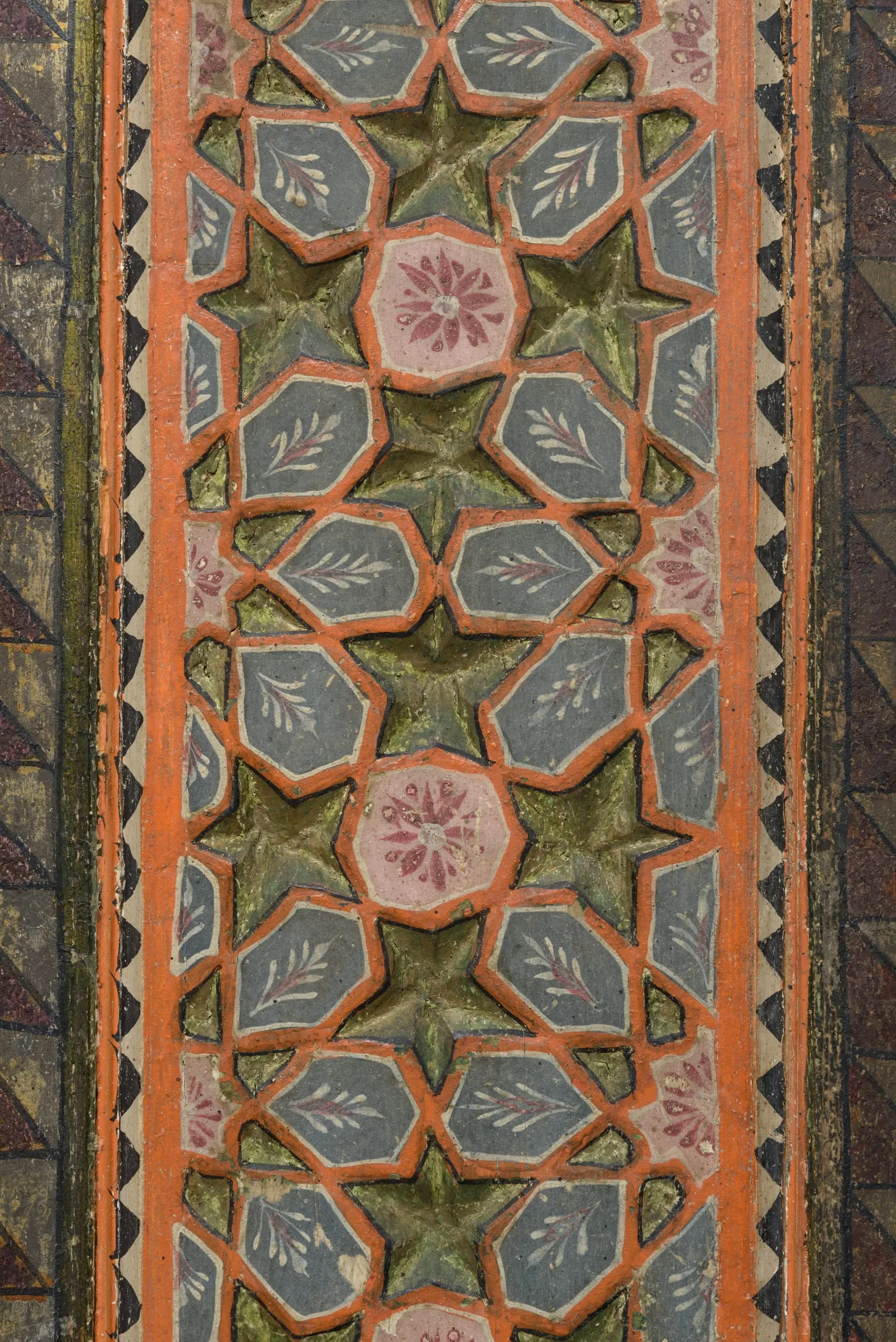
Architectural panel with polychrome geometric interlace pattern; repeating eight-pointed stars and octagons in terracotta orange, slate blue, and olive green, with painted floral sprigs and pink rosettes at intervals.
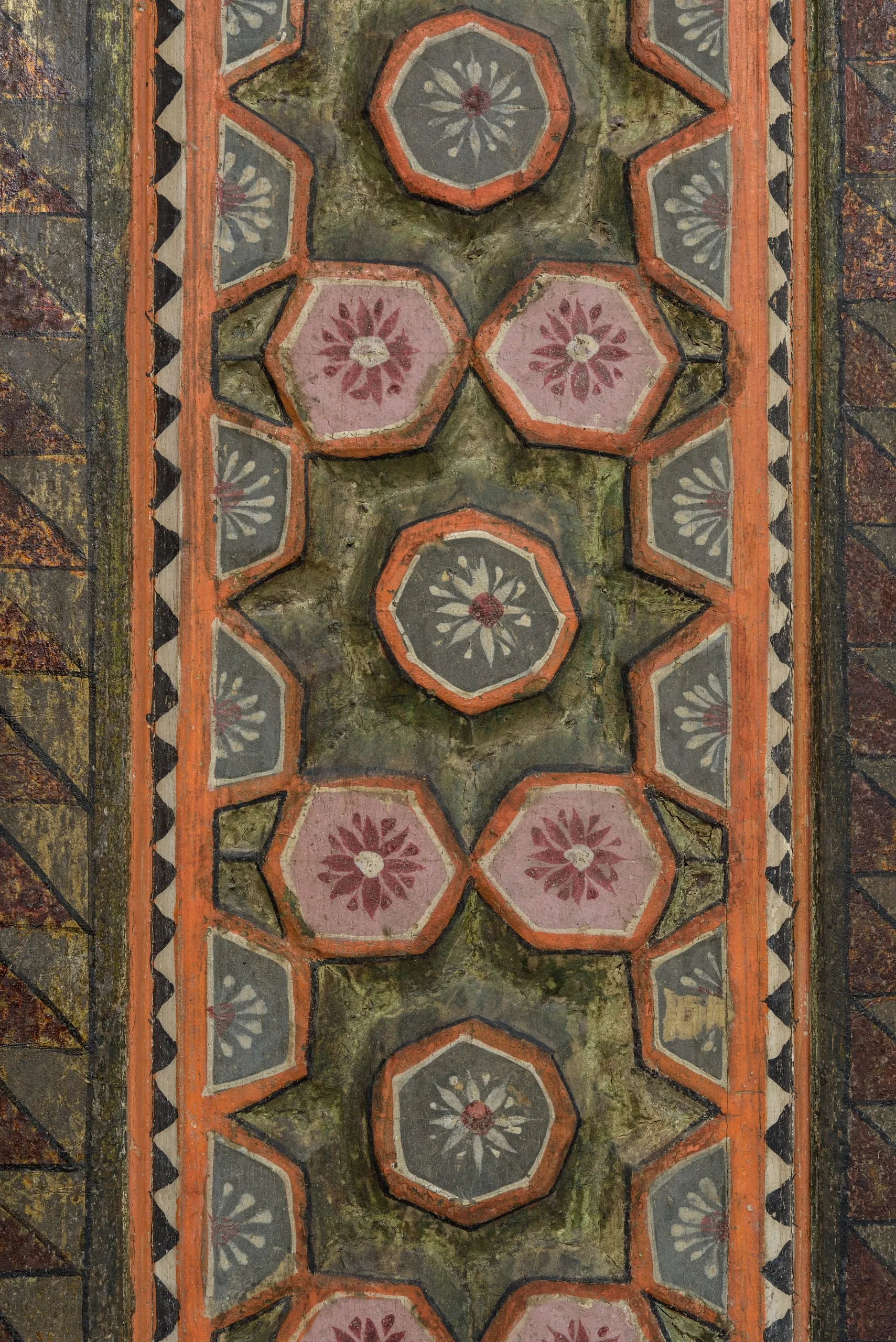
Painted architectural panel with repeating geometric pattern: alternating octagons and hexagons in muted olive green and pink, each containing a stylized floral rosette, framed by orange borders and a diagonal chevron band at right. Aged painted surface with visible wear.
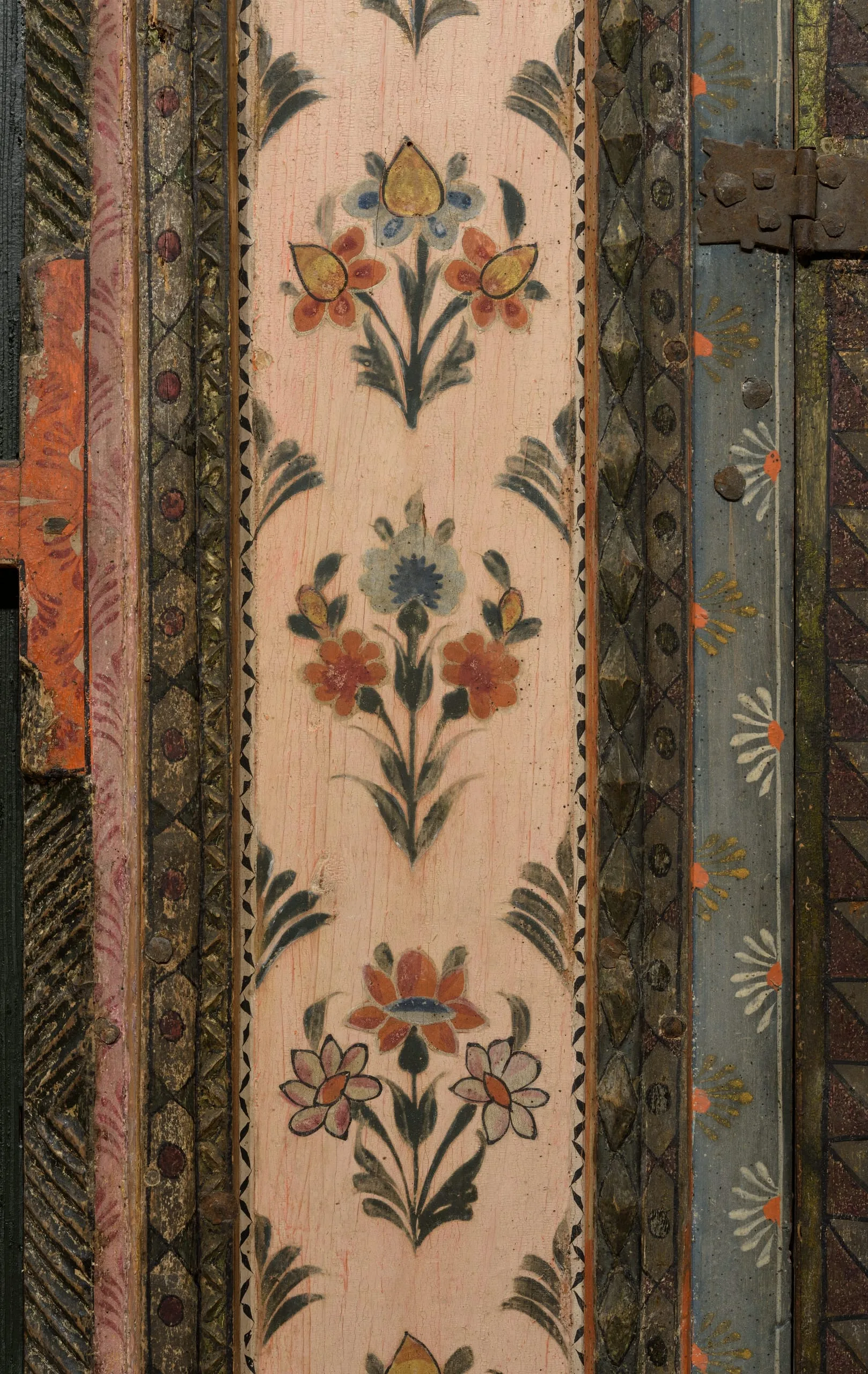
Painted wooden panel with a vertical repeating floral motif on a pale pink ground, featuring three clusters of red, blue, and yellow flowers with green stems and leaves, bordered by narrow geometric zigzag bands; a metal hinge and adjacent decorated panels are visible at the edges.
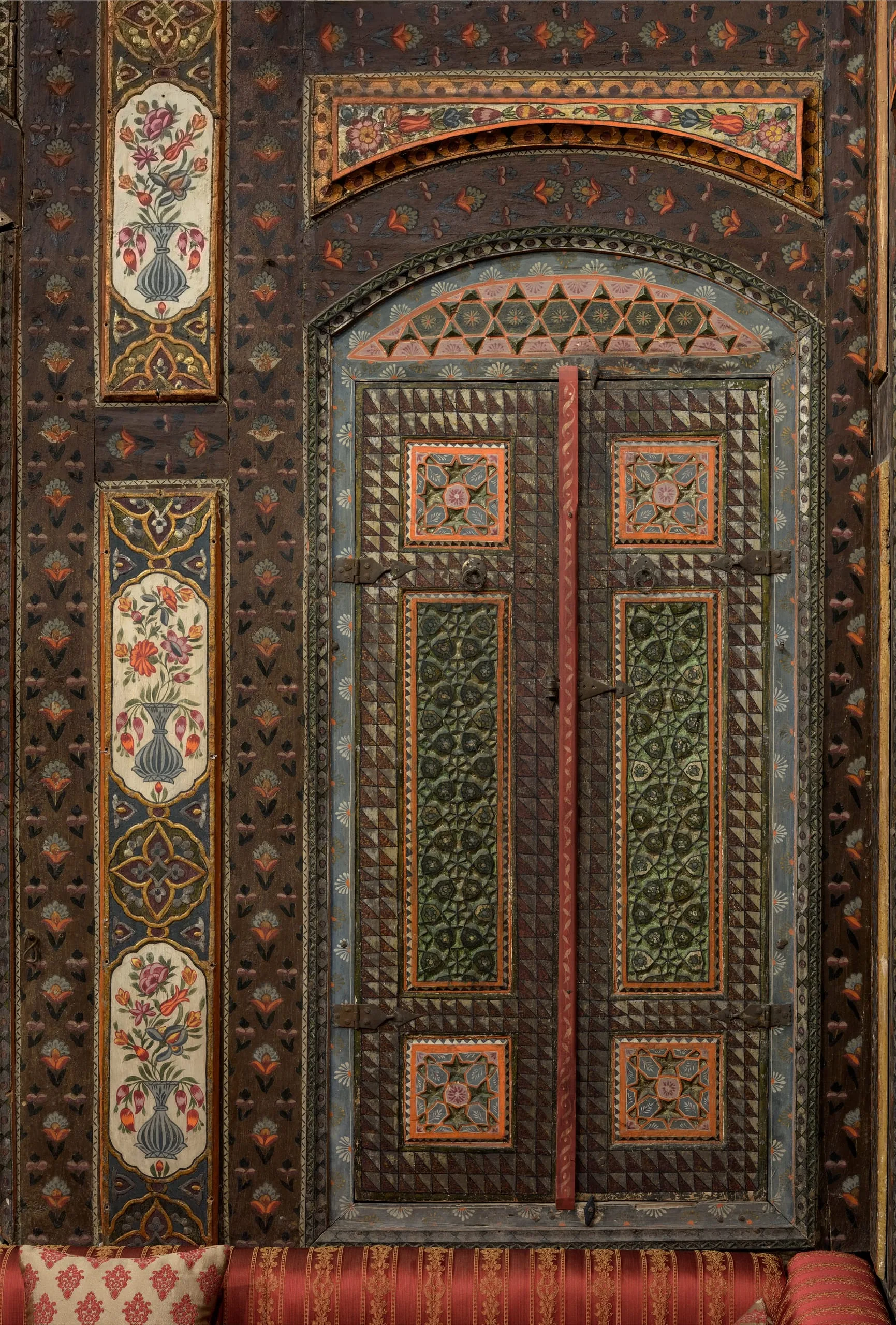
Elaborately painted wooden interior wall and arched doorway, densely covered in carved geometric and floral patterns in deep brown, green, orange, and blue; flanking panels feature polychrome floral bouquets on white grounds within cartouches.
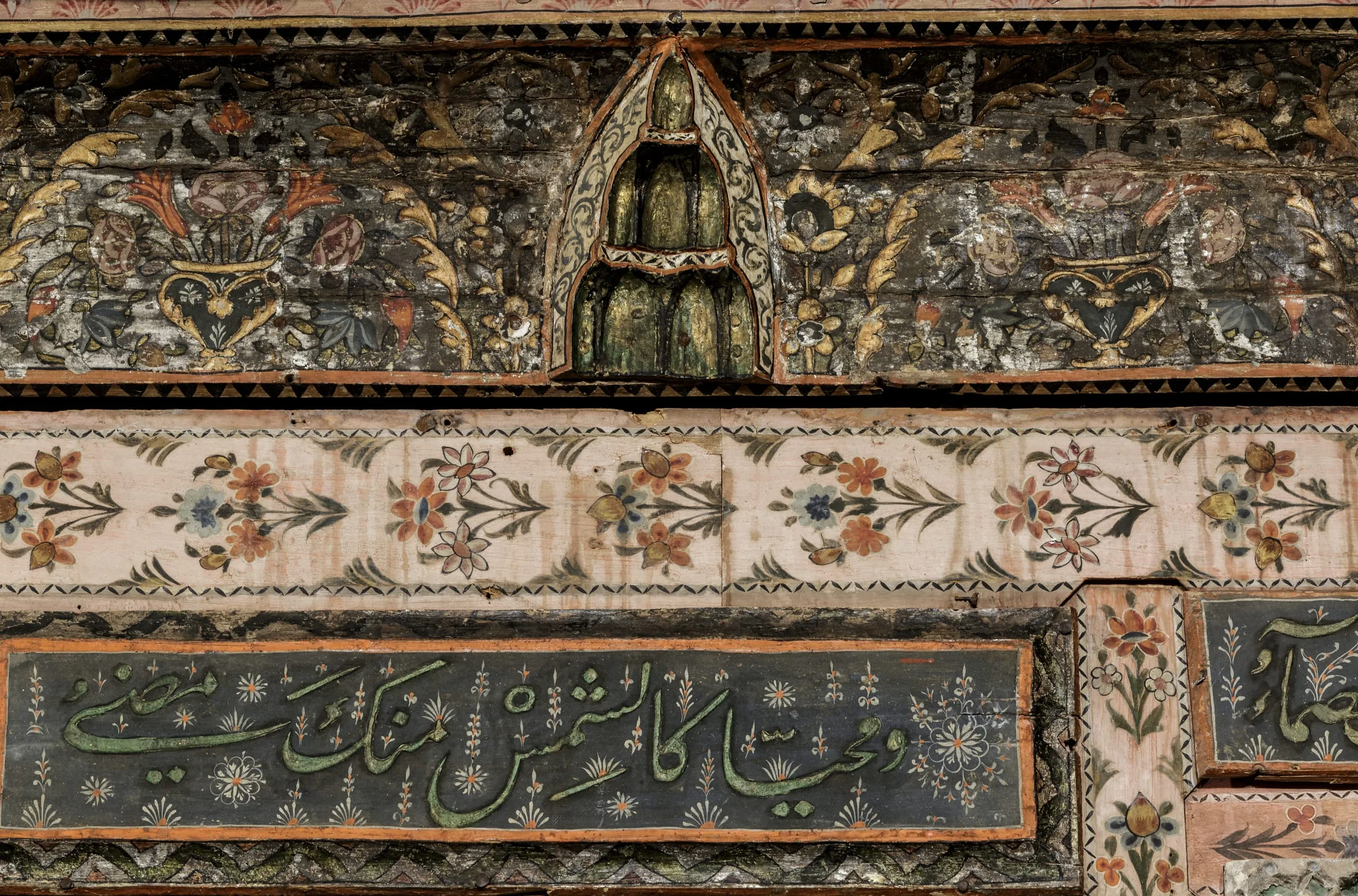
Painted architectural surface with three horizontal registers: an upper band of dense floral and foliate motifs in red, gold, and green with a carved pointed niche at center; a middle band of repeating floral sprays in pink, orange, and blue on a pale ground; and a lower dark panel bearing a horizontal line of Nastaliq script in green, surrounded by small painted flowers.
Title
Damascus Room
Place Made
Syria, Damascus
Date Made
AD 1766–67/ AH 1180
Medium
Wood (poplar) with gesso, tin and brass leaf, glazes and paint; plaster with stonepaste inlays; and multicolored stones
Dimensions
Installation: 240 × 180 × 144 in. (609.6 × 457.2 × 365.76 cm)
Credit Line
Conservation of the room was organized in partnership with the King Abdulaziz Center for World Culture; additional conservation support was provided by the Friends of Heritage Preservation
Accession Number
M.2014.33
Classification
Architecture
Collecting Area
Art of the Middle East: Islamic
Curatorial Notes

Unlike fashionable residences in early modern Europe, the homes of the well-to-do in Ottoman-era Damascus had plain exteriors, within which were concealed elaborately decorated reception rooms that faced onto courtyards. The ornate stone courtyards provided a cooler living space during the hottest times of the year, while the lavishly bedecked reception rooms were used primarily in the winter months. With the modernization and growth of Damascus, many such historic homes were demolished, but occasionally their sumptuous interiors were spared. Several have found their way into museums not only in Damascus but also in Europe and the United States.

In 2014 the Los Angeles County Museum of Art acquired this Damascus room dated AD 1766–67 / AH 1180, which had been dismantled intact from a courtyard home in the al-Bahsa quarter that was torn down in 1978 to make way for a road. The room has colorful stone floors, painted and carved wood walls, elaborate cupboard doors and storage niches, and an intricately inlaid stone wall fountain with a carved and glazed ceramic hood. The room was largely in its original state, with one of the best-preserved painted surfaces of any similar room of the period but covered with layers of dirt and grime. Brilliant pinks, oranges, blues, and greens have now been revealed in the conserved and reintegrated room.

https://player.vimeo.com/<wbr>video/175283839?title=0&<wbr>byline=0&portrait=0</a><span style="font: 12.8px/normal arial, sans-serif; color: rgb(34, 34, 34); text-transform: none; text-indent: 0px; letter-spacing: normal; word-spacing: 0px; float: none; display: inline !important; white-space: normal; widows: 1; font-size-adjust: none; font-stretch: normal; background-color: rgb(255, 255, 255); -webkit-text-stroke-width: 0px;">" width="290" height="163" frameborder="0" webkitallowfullscreen mozallowfullscreen allowfullscreen>


Archival support provided by kölnprogramm GmbH & Co. KG and the Cologne Film Heritage Foundation. Visit YouTube at https://youtube.com/playlist?list=PLEQYvfHj56hTg_TxuRYQa21gdfTsKLau0&si=kw-WAlGH6s5DzyBs

Selected Bibliography
  • Komaroff, Linda. "Islamic Art Now and Then." In Islamic Art: Past, Present, Future, edited by Sheila Blair and Jonathan Bloom, 26-56. New Haven, New York, and London: Yale University Press, 2019.

  • Komaroff, Linda. "A Damascus Room in Los Angeles." In The Making of Islamic Art: Studies in Honour of Sheila Blair and Jonathan Bloom, edited by Robert Hillenbrand, 117-37. Edinburgh: Edinburgh University Press, 2021.
  • Komaroff, Linda, editor. Dining with the Sultan: The Fine Art of Feasting. Los Angeles: Los Angeles County Museum of Art; New York: DelMonico Books, 2023.