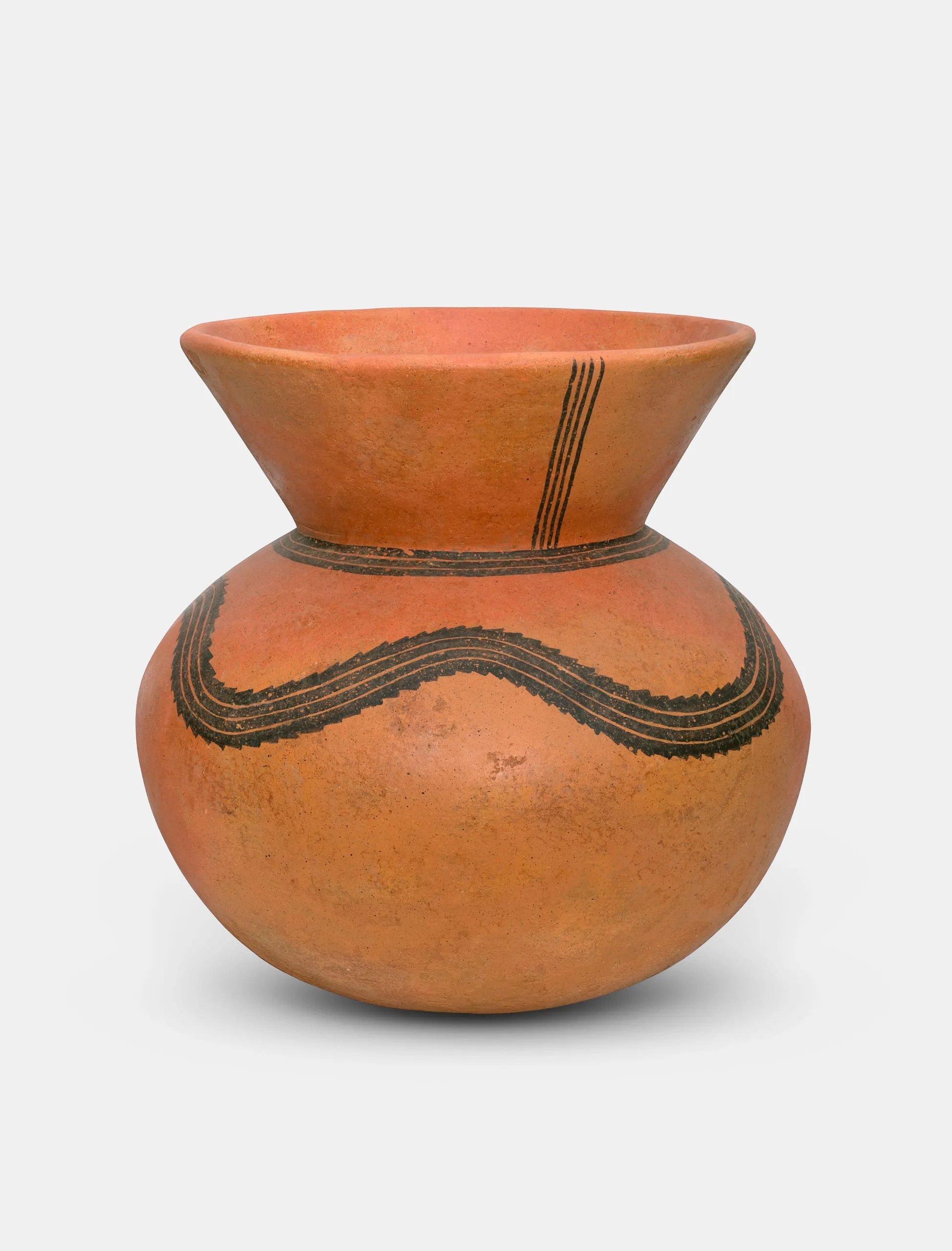
This large, globular jar with its wide, flaring rim, decorated with an undulating serpent and parallel black lines along and up the rim, is typical of pottery of the La Mula style. Beginning around 300 BCE, Panamanian potters began to create these more thin-walled vessels and decorate them with increasingly elaborate, colorful, and symmetrical designs, mostly black applied over a red, orange, or occasionally buff slip. This type of pottery has been found in several regions of central Panama, particularly near Soná, Veraguas, but intact vessels such as this one are extremely rare.
Undulating serpents, many with associated elements or beings painted above and below the curves of their bodies, are a common and apparently important motif in ancient Panamanian art, persisting in ever-evolving form for nearly 2,000 years (see M.2019.379.5, M.2019.379.8, and M.2022.280.7). The precise mythological and cosmological connotations are lost, but scholars have used documentary evidence from other regions as well as ethnographic information to suggest that serpents were associated with moving water, caves (the underworld), the sky, rainbows, the milky way, fertility, and immortality.
Selected Bibliography
Grinnell, Alan. Painting the Cosmos: Art and Iconography of the Ceramics of Ancient Panama. University of New Mexico Press, 2025.