LACMA

ShopMembershipMyLACMATickets
LACMA
Los Angeles County Museum of Art
5905 Wilshire Blvd.
Los Angeles, CA 90036
info@lacma.org
(323) 857-6000
Sign up to receive emails
Subscribe
© Museum Associates 2026
  • About LACMA
  • Jobs
  • Building LACMA
  • Host An Event
  • Unframed
  • Press
  • FAQs
  • Log in to MyLACMA
  • Privacy Policy
© Museum Associates 2026
Collections

Giovanni Baratta
Allegorical Figure of Prudence, from Palazzo Giugni, Florencecirca 1703-1708

On view:
Geffen Galleries, Model Lives in Baroque Italy
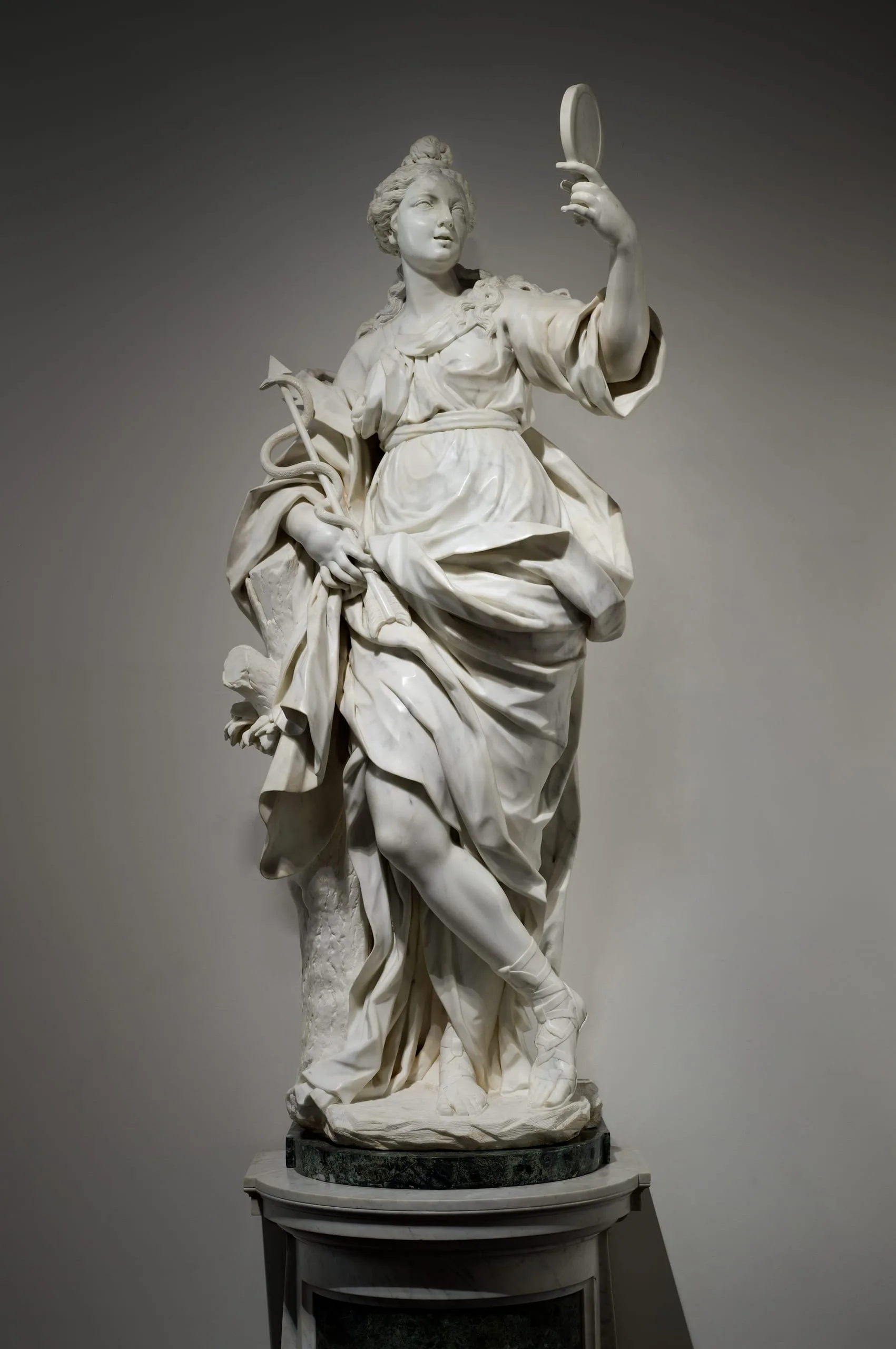
Full-length white marble sculpture of a standing female figure, twisting dynamically, raising a hand mirror overhead while grasping a serpentine form, with deeply carved billowing drapery
Artist or Maker
Giovanni Baratta
Italy, Carrara, 1670-1747
Title
Allegorical Figure of Prudence, from Palazzo Giugni, Florence
Date Made
circa 1703-1708
Medium
White carrara marble
Dimensions
Figure: 71 5/8 × 29 × 22 in. (181.93 × 73.66 × 55.88 cm) Base: 41 1/4 × 31 × 22 in. (104.78 × 78.74 × 55.88 cm)
Credit Line
GIft of The Ahmanson Foundation
Accession Number
M.2011.81.2
Classification
Sculpture
Collecting Area
European Painting and Sculpture
Curatorial Notes

The garments of this sizable allegorical sculpture, Prudence, and its pair, Wealth (M.2011.81.1), flutter in the wake of the figures’ movement. Prudence gazes into a mirror as a serpent slithers up an arrow on her side, while Wealth, adorned with jewels, presents a crown. Commissioned by Nicolò Maria Giugni, the statues were originally exhibited in the Palazzo Giugni in Florence. The Giugni family—whose coat of arms is discernible on the vase by Wealth’s leg—served as advisors to the Medici, grand dukes of Tuscany. Wealth and Prudence were part of an intricate iconographic program designed to glorify the Medici family and highlight the Giugni family’s allegiance to them. Nicolò’s choice of Giovanni Baratta was sensible, as the sculptor was a pupil of Giovanni Battista Foggini, superintendent of the Medici’s artist workshops. Within the Palazzo Giugni, the two statues were positioned in a long gallery flanking many wall paintings that were copies of contemporary works from the Medici collection in the Villa del Poggio Imperiale. While the gallery displayed a series of Medici portraits, Wealth and Prudence would have especially complemented four paintings that celebrated feminine virtues. These allegorical figures may also allude to the patron’s mother, Orsola Guasconi, who, widowed in 1675, managed the palace and the Giugni patrimony.

Baratta executed Wealth and Prudence shortly before the peak of his fame; he would later receive commissions from the duke of Marlborough, the king of Denmark, and the Royal House of Savoy in Turin. The sculptures garnered acclaim in Florence and were even reproduced in various versions by the Doccia porcelain factory, which specialized in copying important works from prominent Italian collections.

2024

Provenance

Commissioned from the artist ca. 1703–4 by Niccolò Maria Giugni (1672–1717),(1) Palazzo Giugni, Florence, by descent to; Niccolò Giugni (1714–1775), by descent to; Doria Colonna family, who purchased the palace and most of its contents in 1830, to; the Fraschetti family, who purchased the palace and its contents in 1893, sold by 1904 through; [Gustavo Volterra and Adele Melli, Florence, to]; James Buchanan Duke (1856–1925), Duke Farms, Somerville, NJ, by descent to; Doris Duke (1912–1993) (sale, Morristown, NJ, Millea Brothers Auction House, 3 May 2009, lots 836, 837 to); [Trinity Fine Art Ltd., London, sold 2011 to]; LACMA.

Footnote

(1) Inventario dei beni di Niccolò Giugni presenti alla sua morte nel palazzo di via degli Alfani a Firenze, 1775. Archivio di Stato, Florence, Magistrato dei Pupili del Principate, 2701, nos. 166-253.
Selected Bibliography
  • Freddolini, Francesco, Carlo Milano, and John Winter. Giovanni Baratta: the statues from Palazzo Giugni rediscovered. London: Trinity Fine Art, 2010.
  • Freddolini, Francesco. Giovanni Baratta 1670-1747: Scultura e Industria del Marmo tra la Toscana e le Corti d'Europa. Rome: L'Erma di Bretschneider, 2013.
  • Gifts on the Occasion of LACMA's 50th Anniversary. Los Angeles: Los Angeles County Museum of Art, 2015.
  • Freddolini, Francesco. Giovanni Baratta, 1670-1747: Scultura e Industria del Marmo tra la Toscana e le Corti d'Europa. Roma: "L'Erma" di Bretschneider, 2013.
  • Lehmbeck, Leah, editor. Gifts of European Art from The Ahmanson Foundation. Vol. 1, Italian Painting and Sculpture. Los Angeles: Los Angeles County Museum of Art, 2019.