- Title
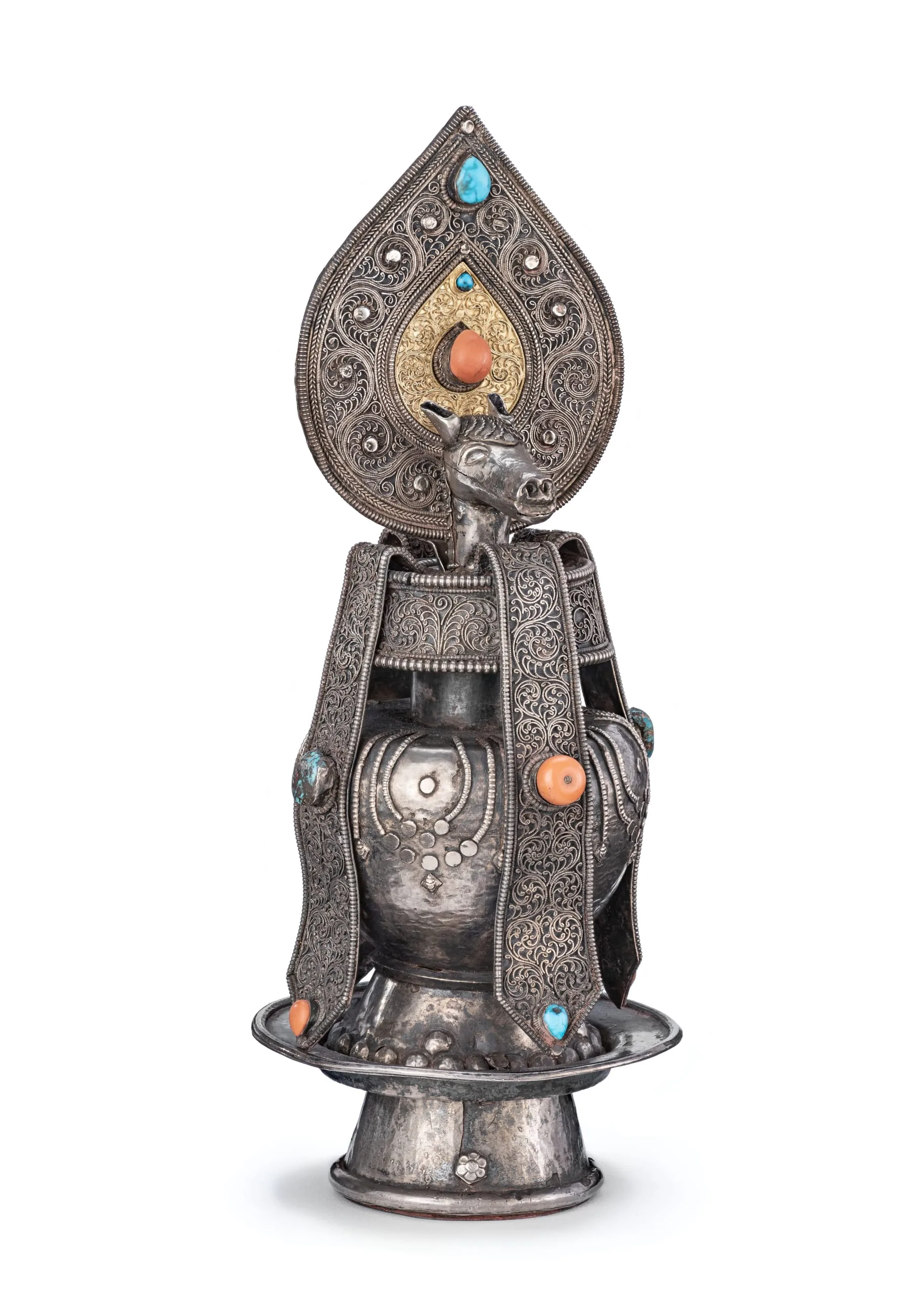
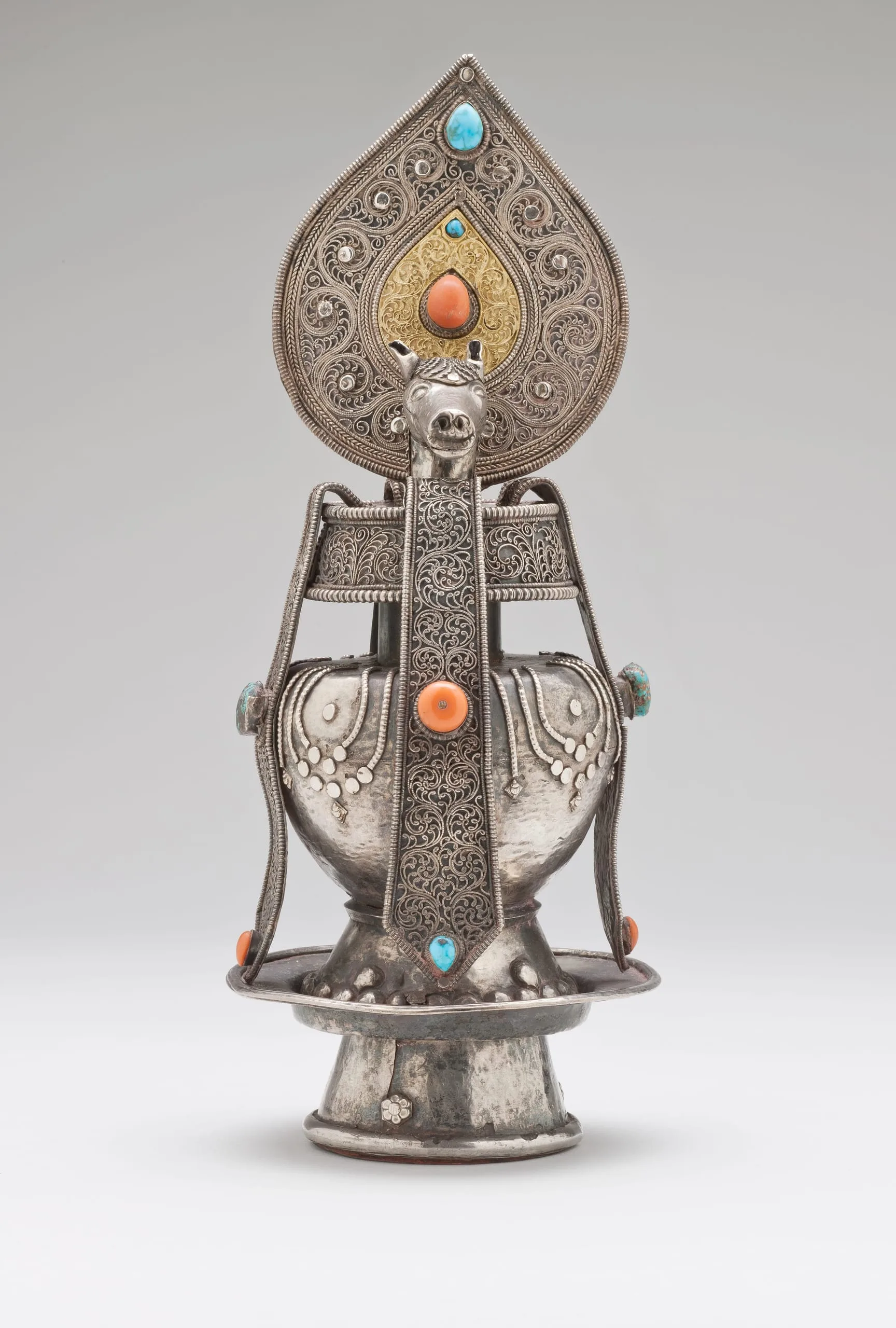
- Vase of Immortality with the Head of a Wind-Horse and the Precious Jewel
- Date Made
- 18th-early 19th century
- Medium
- Silver and silver filigree, gold and gold filigree; inset with coral and turquoise
- Dimensions
- a) Finial: 5 x 3 x 1/2 in. (12.7 x 7.62 x 1.27 cm); b) Stopper: 2 1/4 x 3/4 x 1 1/4 in. (5.72 x 1.91 x 3.18 cm); c) Vase height: 5 3/4 in. (14.61 cm); c) Vase diameter: 3 3/4 in. (9.53 cm); a-d) Overall height: 9 1/2 in. (24.13 cm); a-d) Overall diameter: 3 3/4 in. (9.53 cm)
- Accession Number
- M.2011.157.3a-c
- Curatorial Notes
The exquisite silver and gold filigree embellishing this vase suggest it was made in Tibet or for the Tibetan trade by a Newar artist, a member of the chief historical and cultural ethnicity in Nepal that was renowned for its fine filigree metalworking.
Known in Tibetan as a tshe bum, this Vase of Immortality with the Head of a Wind-Horse and the Precious Jewel was used in longevity rituals to dispense sacred water symbolizing amrita, the nectar of immortality. Related types of ritual water vases have a spout and are often graced with peacock feathers, whose eyespots or ocelli symbolize the transcendental insights of the Five Jina Buddhas (see M.83.2.1). The Vase of Immortality is also an attribute of Amitayus, the Buddha of Eternal Life (see M.84.32.5 and M.77.19.14).
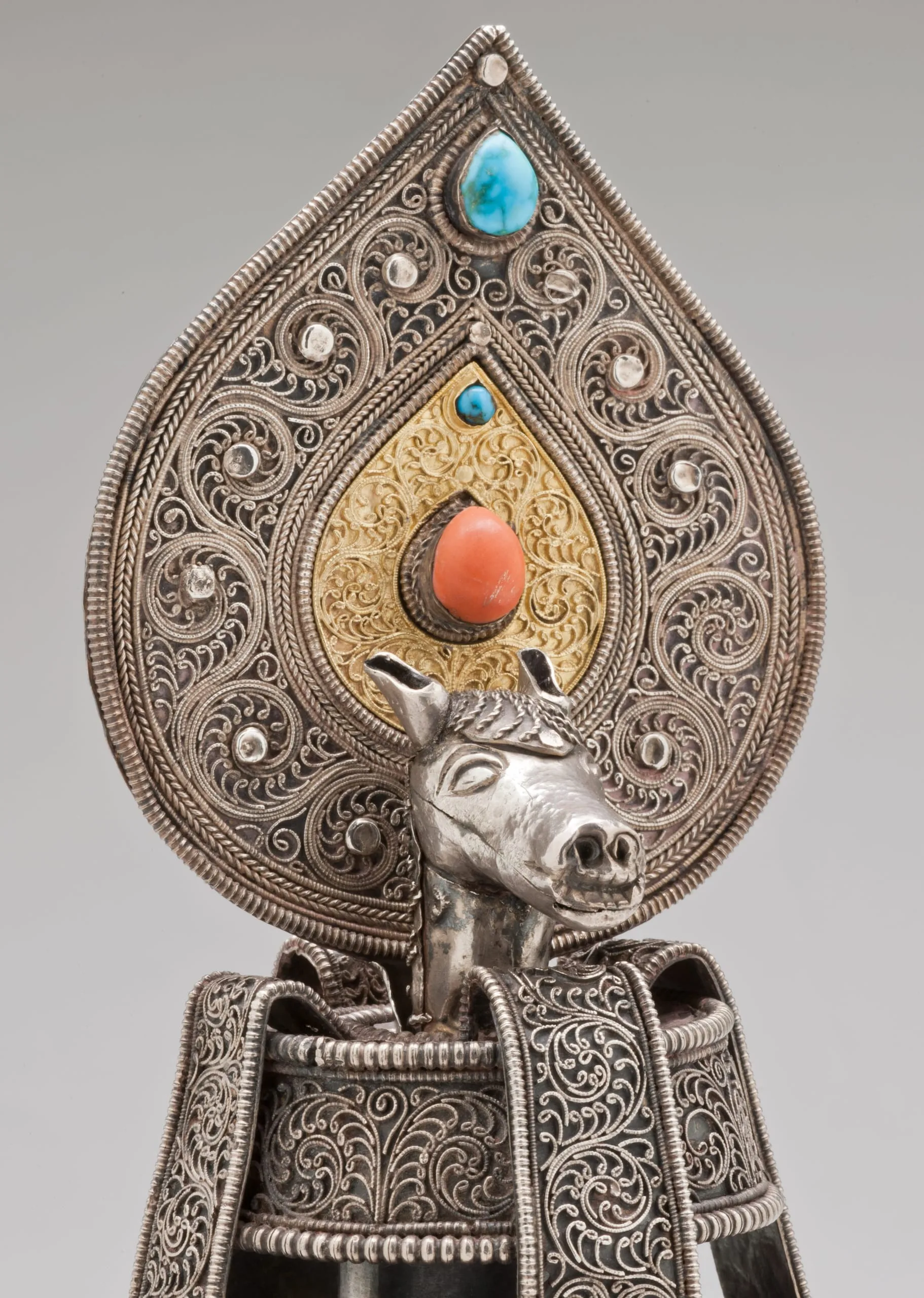
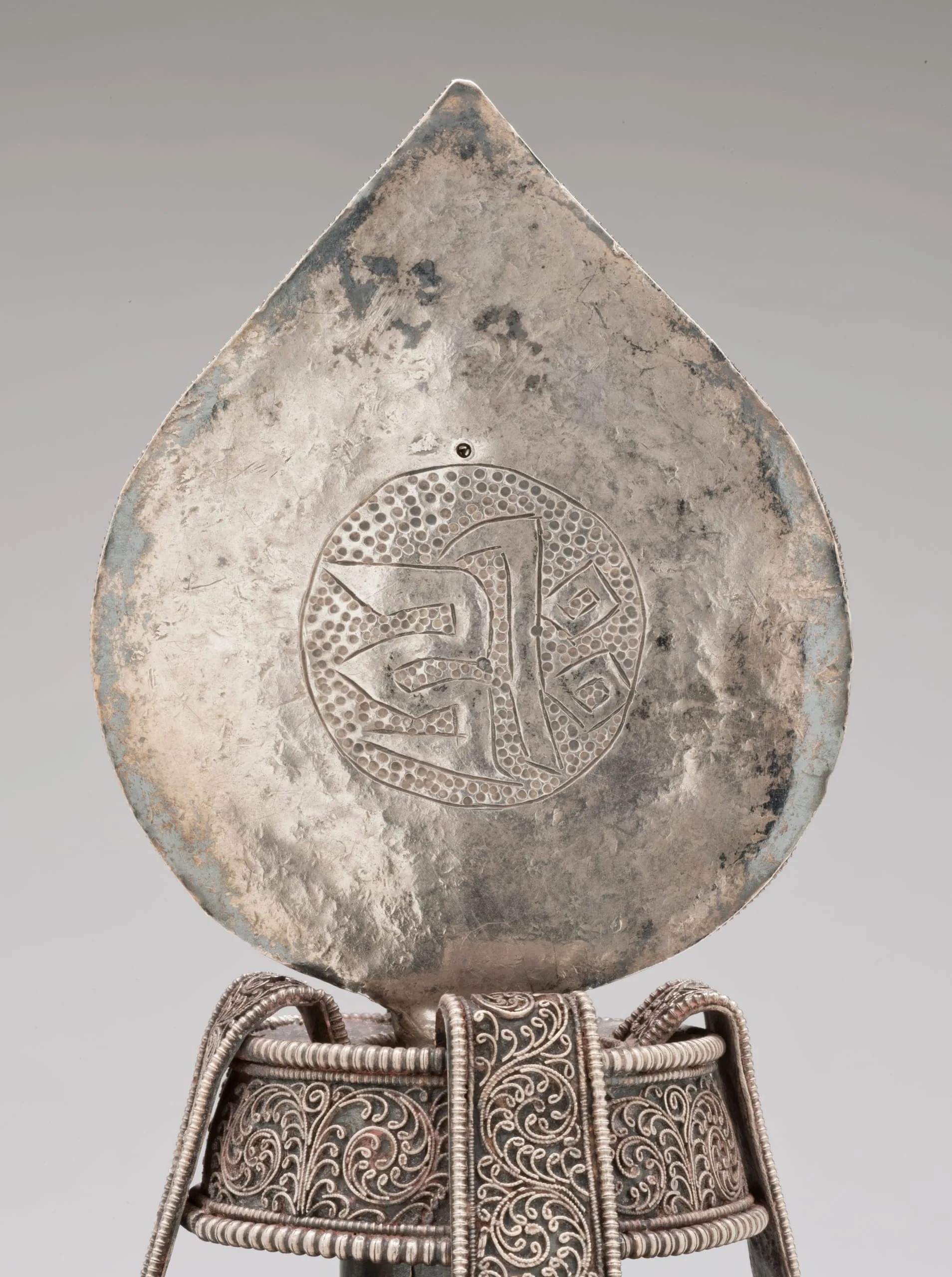
The base has a bulbous body adorned with garlands. It is supported by a splayed foot resting on an elevated stand. Issuing out of the vase’s tapered horizontal cap are four silver filigree cascading pendants symbolizing the overflowing of the nectar of immortality. Protruding from the mouth of the vase is the head of a Wind-Horse, a symbol of well-being. The wish-fulfilling Precious Jewel is a teardrop-shaped finial. It is enriched with delicate silver and gold filigree in floral scrolls and inset with coral and turquoise. On the reverse of the finial is a stylized Sanskrit character representing a mystical "seed syllable" (bija) that embodies the spiritual essence of the particular mantra invoked.
- Selected Bibliography
- Little, Stephen, Tushara Bindu Gude, Karina Romero Blanco, Silvia Seligson, Marco Antonio Karam. Las Huellas de Buda. Ciudad de México : Instituto Nacional de Antropología e Historia, 2018.
- Little, Stephen, and Tushara Bindu Gude. Realms of the Dharma: Buddhist Art across Asia. Los Angeles: Los Angeles County Museum of Art, 2025.