Wilhelm Trübner (1851-1917) is sometimes labeled a German Impressionist. Yet his facture, his manner of handling paint and brush, never went so far as to dissolve physical forms into purely optical effects, the way it does in Impressionism. Rather, Trübner’s attention to the atmospheric variability of nature came out of the tradition of Munich plein-air painting: Trübner began to study art in 1869 at the Akademie der schönen Künste in Munich, which at the time was the undisputed art capital of Germany. Outside of the academy, he also quickly became involved with the circle of artists around Wilhelm Leibl, a group of painters with anti-academy leanings who were greatly influenced by the French Realist Gustave Courbet, and devoted to Courbet’s brand of naturalism. The artists of the Leibl circle (which also included Hans Thoma, whose painting The Spring LACMA acquired in 2008) focused on portraits, still lifes, and landscape compositions. They also developed a notion of "pure painting," in which color and formal qualities were their primary focus, outweighing the requirements of traditional subjects and conventional composition schemes.
Trübner was primarily a figure painter. He created ambitious scenes from history and literature, but also genre compositions and portraits, notably an extraordinary series of life-size plein-air equestrian portraits. Arguably, however, it is in Trübner’s landscape paintings, more modest in scale and subject, that his sense of experimentation and innovation is most consistently realized.
Trübner turned to landscape painting in the early 1870s, joining his friend Carl Schuch in exploring various locations around Munich. One of his favorite sites became Lake Chiemsee, already in the nineteenth century a popular tourist destination in Upper Bavaria. Trübner first visited the Chiemsee in 1873, but over the years returned numerous times to paint a series of views on the lake’s two main islands, Frauenchiemsee and Herrenchiemsee.
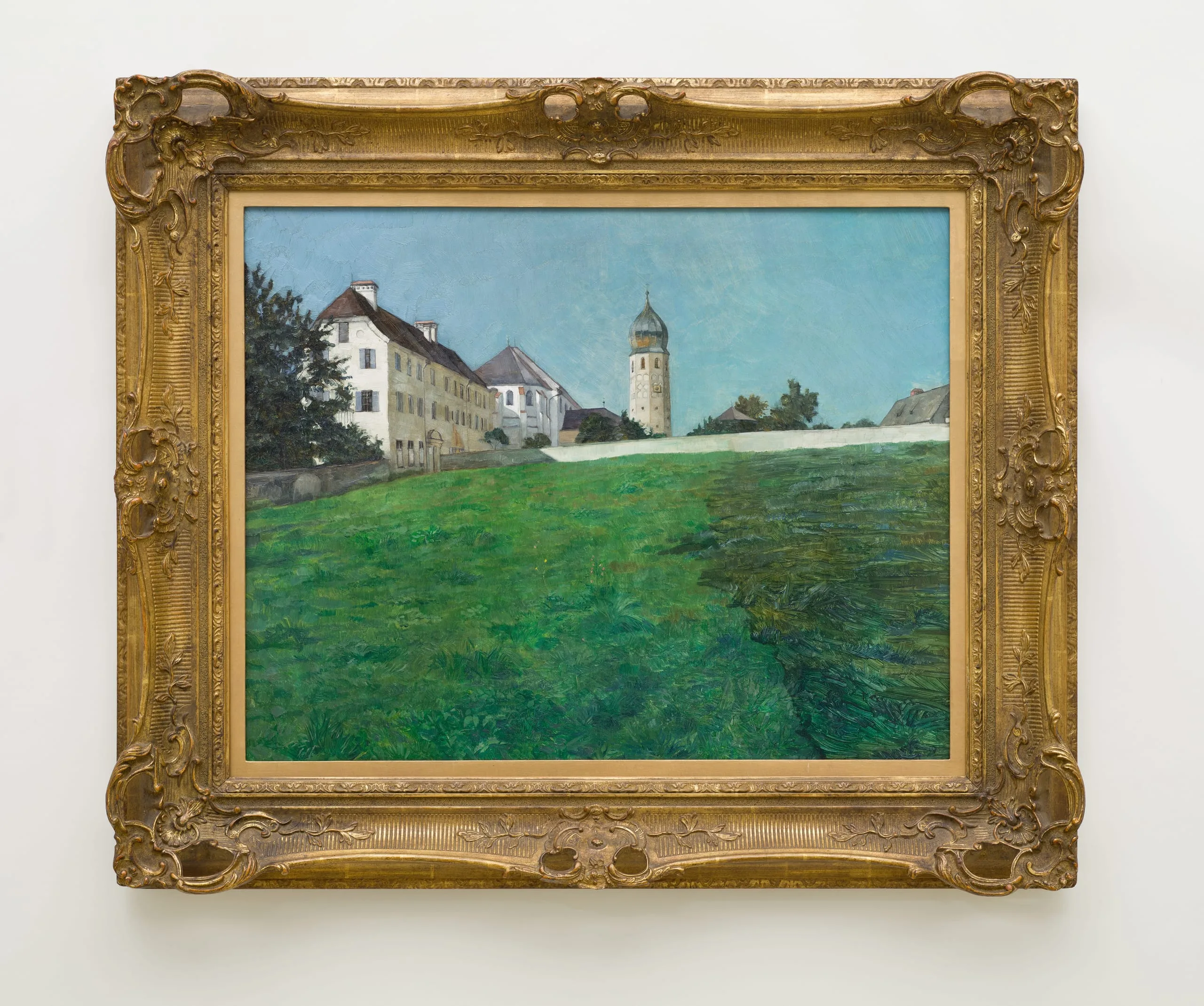
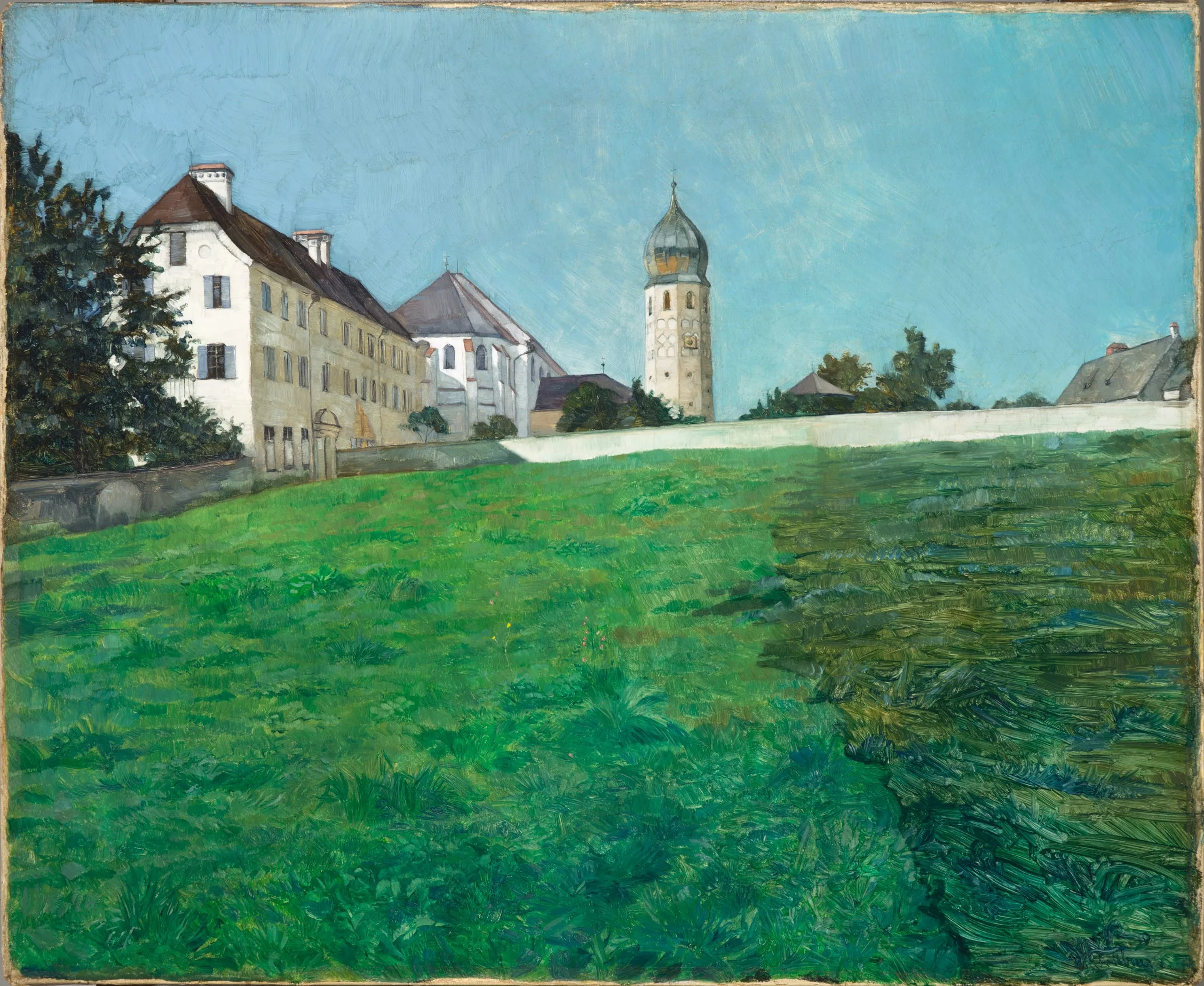
The 1891 painting Frauenchiemsee is one of two that depict the same striking vista of the Benedictine convent on the island; its sturdy bell tower and white buildings are seen from a low vantage point across an expansive meadow. The convent was founded in the eighth century and rebuilt in the early eighteenth century. In the early nineteenth century it was secularized, but reinstated by King Ludwig I in 1836. Dedicated to girls’ education, the convent buildings are still in use, looking very much like they do in Trübner’s painting.
However, Trübner’s composition is not a picture postcard. Avoiding the conventions of the picturesque mode, it offers an original, painterly take on the scene. The picture’s most striking features are the idiosyncratically dramatized perspective and the vigorously brushed foreground, behind which the motif itself, the historic site, seems almost incidental. Trübner’s earlier tonal palette, so typical of the Leibl circle, now has given way to a brighter, more intense range of colors, and his technique has taken on a characteristic steady rhythm of short, straight strokes that generate the pictorial structure. The brilliant play of colors – blue against white against bright green and dark green – and the energetic but fluid gesture are his primary subject.
A first glance at Frauenchiemsee may bring to mind the art of Vincent Van Gogh, particularly in respect to the almost abstract brushwork in the meadow’s darker half, where vivid green paint is lushly applied wet-in-wet. The meaning of this darker zone is unclear: it might be read as the shadow of a cloud overhead or the effect of a wind gust flattening long grasses; or, very possibly, as a mainly formal device intended to heighten the visual and expressive force of the picture – something Van Gogh would have understood. However, although Trübner had been in Paris in 1879 and 1889 for the Universal Expositions (even participating in the 1889 Exposition and garnering an honorable mention), there is no indication that he was even aware of the Dutch artist. At the time, Van Gogh’s work was still very rarely shown and virtually unknown even in Paris. Much more so in Germany, where a first exhibition of Van Gogh’s paintings, at the Galerie Paul Cassirer in Berlin, was a revelation in 1902. Trübner, who in the course of his career, published several essays about contemporary art in general and his own painting in particular, did not deal with Van Gogh at length until an article in 1915. Tellingly, he there ranked Van Gogh as a genius of only the second order: an outstanding, highly gifted colorist, who, however, in Trübner’s estimation, fell sadly short in the area of technical proficiency, lacking the skill to create a sense of form. Undoubtedly, this assessment reveals less about Van Gogh than about Trübner’s own position as a painter in the early twentieth century: as a modern colorist who eschewed the strict descriptiveness of academic art; but also did not subscribe to impressionism’s dissolution of form, or to expressionism’s subjective distortion.
Claudia Einecke, Associate Curator, European Painting & Sculpture (2011)