Ai Weiwei has established himself as one of the most intriguing and thought provoking artists of the early twenty-first century. Born in 1957, to a poet father whose leftist leanings led to the family spending the 1960s in Siberia, Weiwei early in his career thought of art as a means of getting away from politics, but also as a means of expressing himself as an individual. After his father’s “rehabilitation” and the end of the Cultural Revolution, the family returned to Beijing in 1976, where the young Weiwei was part of the Stars Group, which believed each of their members to be a star in direct confrontation to communist uniformity. Having obviously put himself in the way of politics, as had his father, Weiwei embraced another exile, though voluntarily this time, spending most of the 1980s in New York until returning to Beijing in 1993, when his father fell ill – and four years after Tiananmen Square. Back in Beijing, Weiwei helped establish the experimental art community, the East Village, which also included the artists Ma Liuming and Zhang Huan, whose work recently came into the collection as a donation from Audrey Irmas. Since then, Weiwei has become increasingly well-known and his work constantly probes and pushes boundaries, aesthetically and politically, and often explores the role of the individual in society.
Amidst his activism, work as an architect – he was a collaborator with Herzog de Meuron
on the “Bird’s Nest,” China’s Olympic stadium in Beijing, in 2008 – and busy studio practice that includes projects around the world, Weiwei also continues to make objects – the real heart of all his artistic endeavors.
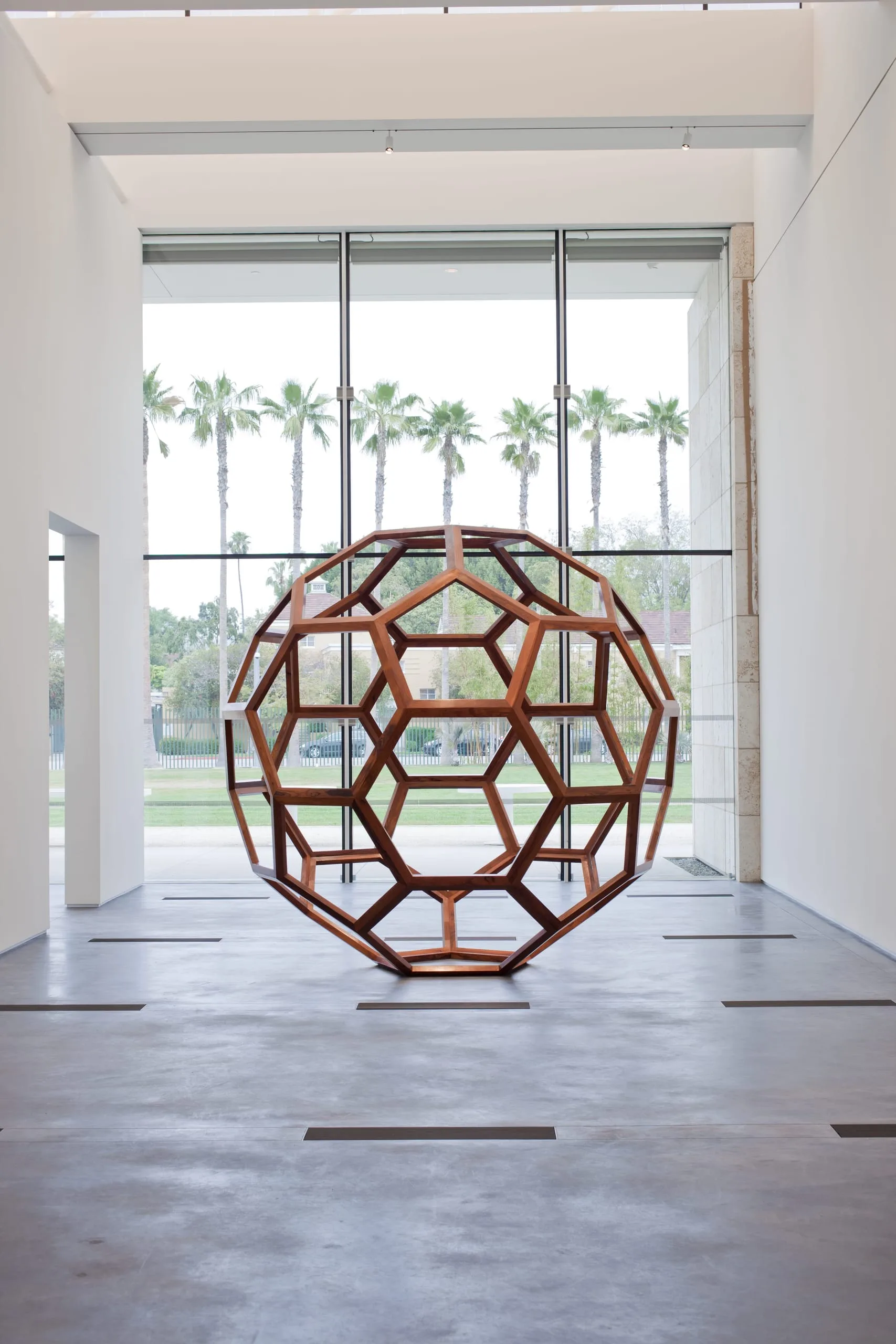
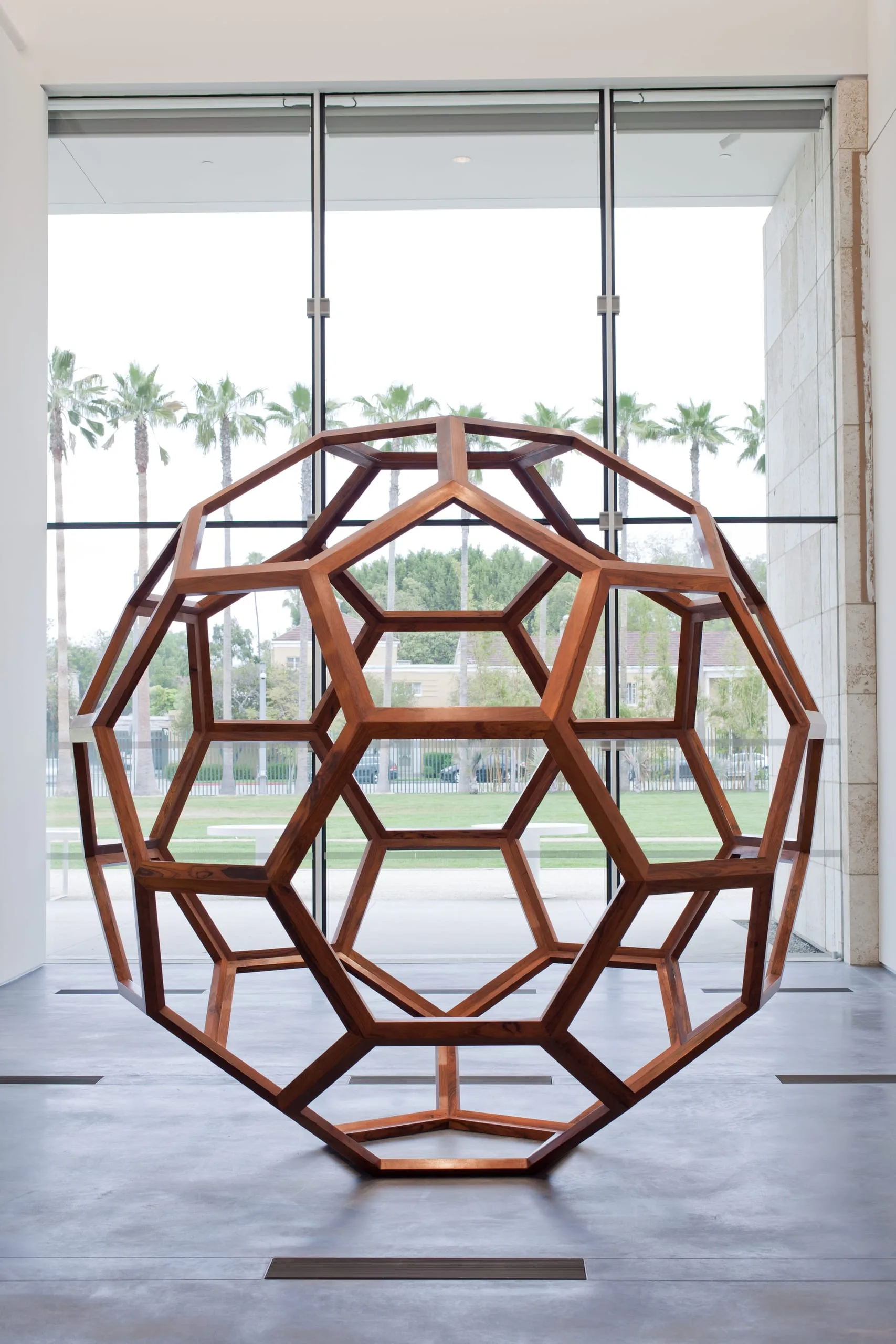
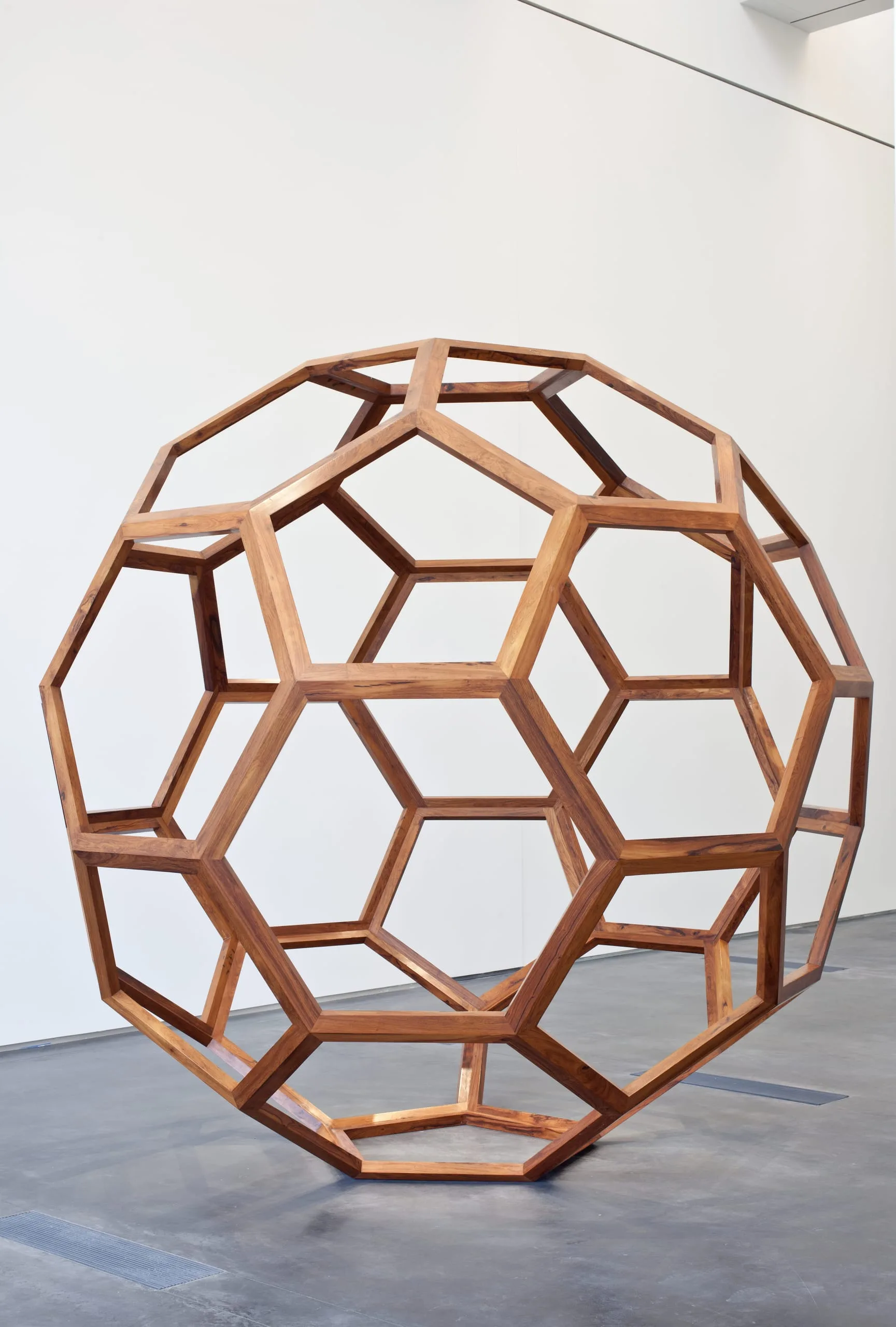
Crafted from Huanghuali wood, a fine Rosewood used to make furniture during the Qing
Dynasty, Untitled, Divine Proportion is made by a carefully crafted tenon and mortise technique perfected during the Ming (1368-1644) and Qing Dynasties (1644-1912). This nail free joinery technique achieves a seamless connection of surfaces regardless of thickness or placement of wood. Crafted to withstand time, as earlier pieces were in this mode, Untitled, Divine Proportion evokes the past though it is built for the future.
A collector and connoisseur of Chinese antiquities, Weiwei is fond of using “found objects,” in his own work. While this practice began when he was in New York, his return to Beijing in 1993 inspired him to turn to Chinese cultural materials and artifacts as an integral part of his art making process. Untitled, Divine Proportion employs the material and technique most associated with the historical past, in order to explore the object in the present. While the type of wood and the way it is used recalls the making of the utilitarian objects of an earlier era, Weiwei’s contemporary work of art is thoroughly of our moment. In its formal simplicity – probably the most common form in diverse societies around the world – and its title, the artist presents us with a contemplative object hinting at a spiritual dimension. Is it a globe, a ball or just an abstracted work in the form of circle? Looking at closely at the artist and his work, it is safe to say that the ambiguity and double duty performed by the object makes it a successful and beautiful work of art. “Overturning practical function transforms [Weiwei’s] pieces into inoperative but strangely elegant mutations that reintroduce the conceit of ornament and ritual back into the domain of art,” Charles Mereweather wrote. (Franklin Sirmans, The Terri and Michael Smooke Department Head and Curator of Contemporary Art)