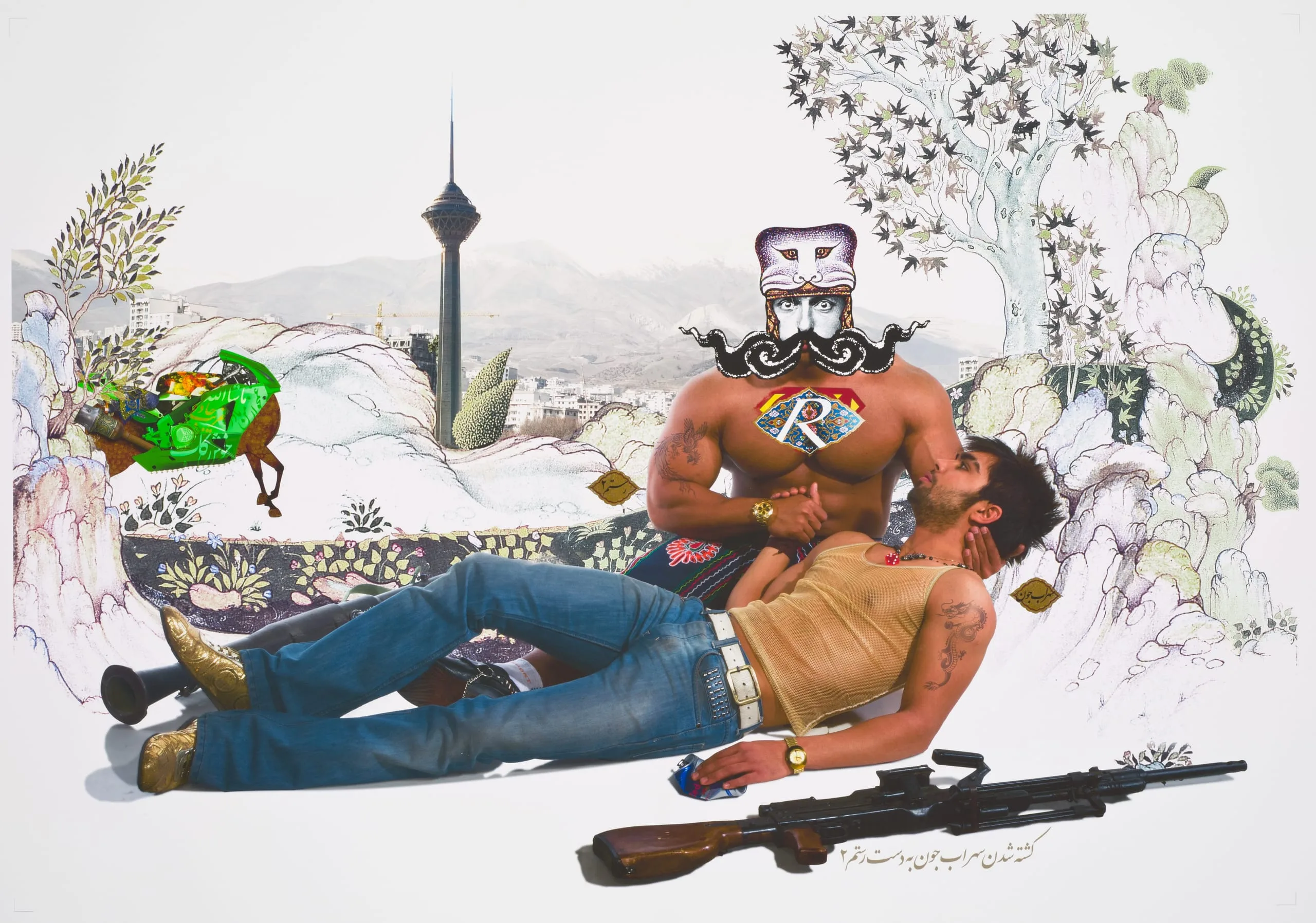
In his ingenious mixed-media series "Rostam 2 – Return," the Iranian artist Siamak Filizadeh transports the mythical Persian hero Rostam into the context of the present day. Riding a souped-up hybrid vehicle—half horse, half motorcycle—Rostam 2 performs his deeds of valor against the backdrop of twenty-first-century Tehran. Filizadeh has cleverly and seamlessly refashioned this ancient account, enacted across four generations and set amidst tragedy, romance, and heroism, in much the same manner as director Baz Luhrmann modernized Shakespeare’s Romeo and Juliet in the 1996 film version. But in his retelling of this classic Persian tale from the Shahnameh or Book of Kings, the Iranian national epic, Filizadeh bypasses its universalities in favor of more specific social commentary. As with other literary masterpieces, the Shahnameh has an appeal and an elasticity that has allowed successive generations to discover or invent new meanings.
In what would seem to be the culminating act, set within a charming, traditional Persian landscape with a flowing river, Rostam 2 cradles the head of his dying son; the motorized loyal Rakhsh waits nearby. In the background is the Burj-i Milad, the tallest structure in Tehran, completed in 2008 as part of the international trade and convention center. Far below, Sohrab clutches his father with one hand and with the other he gently reaches for a crushed can of Red Bull as though pointing us to the real source of his downfall. Rostam 2 looks toward the viewer, his face, as always, a mask.