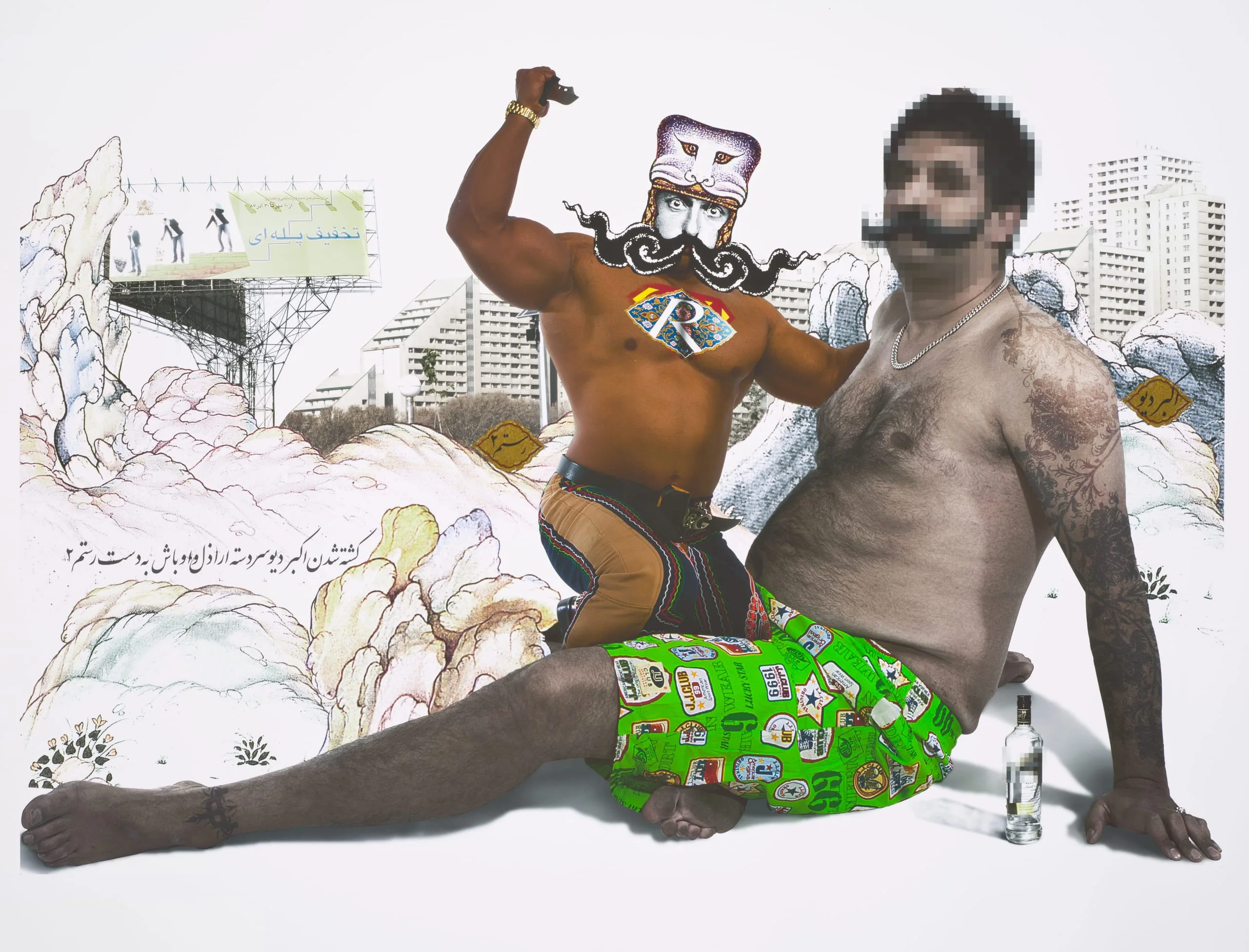
In his ingenious mixed-media series "Rostam 2 – Return," the Iranian artist Siamak Filizadeh transports the mythical Persian hero Rostam into the context of the present day. Riding a souped-up hybrid vehicle—half horse, half motorcycle—Rostam 2 performs his deeds of valor against the backdrop of twenty-first-century Tehran. Filizadeh has cleverly and seamlessly refashioned this ancient account, enacted across four generations and set amidst tragedy, romance, and heroism, in much the same manner as director Baz Luhrmann modernized Shakespeare’s Romeo and Juliet in the 1996 film version. But in his retelling of this classic Persian tale from the Shahnameh or Book of Kings, the Iranian national epic, Filizadeh bypasses its universalities in favor of more specific social commentary. As with other literary masterpieces, the Shahnameh has an appeal and an elasticity that has allowed successive generations to discover or invent new meanings.
Rostam 2 is shown subduing a giant div or demon. In contrast to the menacing depictions of supernatural divs in historical Shahnameh illustration, this large, curly-haired and mustachioed fellow wears colorful "JJ Club American Sportswear" trunks and sits back in a leisurely manner, as though enjoying a day at the beach. According to the caption, he is one of Tehran’s drug dealers. Unlike Rostam 2’s buff and nearly hairless torso, the div’s untoned and hirsute belly hangs over his waistband; a bottle of vodka is near at hand, perhaps further signaling the div’s debased nature, while his face is pixilated as though to hide his true identity. The background is filled with apartment blocks and billboards, suggesting the close proximity of the city.