- Title
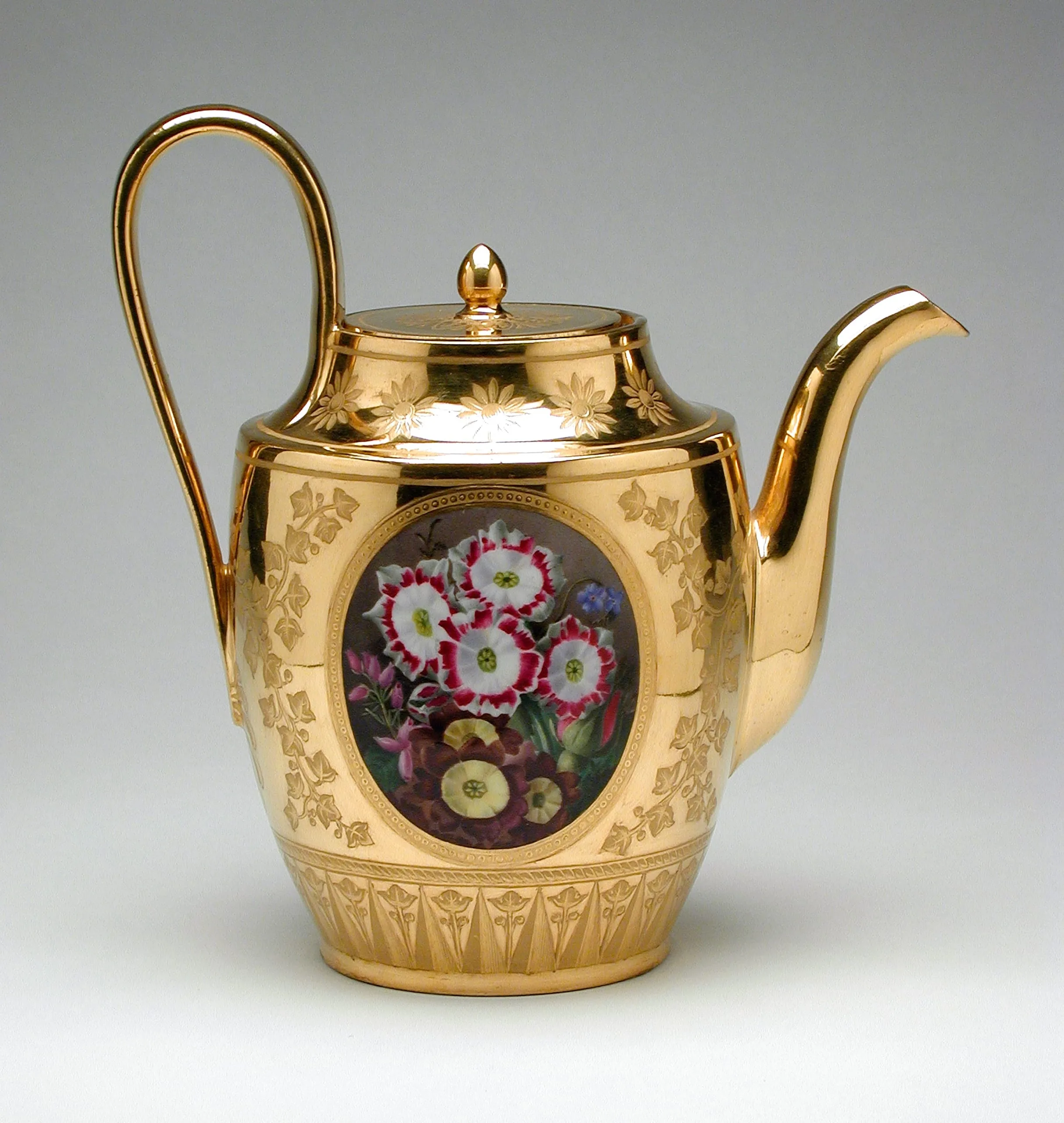
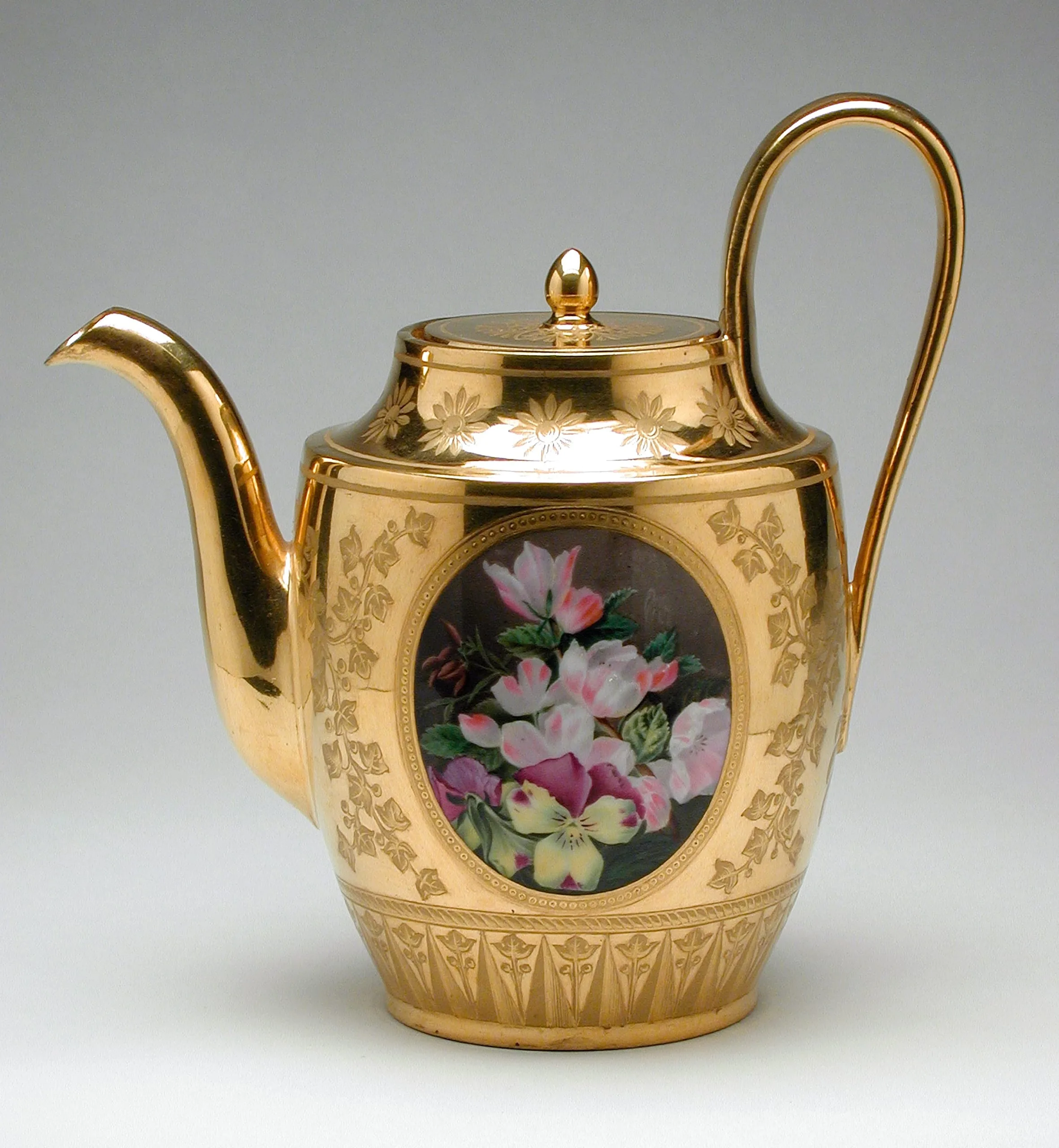
- Coffee Pot and Cover
- Date Made
- 1812-1813
- Medium
- Porcelain with enamel, gilding, and glaze
- Dimensions
- Height at handle: 7 1/8 in. (18.1 cm)
- Accession Number
- 49.13.5.2a-b
- Curatorial Notes
Floral still-life painting reached its peak of popularity in the Netherlands in the seventeenth century. This still-life tradition was kept alive into the eighteenth and nineteenth centuries by Dutch and Flemish artists living in Paris. Among them was Georgius Jacobus Johannes van Os, the son and brother of well-known Dutch artists. After establishing a successful practice in Amsterdam, van Os moved to Paris, where between 1811 and 1815, and again from 1820 to 1822, he worked at the Sèvres Porcelain Manufactory as a specialist painter of flowers on porcelain. Van Os decorated each piece in this sumptuous tea service (see also 49.13.5.1, .3a-b, .4, .5a-b, and .6a-b) with finely observed flowers. Such gilded and hand-painted porcelain required great technical skill during firing to preserve the intricate design. The early nineteenth century saw a revival of interest in Dutch and Flemish still-life painting and a general preference for such highly refined technique. These trends coincided with the determination of the Sèvres factory director, Alexandre Brongniart, to promote the broad range of enamel colors he had perfected.
The tea service has an illustrious history. It was commissioned in 1813 by Napoleon and Empress Marie-Louise as a New Year’s gift for Napoleon’s sister Pauline Bonaparte, Princess Borghese.
- Selected Bibliography
- Hopkins, Henry T., ed. Illustrated Handbook of the Los Angeles County Museum of Art. West Germany: Bruder Hartmann, 1965.