- Title
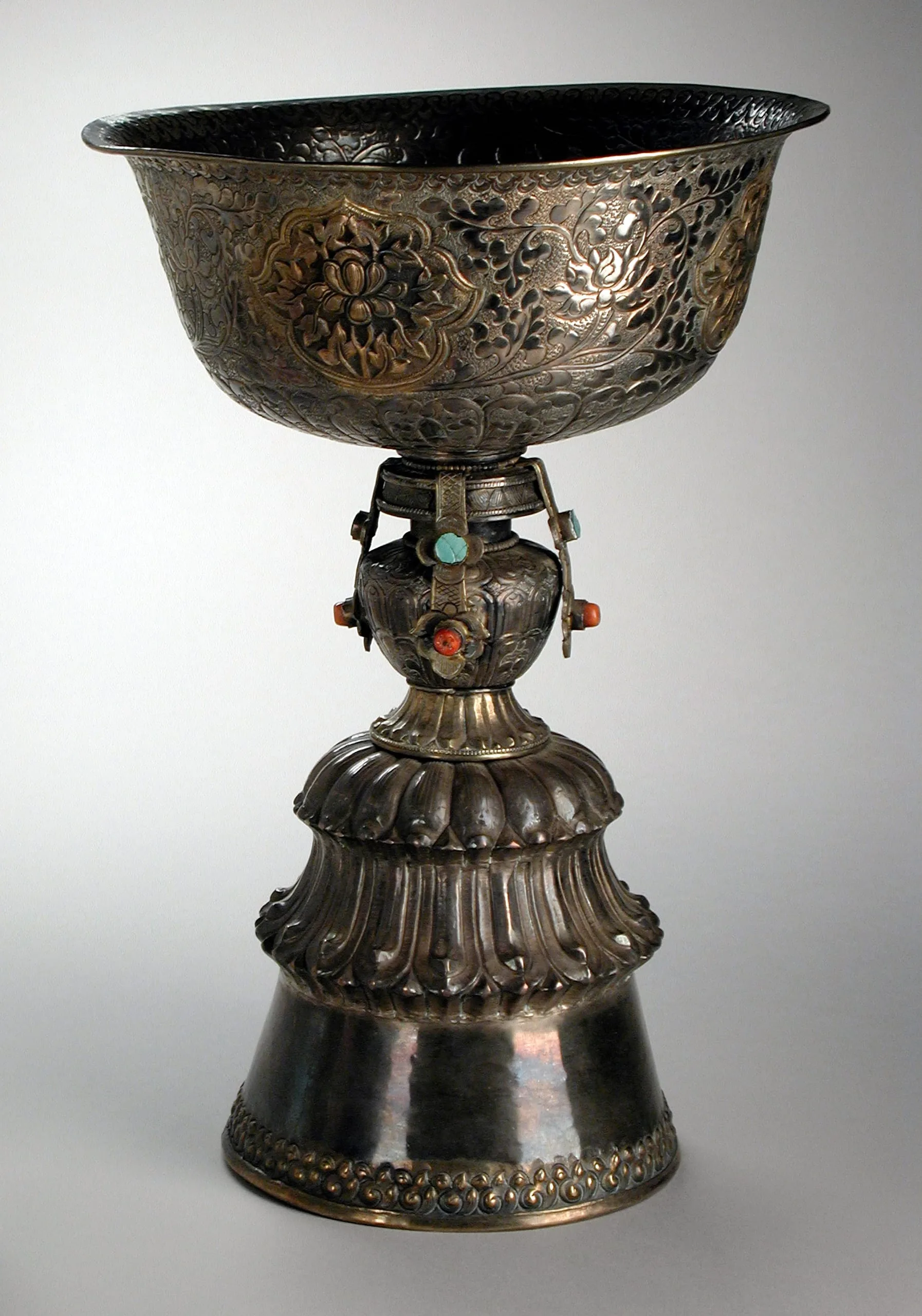
- Ritual Butter Lamp
- Date Made
- 18th century
- Medium
- Parcel-gilt silver, repoussé and cast; inlaid with turquoise and coral
- Dimensions
- 11 x 7 5/8 in. (27.94 x 19.37 cm)
- Accession Number
- M.78.23b
- Curatorial Notes
This butter lamp and its pair (M.78.23a) are quintessential accoutrements of Tibetan altars and domestic shrines. They are made in the form of a chalice used as elite Western secular goblets and as consecrated drinking vessels in Christian liturgical services. The chalice form was likely adopted from Central Asian Christian communities in the 7th-8th centuries. Yak butter is traditionally burned in Tibetan butter lamps during their ritual usage.
The butter lamps are made in three sections. The wide bowl on the top is embellished with exquisite repoussé lotuses with scrolling foliage and gilded lotuses in lobed cartouches. It has lotus petals encircling the bottom. The middle section is the Vase of Immortality (Tshe-bum; see M.83.2.1a-b) that is associated with Amitayus, the Buddha of Eternal Life (see M.84.32.5 and M.77.19.14). The vase is draped with four pendant banners inset with turquoise and coral. The vessel is supported by a quadripartite flaring pedestal foot. The connecting shoulders and upper two tiers of the base are bands of lotus petals.
- Selected Bibliography
- Pal, Pratapaditya. Art of Tibet. Los Angeles; Berkeley, CA: Los Angeles County Museum of Art; University of California Press, 1983.
- Pal, Pratapaditya; Dehejia, Vidya; Slusser, Mary Shepherd; Fisher, Robert E.; Brown, Robert L. Arts of Asia 15 (6): 68-125 (November- December 1985).
- Pal, Pratapaditya. Art of Tibet. Expanded edition. Los Angeles: Los Angeles County Museum of Art, 1990.