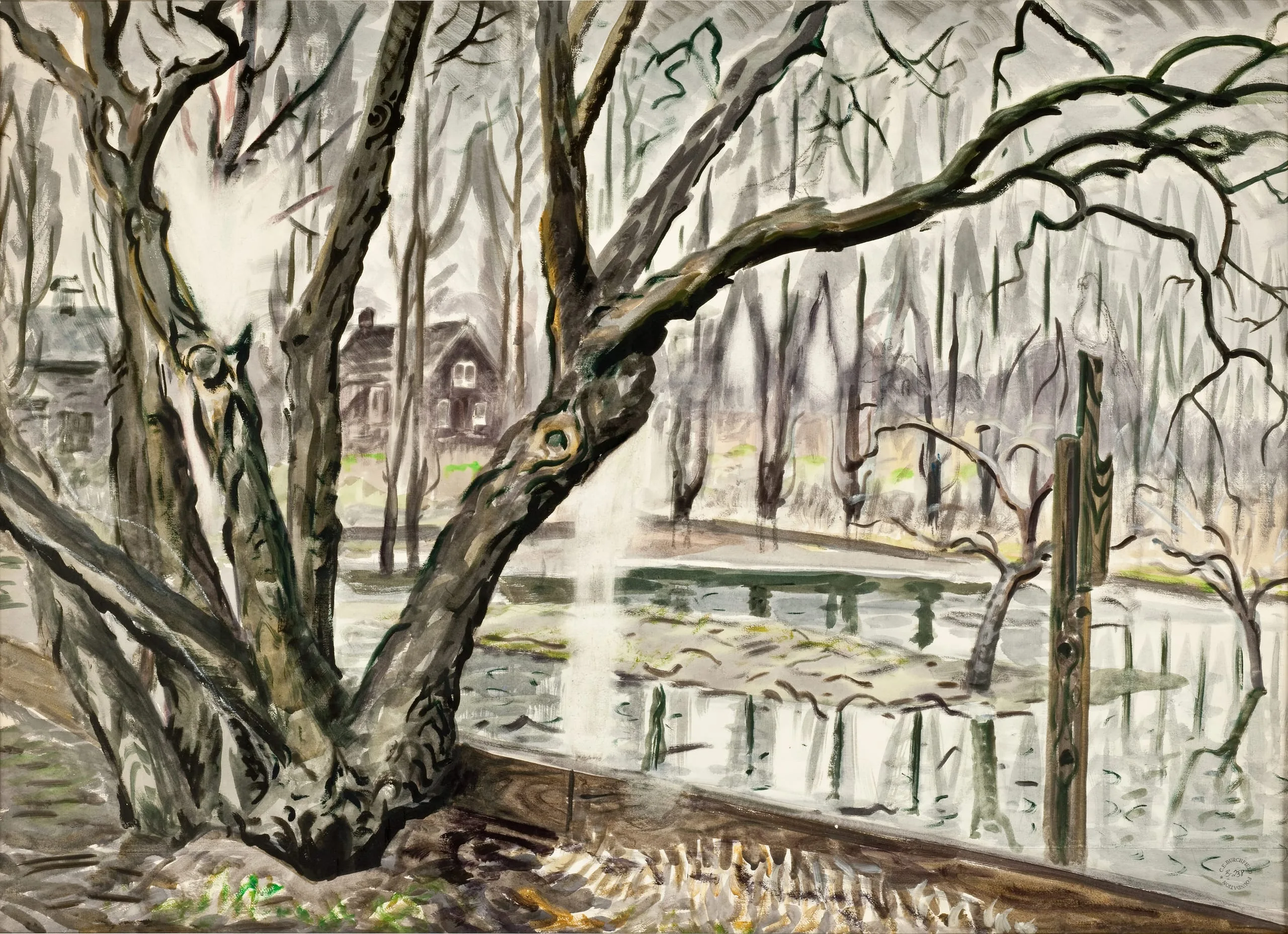
Painted on April 10, 1947, at the height of Charles Burchfield's career, Spring Landscape with Trees and Pond is an expressionistic, almost haunting image that epitomizes Burchfield's approach to painting seasons in transition—especially winter into spring, one of the central themes of his art. A sense of gloomy uncertainty tinged with anxious anticipation pervades the scene in which spare touches of bright green in the middle ground signal the gradual arrival of spring. The dense accumulation of arrow-point brushstrokes in the forested, roof-lined background merges into the foreground forms of tree trunks and branches and their reflection, creating a rich visual pattern and sense of vibration typical of Burchfield's best work, which also has a sonic quality. Specter-like white areas in the center of the painting and in the upper branches of the large tree at left appear to be deliberately scraped away rather than unfinished: traces of underlying forms can be detected through the roughened paper over which Burchfield very thinly layered diluted white gouache. These erasures evoke the mysteries of seasonal transformation.
A native of Ohio, Charles Burchfield specialized in painting watercolors that expressed extraordinary aspects of ordinary natural and urban environments. He is renowned for the ecstatic images of nature he began painting around 1917, his self-professed "golden year," his large scale paintings of the American scene, and monumental late paintings in which he revised and expanded his early work. Trained at the Cleveland School of Art, Burchfield settled permanently in Buffalo, New York in 1921, and worked for eight years as a designer for the prominent wall paper company, M.H. Birge & Sons, before devoting himself full time to his painting in 1929. His 1930 retrospective at the Museum of Modern Art in New York was the first single-artist retrospective ever held at the museum. "Burchfield's America," published in Life magazine in December 1936, cited the artist as one of the ten greatest painters in the country.