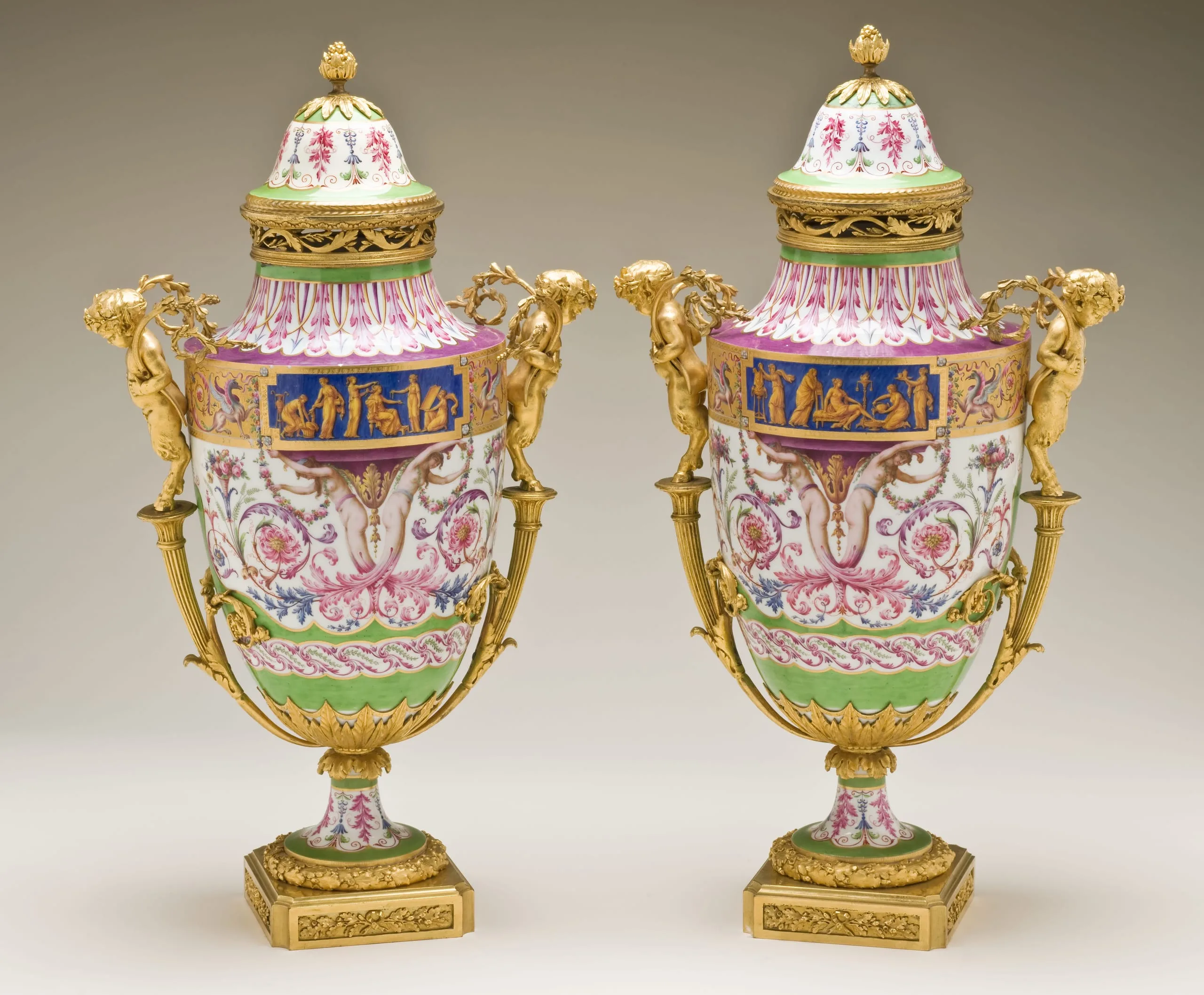
This pair of vases in the Louis XVI style represents the height of production at the royal Sèvres Porcelain Manufactory on the eve of the French Revolution. The porcelain painting and gilded bronze mounts are of exceptional quality. Terminating in chubby baby satyrs with profusions of scrolling foliage, the mounts were most likely made by Pierre-Philippe Thomire, who had recently become the manufactory’s supplier of bronze mounts. The mounts were designed to echo and complement painter Nicolas Sinsson’s delicate and colorful designs. The scrolls and vegetal motifs, characteristic of an arabesque style, were informed by Raphael’s ancient-inspired frescoes in the Loggia of the Vatican in Rome. Sinsson also painted friezes of gold figures against a dark blue ground following designs by the manager of the manufactory’s art department, Jean-Jacques Lagrenée, who was himself looking at published designs from ancient Greek vases. The bands of arabesque patterns painted on a ground of burnished gold, in which these friezes are set, demonstrate the extreme sophistication achieved by painters like Sinsson at Sèvres in the 1780s and 1790s. His payment for this work perhaps corresponds to an entry in the manufactory’s registers in September 1787, and it is possible the vases are one of two pairs listed in the sales registers soon afterward as being purchased on credit by the minister of foreign affairs (presumably as a royal diplomatic gift).
Formerly in the collection of Sir Arthur Gilbert (1913−2001), the vases featured in the LACMA exhibition The Stowe Vase: From Ancient Art to Additive Manufacturing, in 2016. The closest comparison is a pair of vases now in the Royal Collection in London that once decorated Louis XVI’s private apartments at the Palace of Versailles.
Rosie Mills, 2018
Edited by Cynthia Kok, 2025