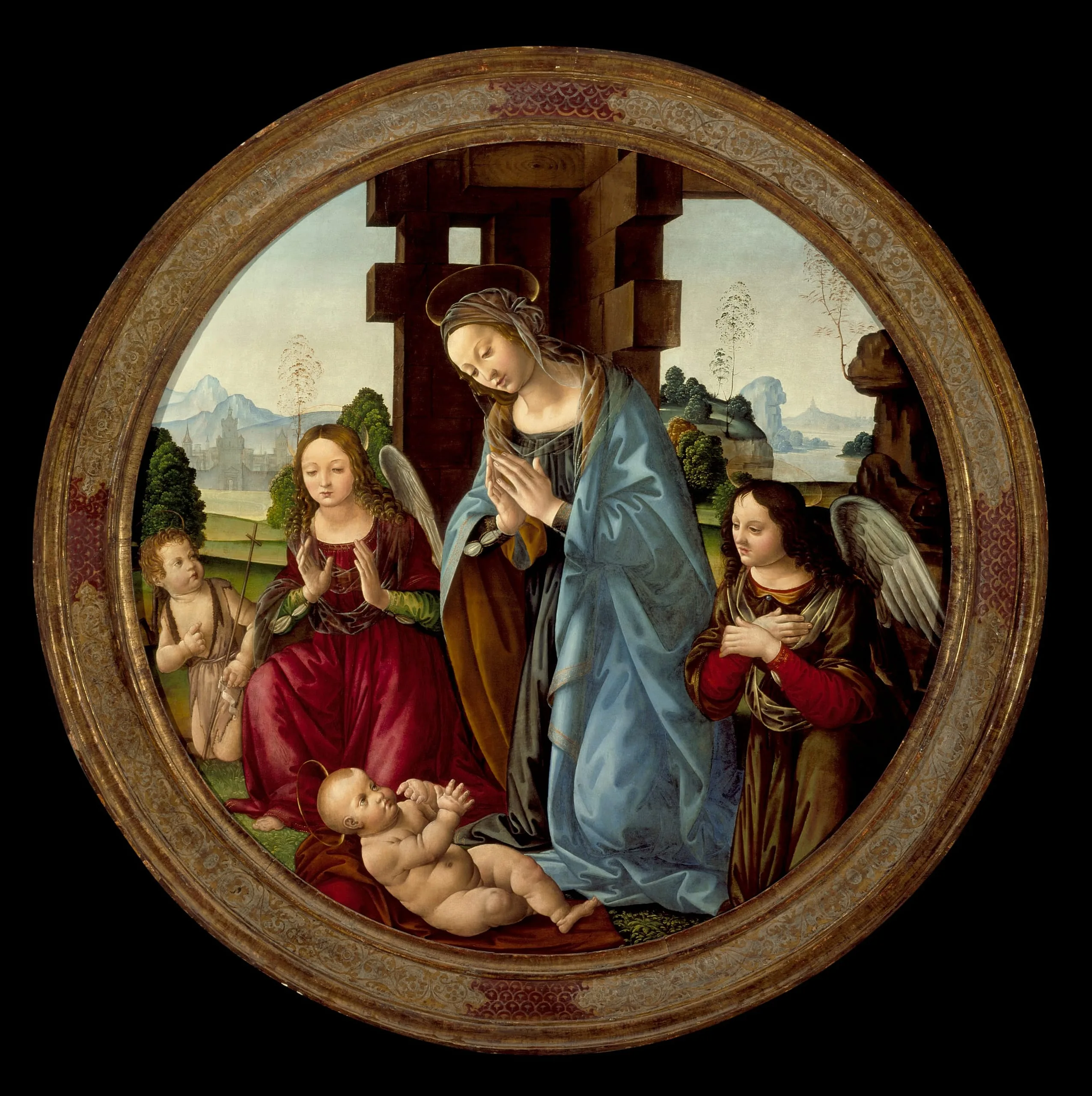
As if looking through a round window, this tondo, or circular painting, draws viewers into a moving scene. The Virgin Mary, accompanied by two angels, looks down adoringly at her son. The figures gesture expressively at the miracle before them—the birth of the living God. All three are dressed in luxurious fabrics dyed in vivid jewel-toned hues; a delicate translucent veil covers Mary’s fair hair. Rendered realistically as a healthy infant, the Christ Child reaches up to his mother. Off to the left, a young John the Baptist, dressed in a ragged brown costume foreshadowing his hair shirt and role as a religious ascetic, points toward Mary and the angels as if to direct a devotee’s gaze. He also holds a cross in reference to Christ’s later Crucifixion. According to the Gospel of Luke, John was the first to recognize Christ as the Messiah, an understanding that came in the womb when his mother Elizabeth met with the pregnant Virgin Mary.
Both the tondo format and depictions of the Madonna and Child were popular in Renaissance Florence, especially for domestic spaces, as evinced by personal inventories and surviving artworks. Workshops relied on standardized designs that they could adapt and vary depending on market demands or client needs. This appears to be the case with work attributed to “Tommaso,” a nickname given to the anonymous artist responsible for this piece. He likely apprenticed with Lorenzo di Credi (c. 1456–1536), a celebrated artist active in Florence who had trained alongside Leonardo da Vinci and Perugino. Scholars hypothesize that Tommaso oversaw the commercial output of Lorenzo’s studio, producing multiple tondos like this one for the city’s elite. In the early sixteenth century, Florence was home to many wealthy families involved with finance and commerce who cultivated the arts. At the same time, the city also experienced religious turmoil, with preachers like Savonarola warning against the spiritual danger of excessive luxury, resulting in the destruction of artworks. Paintings like this one had to strike a balance between honoring sacred subject matter, suiting the tastes of patrons, and maintaining a sense of decorum.
2024