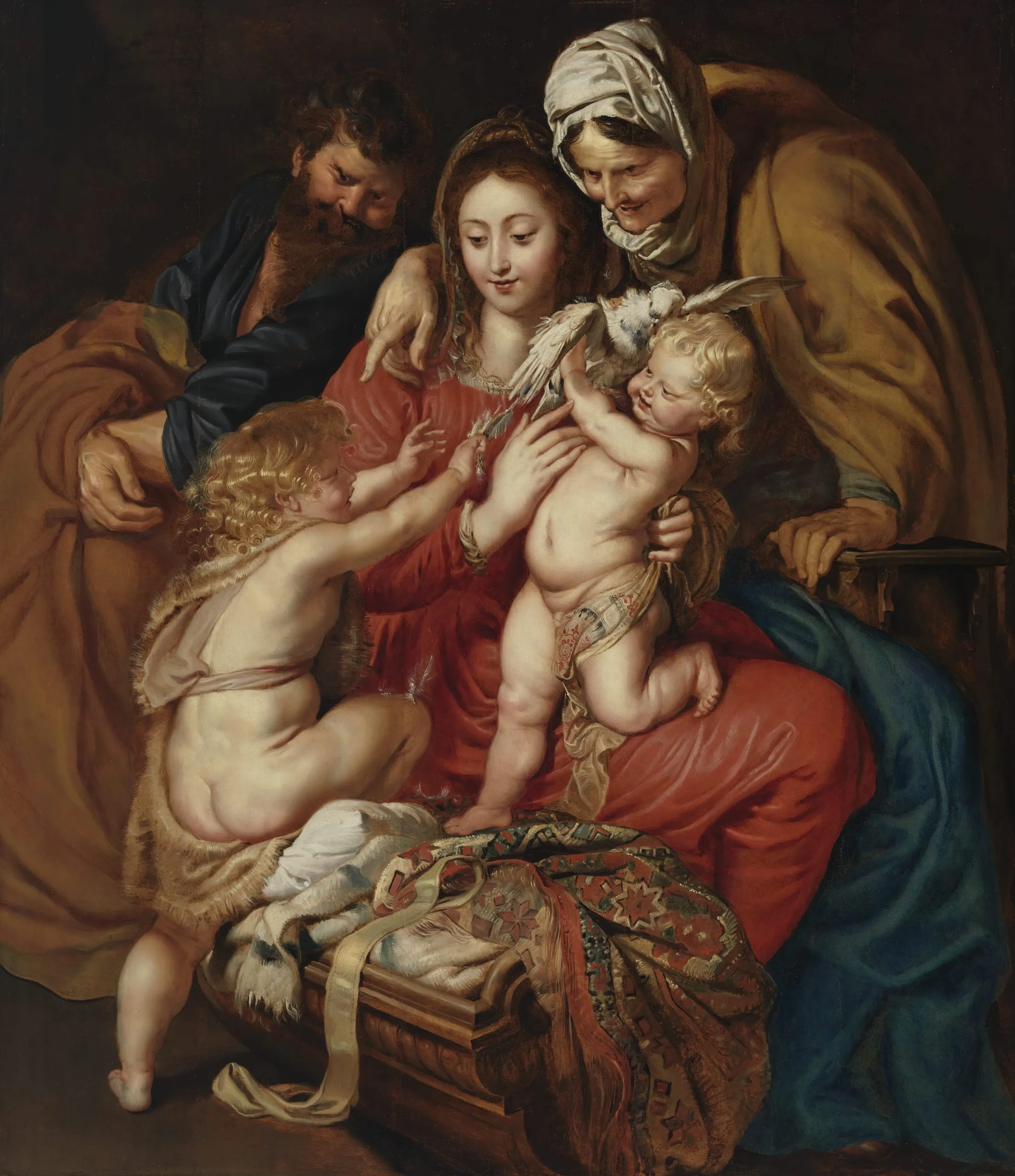
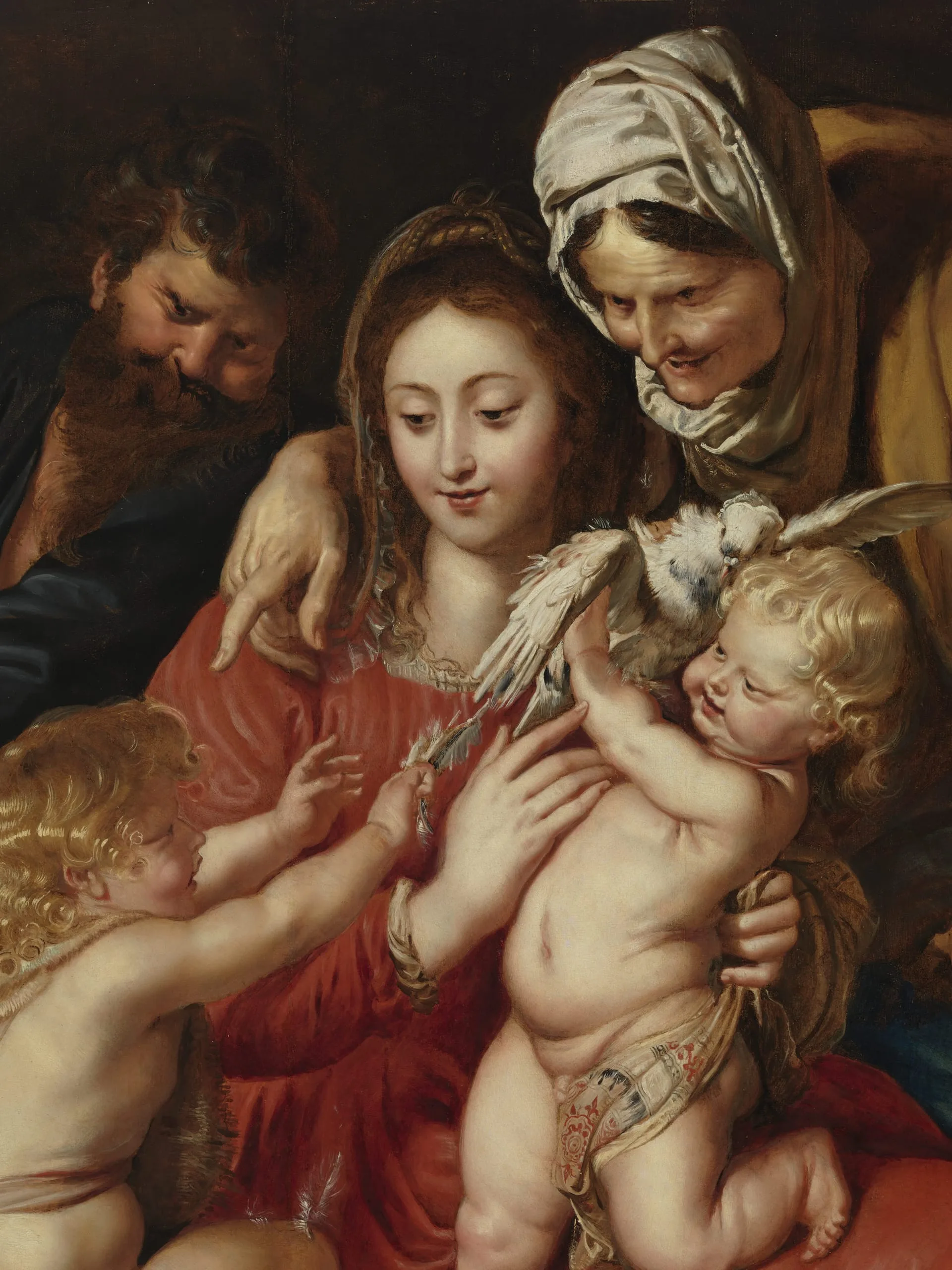
Five closely arranged figures create a dynamic composition of the Holy Family. The Christ Child, with a bent leg supported on the Madonna’s lap, forcefully pulls a dove from the hands of Saint John the Baptist. Hovering above are Saint Elizabeth, John’s mother, and Saint Joseph, Mary’s husband, both amused by the children at play. The iconography, however, unveils a somber undertone to the seemingly innocent scene. The dove—a symbol of the Holy Spirit—alludes to Christ’s impending sacrifice. The infant Christ’s step toward the wood cradle further foreshadows his eventual entombment.
This painting was completed shortly after Peter Paul Rubens’s return to Antwerp from his formative sojourn in Italy. Having primarily worked in Mantua, Genoa, and Rome from 1600 to 1608, he became well acquainted with the works of renowned figures such as Raphael from Rome and Correggio from Parma, evident in the composition of The Holy Family. Rubens also chose to incorporate Islamic textiles to adorn the infant Christ and his cradle, underscoring his awareness of the sixteenth-century use of Islamic carpets and robes in portraiture and religious paintings in both northern and southern Europe. Specifically, Rubens emulates an early Islamic tiraz textile, suggested by the pseudo-kufic inscription that drapes Christ’s lower body. This smart addition, which would often be interpreted as a method of ostentation, may in fact hint at the artist’s early self-fashioning as a knowledgeable and itinerant figure in early modern Europe. After all, The Holy Family was completed in the early years of Rubens’s impressive career, during which he would serve as a linguist, diplomat, scholar, court artist, and—at one point—a peacemaker between England and Spain.
2024