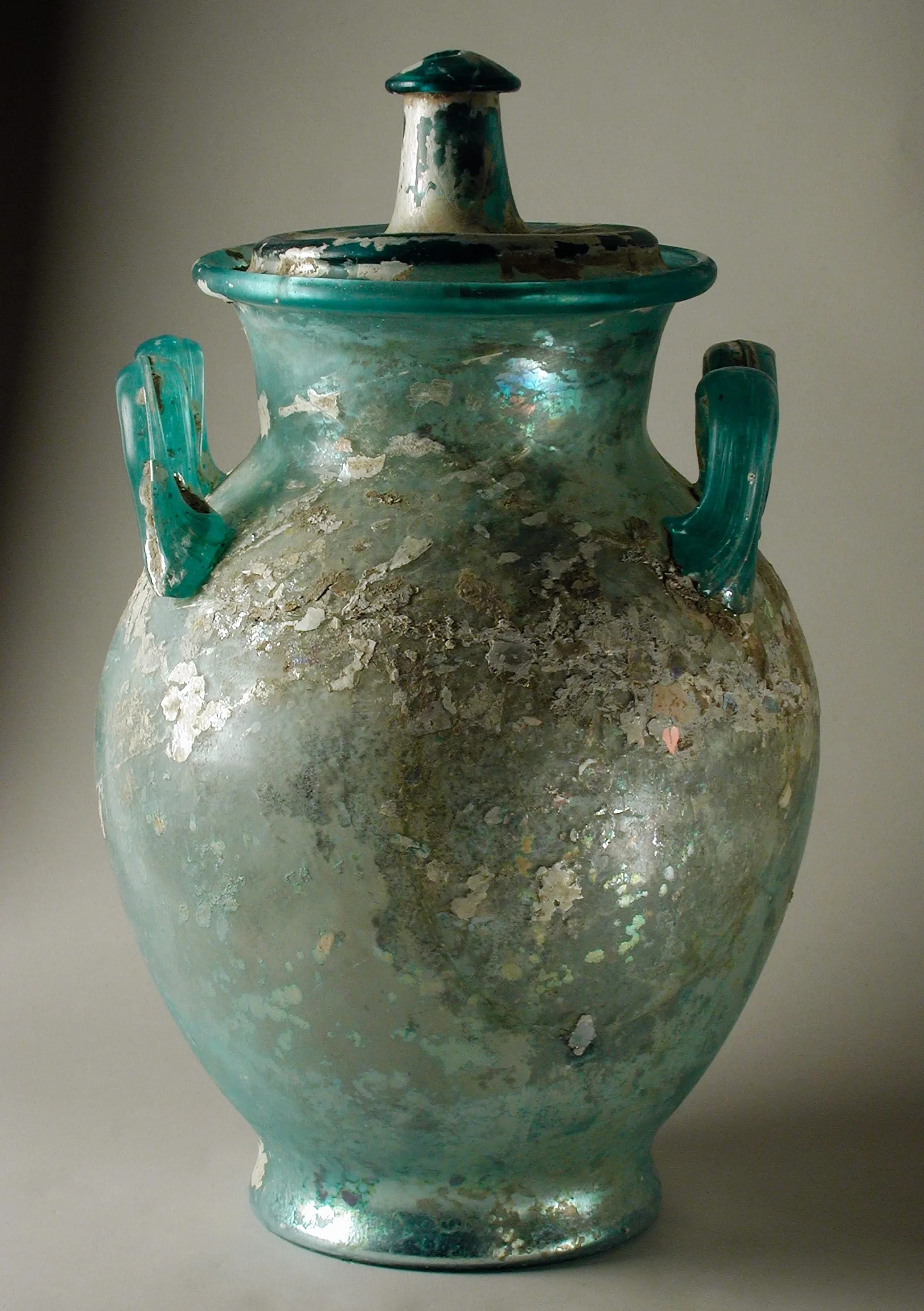
This urn of free-blown, blue-green glass was used as a cinerarium, a place in which the deceased’s cremated remains were laid to rest. Cremation was the norm in the Roman world until the reign of Hadrian (117−138 CE), when inhumation became more popular. The urn’s ovoid body and cylindrical neck somewhat resemble the hadra hydria, a type of vessel used for burials in the Greek world during the Hellenistic period (c. 323−30 BCE). The style seems to have had some influence even a century or two after its heyday, as indicated by our urn. Glass cinerary urns like this one tend to have a similar size and shape, but variations can be found in the forms of their lids and handles. This example has vertical, M-shaped handles set upon the shoulder. The circular lid has a tapered, cylindrical handle topped by a disk-shaped knob. A circular hole runs through the handle and lid and, when inverted, could have served as a kind of funnel, possibly to aid in pouring libation offerings into the urn and over the ashes as a means of honoring the deceased.
The iridescence and the brown and white patches are common to ancient glass and are the result of devitrification, the chemical decomposition of the surface. Although modern glass designers like Louis Tiffany and Johann Loetz Witwe admired and imitated devitrified glass in their work, such effects were not intended by ancient glassmakers.