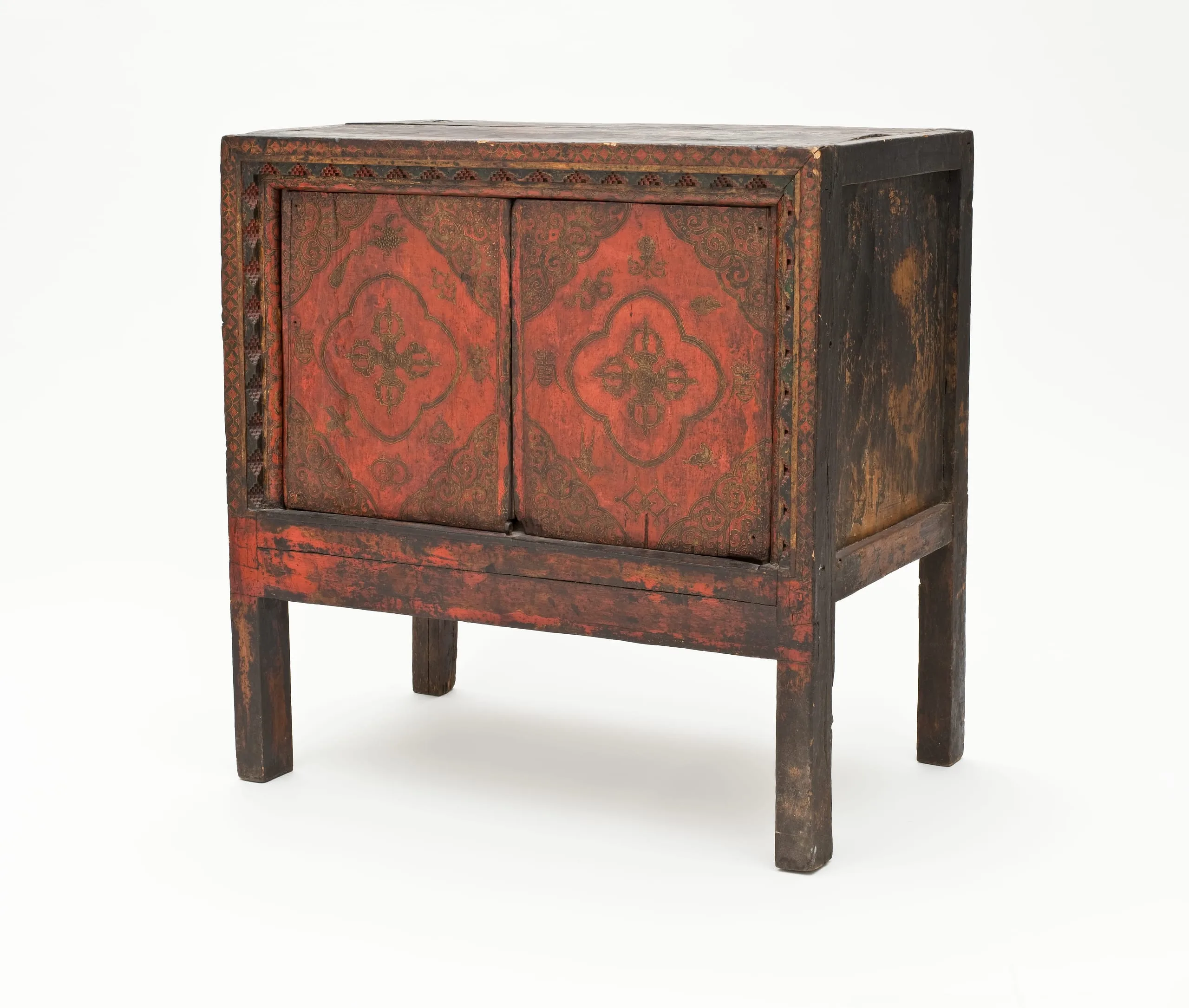
Cabinets, typically with doors on the front, were ubiquitous accoutrements in Tibetan monasteries and temples, as well as shrines and living rooms in many private homes. They were widely used to store myriad objects, including both religious and mundane items. See Luca Corona and Camilla Hulse Corona, "Tibetan Furniture: Construction, Form and Function, in David Kamansky, ed., Wooden Wonders: Tibetan Furniture in Secular and Religious Life (Pasadena: Pacific Asia Museum and Chicago: Serindia Publications, 2004), pp. 41-44.
This two-doored cabinet features a subtle color palette of a brownish red background with now-faded gold ornaments made of raised gesso (kyungbur). The principal design element on each door is a double thunderbolt or double dorje (vishva vajras) centered in a lobed cartouche. The wide band between the cartouches and the scrolling corner designs has five of the seven auspicious royal gems (sapta ratna) that served as insignias for the ancient South Asian cultural concept of the Universal Monarch (chakravartin). Spread across the lower half of the left and right doors, they include the square earrings of the minister, round earrings of the queen, triple-eyed gem (tri ratna), stylized crossed swords that were the Chinese insignia of the military general, and the pair of elephant tusks. The remaining two auspicious gems, the branch of coral and the unicorn or rhinoceros horns, are omitted. In the upper half of the wide bands are the five sense offerings and their symbols: sound (lute), taste (fruit, wild strawberries), touch (scarves), smell (conch shell containing perfumed water), and sight (mirror; see M.87.211). There is also an indeterminate symbol or jewel resembling conjoined trefoils. At the horizontal positions midway are four repeated Chinese characters of shou (long life). The door frame has an inner border of mini cubes (chötseg). The outer border on the topboard and sideboards is embellished with a series of painted coin motifs. The topboard and sides are now unadorned. See Robert Beer, The Encyclopedia of Tibetan Symbols and Motifs (Boston: Shambala Publications, 1999), p. 165, pl. 79 and pp. 194-204, pls. 92-95.