LACMA

ShopMembershipMyLACMATickets
LACMA
Los Angeles County Museum of Art
5905 Wilshire Blvd.
Los Angeles, CA 90036
info@lacma.org
(323) 857-6000
Sign up to receive emails
Subscribe
© Museum Associates 2025

Museum Hours

Monday

11 am–6 pm

Tuesday

11 am–6 pm

Wednesday

Closed

Thursday

11 am–6 pm

Friday

11 am–8 pm

Saturday

10 am–7 pm

Sunday

10 am–7 pm


  • About LACMA
  • Jobs
  • Building LACMA
  • Host An Event
  • Unframed
  • Press
  • FAQs
  • Log in to MyLACMA
  • Privacy Policy
© Museum Associates 2025
Collections

Unknown
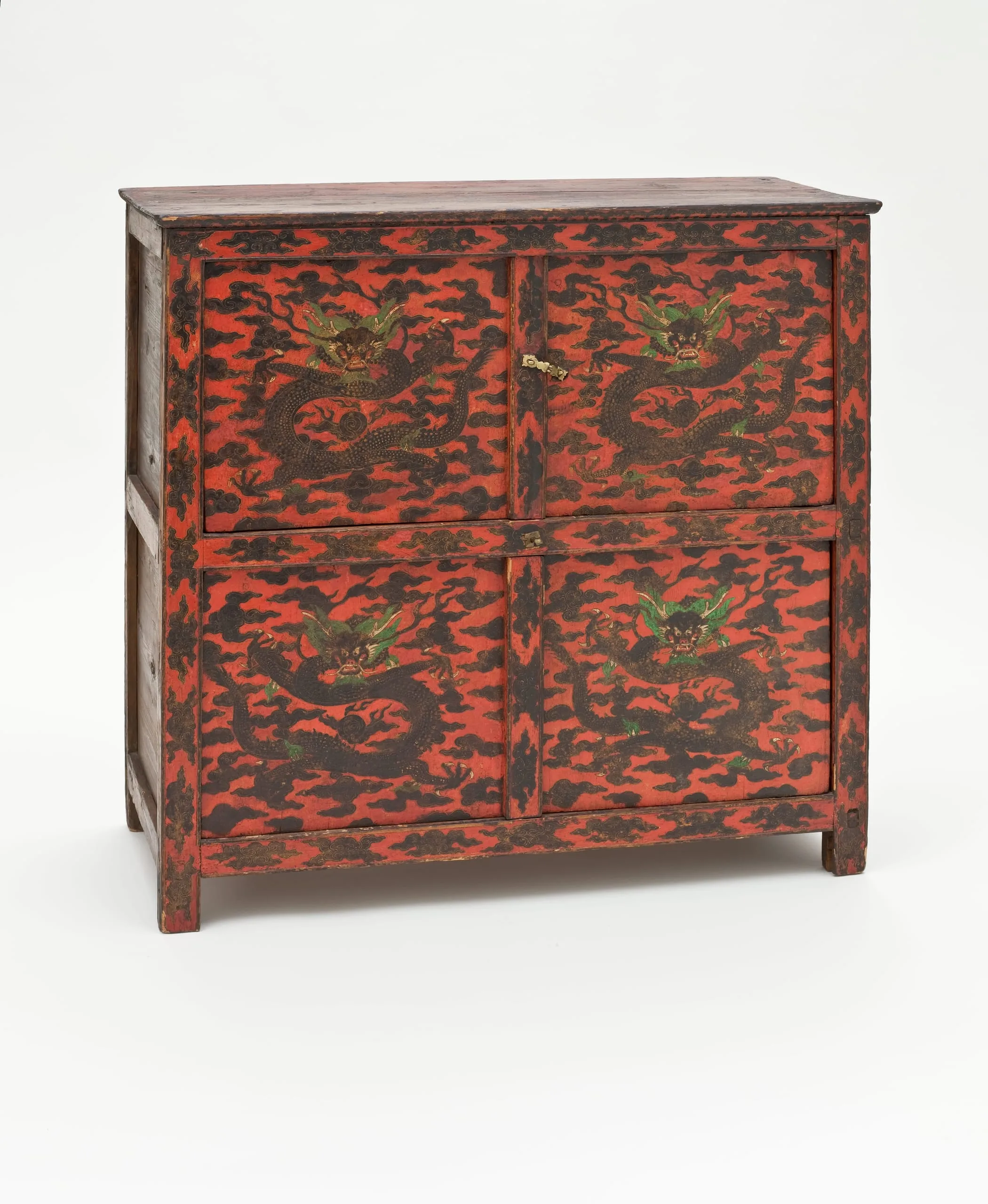
Cabinet with Dragonslate 19th century

Not on view
Painted wooden cabinet with vermilion red ground and allover dark cloud pattern, each of four front panels decorated with a sinuous dragon in dark brown and green
Artist or Maker
Unknown
Title
Cabinet with Dragons
Place Made
Tibet
Date Made
late 19th century
Medium
Wood with mineral pigments, gilding, and gesso; brass fittings
Dimensions
40 x 39 1/2 x 18 in. (101.6 x 100.33 x 45.72 cm)
Credit Line
Gift of Ruth Hayward, Ph.D. and Robert Hayward, M.D., in honor of Michael Govan, LACMA CEO and Wallis Annenberg Director, with appreciation for his informed and inclusive vision of art for the city and people of Los Angeles, through the 2010 Collectors Committee
Accession Number
M.2010.78.11
Classification
Furnishings
Collecting Area
South and Southeast Asian Art
Curatorial Notes

This cabinet and its mate M.2010.78.12 each display four four-clawed dragons in primarily black paint and gesso set in square panels on the front divided by right-angled molding strips. The undulating tales of the dragons are symmetrically positioned so that the top two dragons alternate with the bottom two dragons. The dragon heads are painted green, red, and white. The background and borders are floating clouds painted in black with gold outline. Both cabinets have a brass locking hasp and a brass fitting in the center of the borders that is probably a support pole for inner shelves. See David Kamansky, ed., Wooden Wonders: Tibetan Furniture in Secular and Religious Life (Pasadena: Pacific Asia Museum and Chicago: Serindia Publications, 2004), pp. 294-295, nos. 115-116.