- Title
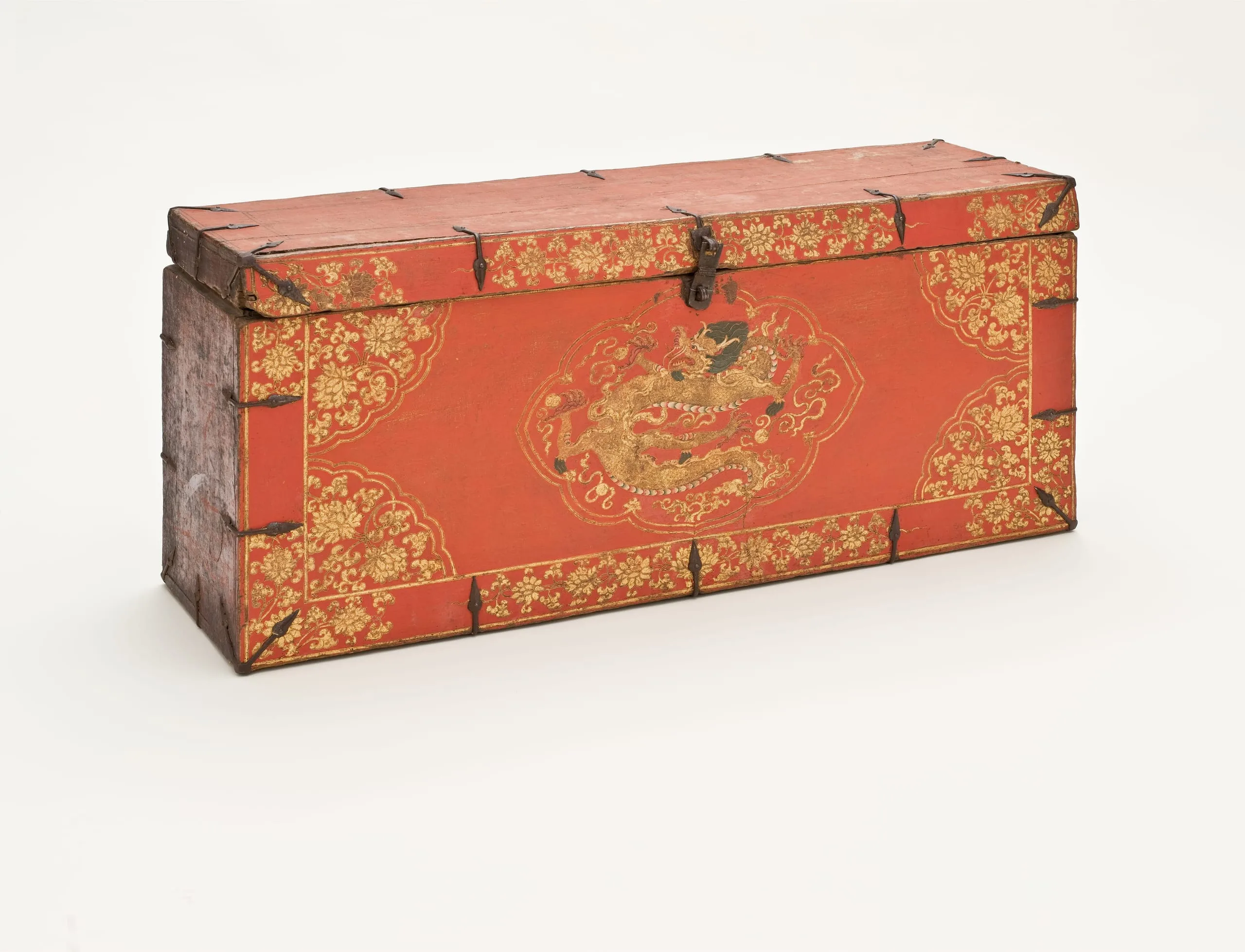
- Trunk with a Five-Clawed Dragon
- Date Made
- circa 1650-1700
- Medium
- Wood with mineral pigments, gilding, and gesso on cloth; metal fittings
- Dimensions
- 17 1/2 x 39 1/2 x 11 1/2 in. (44.45 x 100.33 x 29.21 cm)
- Accession Number
- M.2010.81.3
- Curatorial Notes
This radiant trunk is painted with gold decoration set against a red background made from cinnabar or vermillion. The central design on the front inside a lobed cartouche is a writhing five-clawed dragon with raised gesso scales and a rainbow pattern on its underbelly. Dragons with five claws were the exclusive symbol of the Chinese Emperor, signifying his supreme imperial authority. Four-clawed dragons were used for nobles and three-clawed dragons were appropriate for commoners. It is uncertain if this trunk was in fact associated with the emperor or if the five-clawed dragon was appropriated as an ornamental motif by the Tibetan artists. The front of the trunk has a scrolling floral border and floral corner designs. The top and sides are mainly plain with muted designs. Metal fittings reinforce the corners and edges of the trunk.
See David Kamansky, ed., Wooden Wonders: Tibetan Furniture in Secular and Religious Life (Pasadena: Pacific Asia Museum and Chicago: Serindia Publications, 2004), pp. 244-245, no. 67.