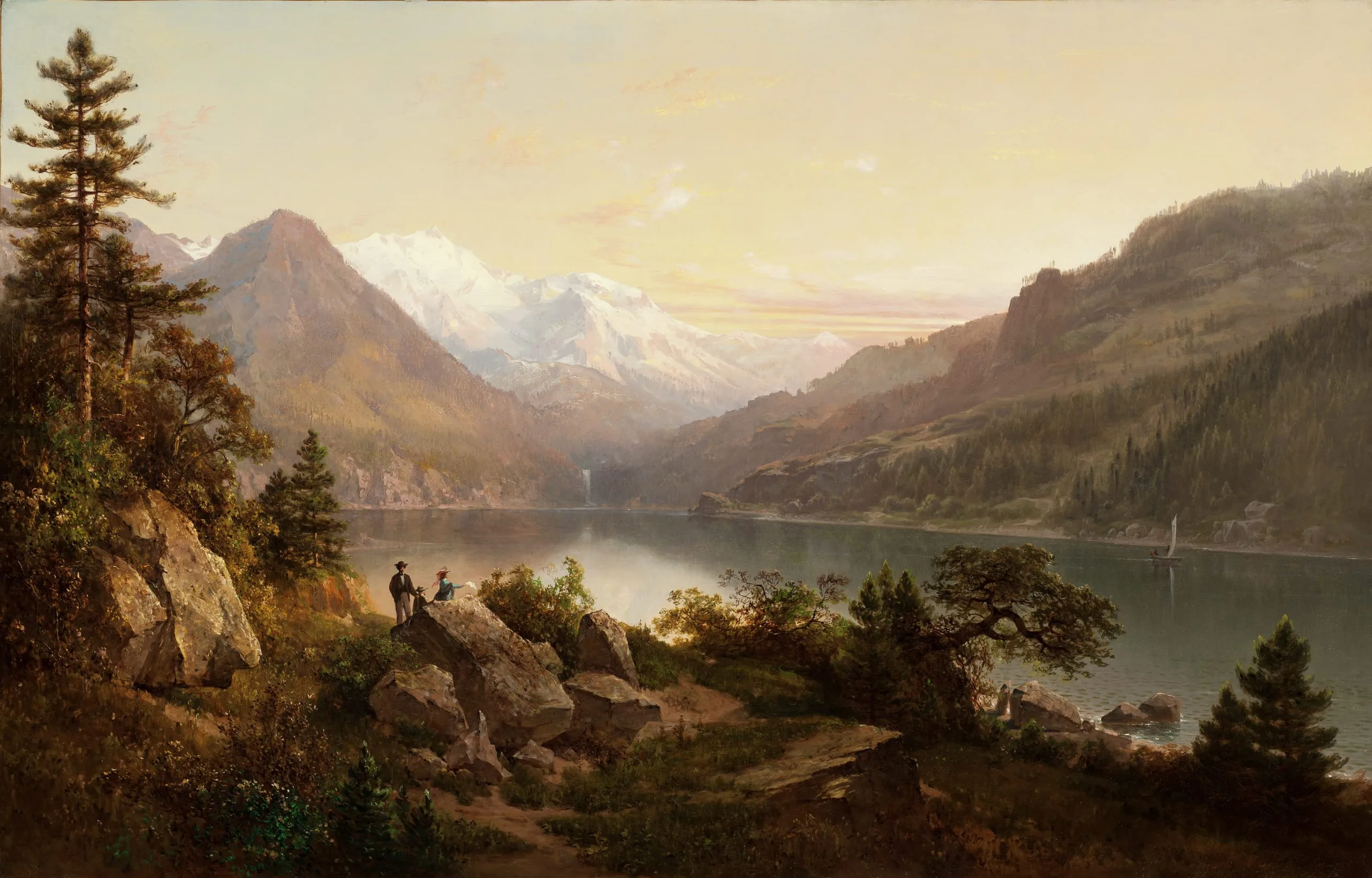
Thomas Hill is so firmly identified with views of Yosemite that this painting was long thought to depict a lake in Yosemite even though no lake of this size is to be found there. The liberties that Hill took with topography make it difficult to identify conclusively the sites of a number of his paintings, but the distinctive double-peaked hill at the left, known as Maggies Peaks, mark this painting as a view of Lake Tahoe, and the waterfall suggests Emerald Bay. The Daily Alta California of June 19, 1864, in the year the museum’s landscape was painted, mentioned that Hill exhibited a view of Emerald Bay of about the same size and also showing Maggies Peaks and the same sunset effect: ‘A beautiful bit of Emerald Bay, Lake Tahoe by T. Hill, was placed in the window of Jones, Woll [sic] and Sutherland. It is about 3’ x 4’, a sunset; the twin buttes (Maggies Peaks, at left) and snowy mountains in the distance are lit by the red rays of evening. The light and shade are forcible . . . ." By the mid-1860s, tourists, such as those depicted in this painting, were visiting Emerald Bay.
The museum’s painting apparently is the earliest dated California landscape by Hill. The artist is so much identified with California views it is easy to forget that he came west as an accomplished landscape painter who had sketched in the White Mountains of New Hampshire with Benjamin Champney (1817-1907), Asher B. Durand (1796-1886), and GEORGE INNESS, among others identified with the Hudson River school. Emerald Bay, Lake Tahoe is very much in the idiom of those artists.