LACMA

ShopMembershipMyLACMATickets
LACMA
Los Angeles County Museum of Art
5905 Wilshire Blvd.
Los Angeles, CA 90036
info@lacma.org
(323) 857-6000
Sign up to receive emails
Subscribe
© Museum Associates 2026
  • About LACMA
  • Jobs
  • Building LACMA
  • Host An Event
  • Unframed
  • Press
  • FAQs
  • Log in to MyLACMA
  • Privacy Policy
© Museum Associates 2026
Collections

Man's Breeches (Pantaloons)1820s

On view:
Geffen Galleries
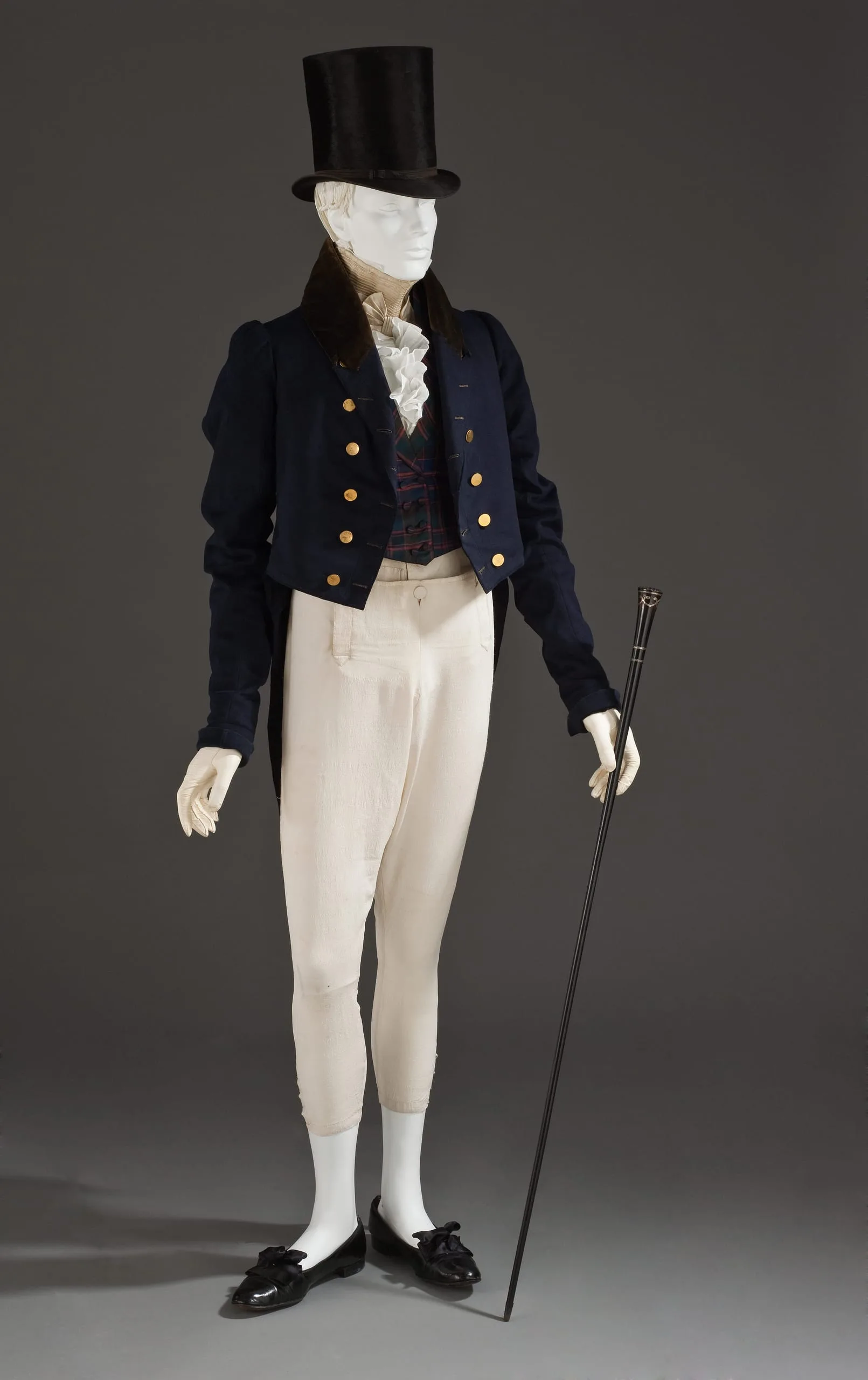
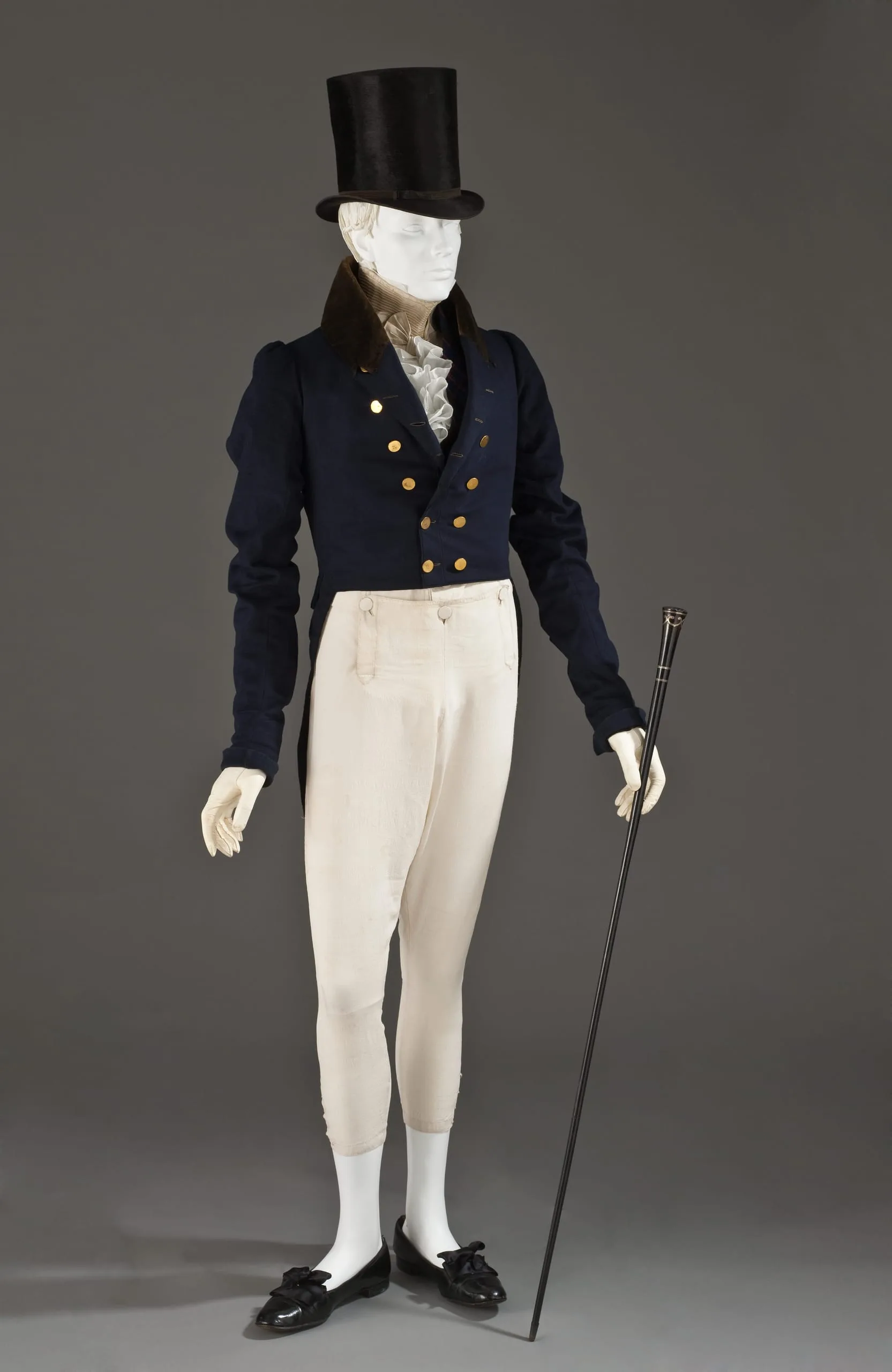
Mannequin dressed in a Regency-era men's ensemble: navy double-breasted tailcoat with gold buttons, cream fitted trousers, white stockings, black patent shoes, and a black top hat, holding a black walking cane
Museum mannequin displaying early 19th-century men's ensemble: navy blue tailcoat with gold buttons, patterned waistcoat, white fitted trousers, white ruffled cravat, black top hat, black flat shoes, and a dark walking cane held in the right hand.
Title
Man's Breeches (Pantaloons)
Place Made
Scotland
Date Made
1820s
Medium
Silk plain weave (crepe)
Dimensions
Inseam length: 24 1/4 in. (61.595 cm); Side length: 37 in. (93.98 cm)
Credit Line
Purchased with funds provided by Suzanne A. Saperstein and Michael and Ellen Michelson, with additional funding from the Costume Council, the Edgerton Foundation, Gail and Gerald Oppenheimer, Maureen H. Shapiro, Grace Tsao, and Lenore and Richard Wayne
Accession Number
M.2007.211.1076
Classification
Costumes
Collecting Area
Costume and Textiles
Curatorial Notes

Body-conscious silk pantaloons were a fashionable pant style for men’s formal wear through the first half of the nineteenth century. The trend reflected an intellectual shift toward Romanticism, which drew inspiration from the natural world, aesthetics, and emotion. As a result, fashions were made to glorify the human form. Men’s wool tailcoats were constructed into an idealized hourglass silhouette, with the front cut above the hips to reveal trousers that softly outlined the lower half of a man’s physique. Not since the Renaissance had men’s jacket hems risen above the hipline. This example is made from a silk crepe, which has an extremely drapey quality that would have further accentuated the male body underneath. The white pantaloon also aligned with the fashionable craze to mimic ancient sculpture in dress for both men and women of the Neoclassical era: the form recalls an idealized Greco-Roman nude statue whose original paint has worn away leaving the stark white carving.

The silk pantaloon was commonly paired with white silk stockings and black pumps. A padded vest, usually made of a nonreflective woven silk or velvet, further emphasized a broad chest. Coupled with the thoughtfully engineered tailcoat over a pressed linen shirt and cravat or stock around the neck, such an ensemble—with its subtle finesse and mindful fit—became the marker of highly prized gentility in a newly democratic period, and the coming of age for the so-called “dandy.”

Clarissa M. Esguerra

2024
Selected Bibliography
  • Takeda, Sharon Sadako and Kaye Durland Spilker. Fashioning Fashion: Deux Siècles de Mode Européenne, 1700-1915. Paris: Arts Décoratifs; Los Angeles: Los Angeles County Museum of Art; Munich; New York: Delmonico Books-Prestel, 2013.
  • Takeda, Sharon Sadako and Kaye Durland Spilker. Fashioning Fashion: European Dress in Detail, 1700-1915. Los Angeles: Los Angeles County Museum of Art; Munich; New York: Delmonico Books/Prestel, 2010.
  • Takeda, Sharon Sadako and Kaye Durland Spilker. Fashioning Fashion: Europäische Moden, 1700-1915. Los Angeles: Los Angeles County Museum of Art; Munich; New York: Prestel, 2012.