LACMA

ShopMembershipMyLACMATickets
LACMA
Los Angeles County Museum of Art
5905 Wilshire Blvd.
Los Angeles, CA 90036
info@lacma.org
(323) 857-6000
Sign up to receive emails
Subscribe
© Museum Associates 2025

Museum Hours

Monday

11 am–6 pm

Tuesday

11 am–6 pm

Wednesday

Closed

Thursday

11 am–6 pm

Friday

11 am–8 pm

Saturday

10 am–7 pm

Sunday

10 am–7 pm


  • About LACMA
  • Jobs
  • Building LACMA
  • Host An Event
  • Unframed
  • Press
  • FAQs
  • Log in to MyLACMA
  • Privacy Policy
© Museum Associates 2025
Collections

Unknown
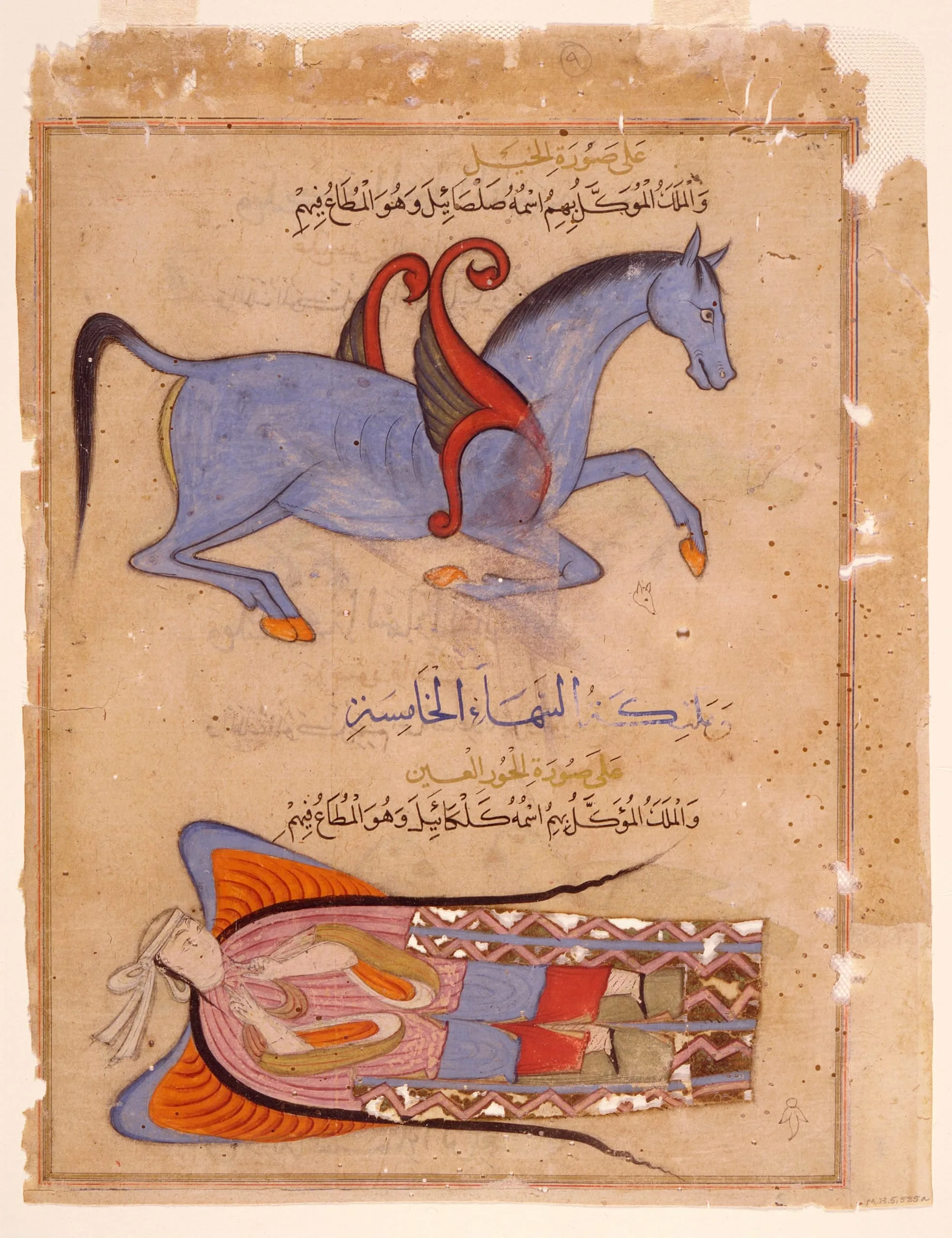
Winged Horse and Angel (recto), Pairs of Hawks and Vultures (verso), Folio from an Ajaib al-Makhluqat wa-Gharaib al-Mawjudat (Wonders of Creation and Oddities of Existence) by al-Qazwinicirca 1570

Not on view
Illustrated manuscript page with Arabic script, showing a blue winged horse galloping above a reclining human figure merging into a patterned textile form
Artist or Maker
Unknown
Title
Winged Horse and Angel (recto), Pairs of Hawks and Vultures (verso), Folio from an Ajaib al-Makhluqat wa-Gharaib al-Mawjudat (Wonders of Creation and Oddities of Existence) by al-Qazwini
Place Made
India, Karnataka, Bijapur
Date Made
circa 1570
Medium
Opaque watercolor, gold, and ink on paper
Dimensions
Sheet: 11 x 8 1/2 in. (27.94 x 21.59 cm); Image: 9 11/16 x 7 5/16 in. (24.61 x 18.57 cm)
Credit Line
The Nasli M. Heeramaneck Collection, gift of Joan Palevsky
Accession Number
M.73.5.585a-b
Classification
Manuscripts
Collecting Area
South and Southeast Asian Art
Curatorial Notes

The Ajaib al-Makhluqat wa-Gharaib al-Mawjudat (Wonders of Creation and Oddities of Existence) is a cosmographical and geographical treatise written in Arabic in 1279-1280 by Zakariyya' al-Qazwini (1203-1283), who was born in Qazvin, Iran. It consists of two volumes: the celestial spheres, including a discussion of chronology, planets, constellations, zodiac, and heavenly inhabitants such as angels and demons; and terrestrial phenomena, including the four elements, geography, the animal kingdom, botany, minerology, and the nature of mankind.

Recto: A Winged Horse (salsail) and a supine Angel or peri (hur) representing the angels of the fourth and fifth heavens led by Sasail and Kalkail respectively.

Verso: Pairs of Hawks (uqab) and Vultures (nasr) representing the angels of the second and third heavens led by respectively.

(Translation by Z. A. Desai.)
Selected Bibliography
  • Pal, Pratapaditya. Indian Painting, vol.1. Los Angeles: Los Angeles County Museum of Art, 1993.
  • Pal, Pratapaditya, ed. Islamic Art: The Nasli M. Heeramaneck Collection. Los Angeles: Museum Associates, 1973.