- Title
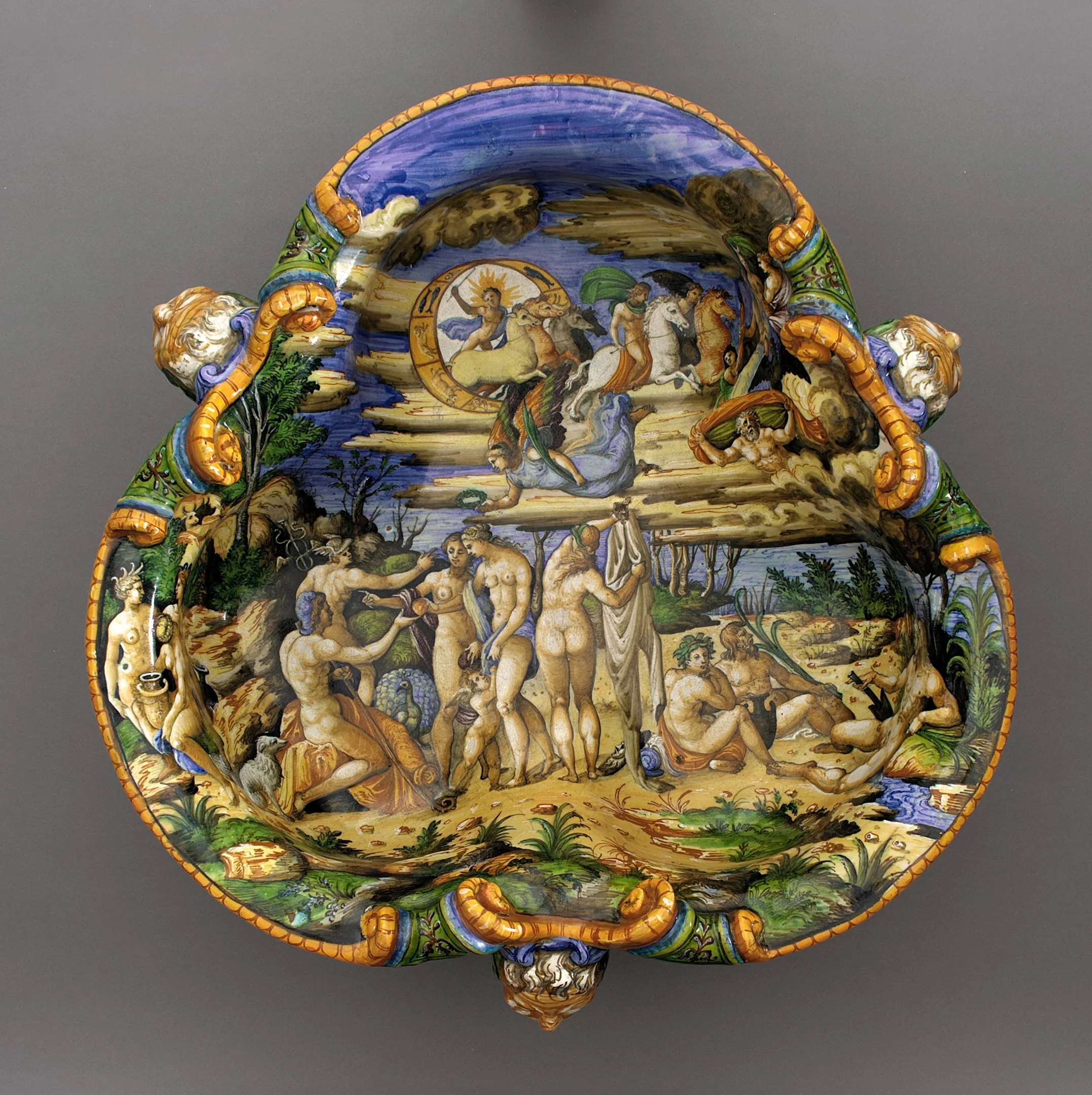
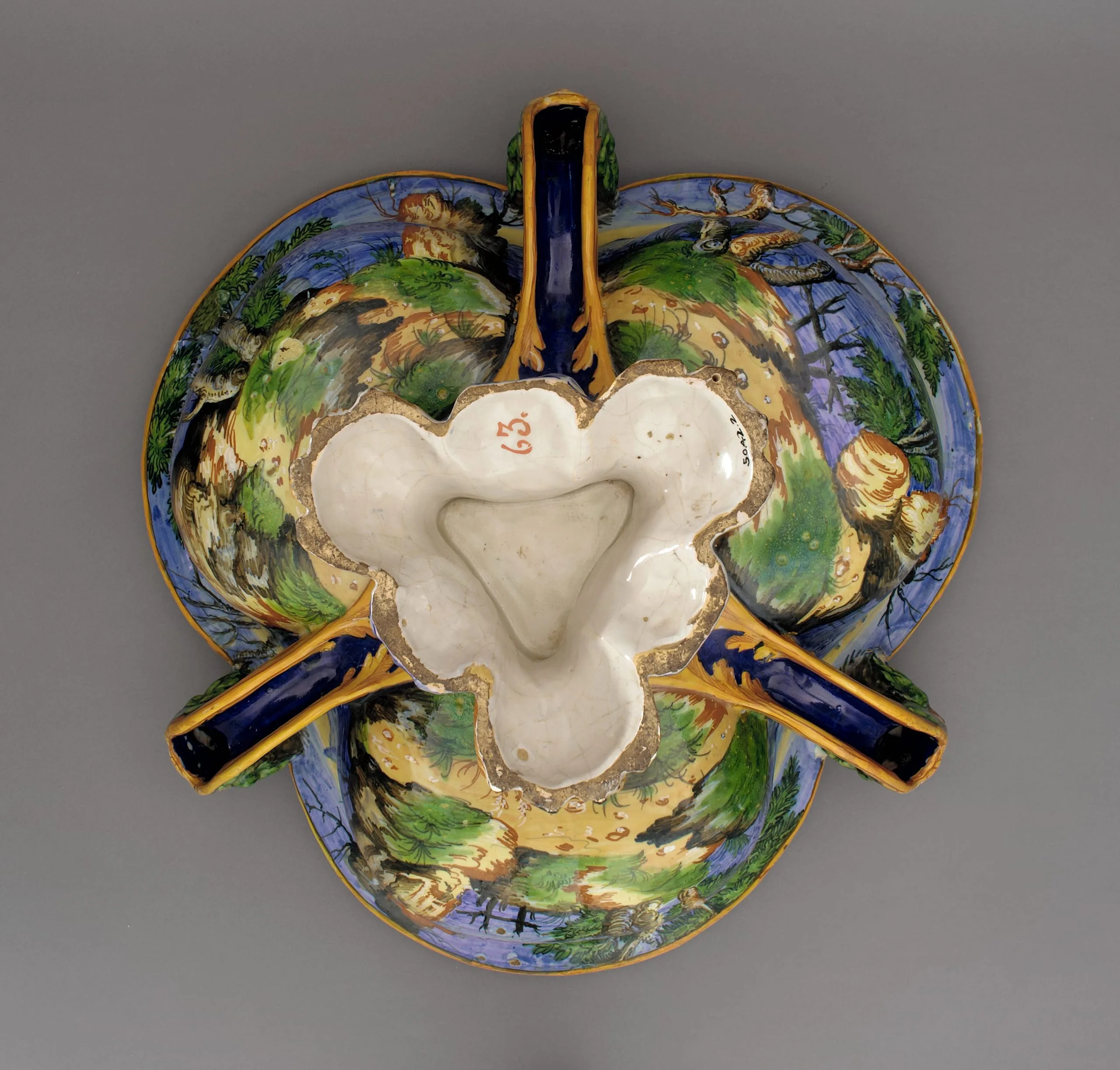
- Wine Cooler with Judgment of Paris
- Date Made
- circa 1565-1571
- Medium
- Tin-glazed earthenware (maiolica)
- Dimensions
- 8 × 19 × 19 in. (20.32 × 48.26 × 48.26 cm)
Height: 8 in. (20.32 cm)
- Accession Number
- 50.42.2
- Curatorial Notes
Three-lobed basins were among the largest and most ambitious ceramic forms created during the Italian Renaissance. Basins like this one and its mate (50.42.1) were a specialty of the Fontana family workshop in Urbino. Its function was for cooling bottles of wine on a banquet table. The deep container has three lobes and stands on lion’s-paw feet. Three handles end in satyr’s masks with horns that curl up and over the rim. The interior of the bowl depicts the Judgment of Paris, a story from Greek mythology about the wedding of Peleus and Thetis, to which all the gods and goddesses except Eris, goddess of discord, have been invited. After Thetis tosses a golden apple inscribed “to the fairest” into the crowd, Paris, a Trojan prince, becomes the judge of a beauty contest among Venus, Minerva, and Juno, each of whom claims the title. In the version of the story illustrated on this basin, Paris sits at the left and hands the apple to Venus, a fateful choice that leads to the Trojan War. The Judgment scene was copied directly from an engraving by Marcantonio Raimondi after a design by Raphael (https://www.metmuseum.org/art/collection/search/337058). Marcantonio’s print was famous in its day and, according to Giorgio Vasari, “amazed all of Rome.” No doubt this celebrated image of banqueting and soon-to-be-quarreling gods and goddesses prompted lively conversation as the wine cooler was emptied and the mythological scene was fully revealed to guests.
- Selected Bibliography
- Keith, D. Graeme. The Triumph of Humanism: a Visual Survey of the Decorative Arts of the Renaissance. San Francisco: The Fine Arts Museums of San Francisco, 1977.