The Ramayana (Adventures of Rama) is traditionally ascribed to the celebrated poet-sage Valmiki. It narrates the epic saga of the valiant Prince Rama and his dutiful wife, Princess Sita, who was abducted by Ravana, the arrogant ten-headed King of Lanka (probably modern Sri Lanka), during Rama's unjust fourteen-year forest exile from his capital of Ayodhya, Uttar Pradesh. Rama eventually vanquishes Ravana, rescues Sita, and returns to rule his kingdom.
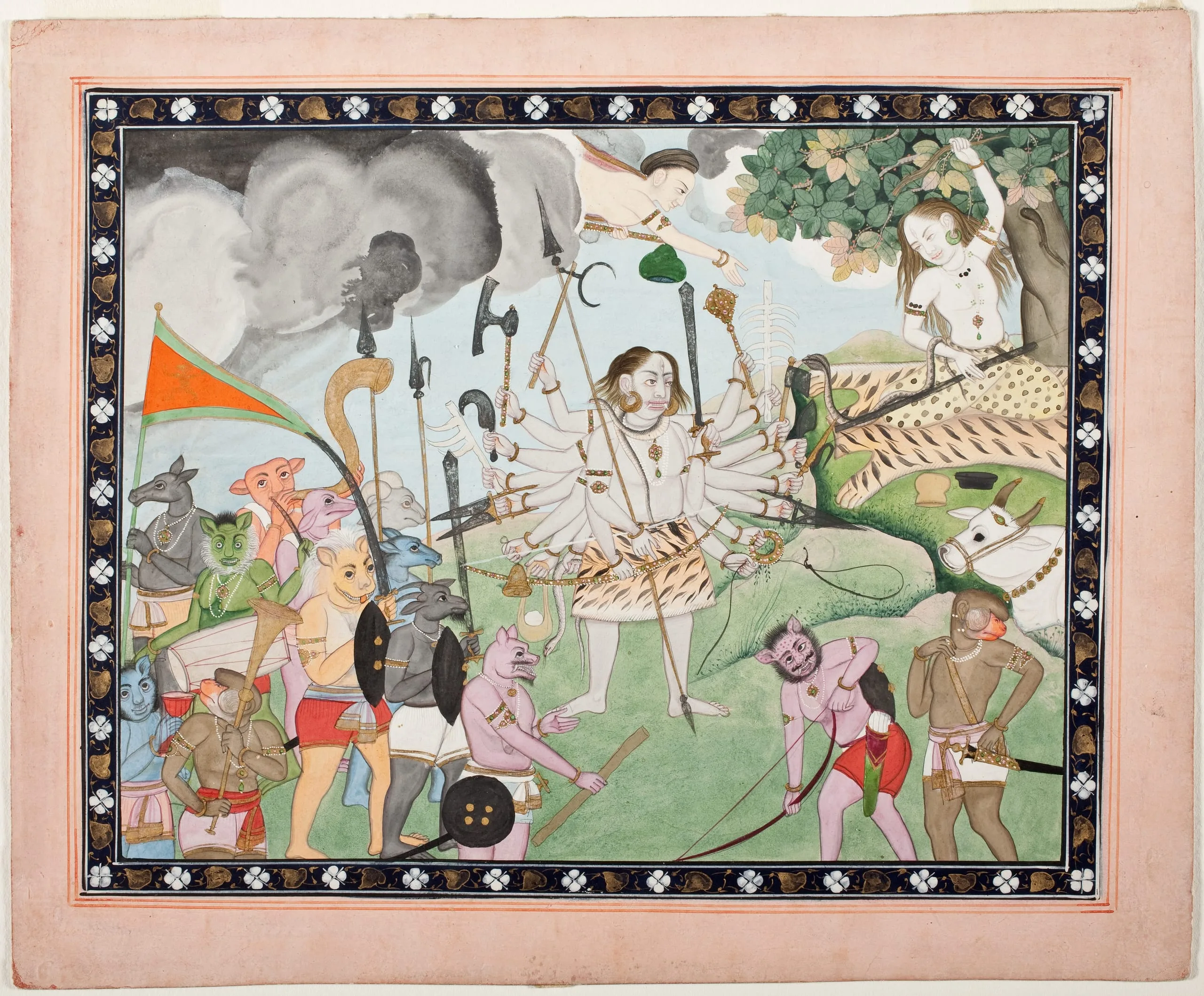
This folio depicts an episode from Book 7 (Uttara kanda) in which Ravana receives the invincible Pashupata Missile (astra) from Shiva after rigorous penance. Ravana later began to wield it in his battle against King Mandhata of the legendary Raghuvamsha Dynasty:
“When they saw that dreadful-looking missile that increased the terror of the triple world, all beings, fixed and moving, were terrified. Through the granting of a boon from Rudra [Shiva], that great weapon had been acquired by austerities. Then the entire triple world, together with its fixed and moving contents, trembled. All the gods trembled, and the great serpents huddled together in their dens.” (Ramayana 7: Prakshipita (Interpolation) 1:4:52-54)
(Translation by Robert P. Goldman and Sally J. Sutherland Goldman.)
Ravana is atypically envisioned here as having only one head instead of his customary ten, which symbolize his prodigious learning of multiple subjects. Shiva sits on a tiger skin holding the Pashupata Missile (likely the long shaft with an entwined cobra).