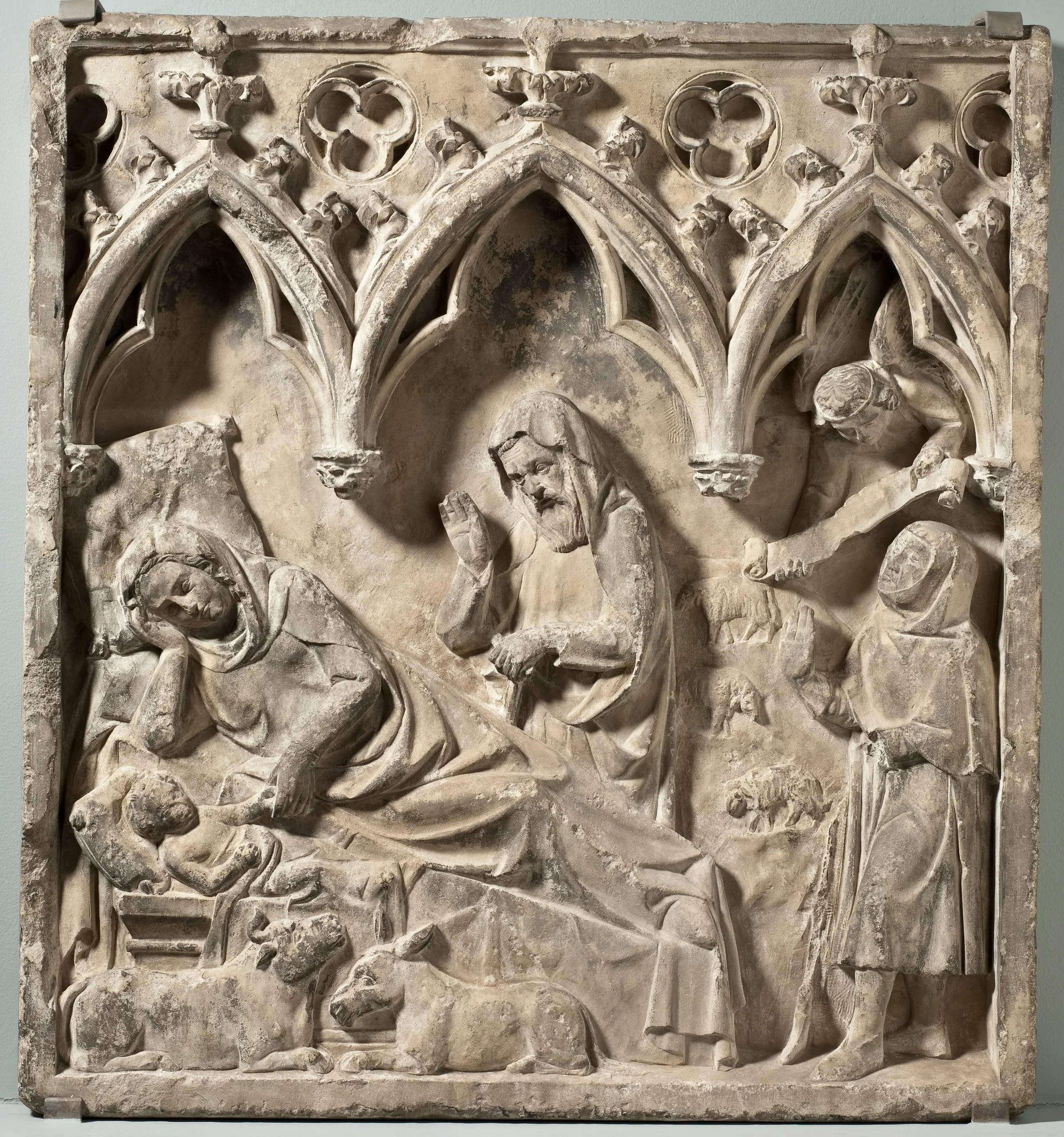
This sandstone carving seamlessly combines two episodes from the Nativity narrative, the Adoration of the Child and the Annunciation to the Shepherds, and may have been part of a larger series of panels depicting the life of Christ, perhaps decorating a stone altar, choir screen, or other component of church architecture. Here, instead of the typical setting of a rustic manger, the scene unfolds beneath a triple trefoil arch with circular trefoil windows punctuating the spandrels. Not only does the Gothic architecture mirror the church environment that housed this piece, and therefore would have been familiar to viewers, but the visual repetition of a tripartite form references the Trinity.
The sculpture’s design reflects popular devotional trends. On the left, the Virgin reclines on a bed, leaning her head on one hand and tenderly holding her infant son’s hand in the other, imbuing the scene with a sense of intimacy, their touch reinforcing the divine physical connection between mother and child. Mary’s elderly husband, Joseph of Nazareth, looks down at his young family; his placement at the center of the composition speaks to the rise in popularity of his saintly cult during the thirteenth and fourteenth centuries, leading to the official establishment of his feast day in the mid-fifteenth century. Joseph is often rendered with an element of humor, showing him busy with mundane tasks and oblivious to the miracle that has just occurred. However, in this scene, he too recognizes and gestures toward the Christ Child. At the right, a scroll-bearing angel dramatically appears above a shepherd and his flock, representing the evening moment in which the Messiah’s birth is announced. Similar compositions also appear in ivories from across Europe, attesting to the effectiveness of this devotional image type.
2024