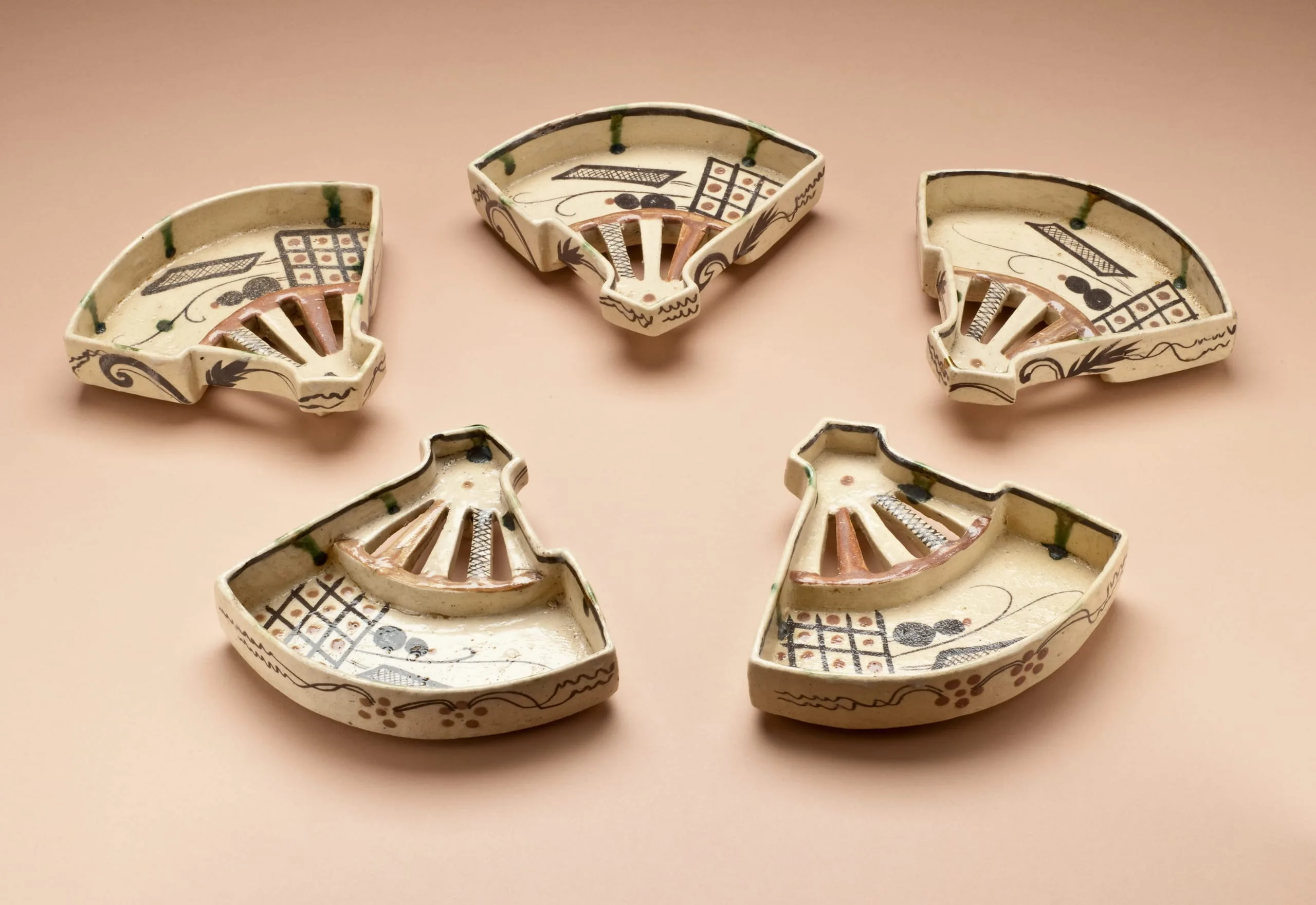
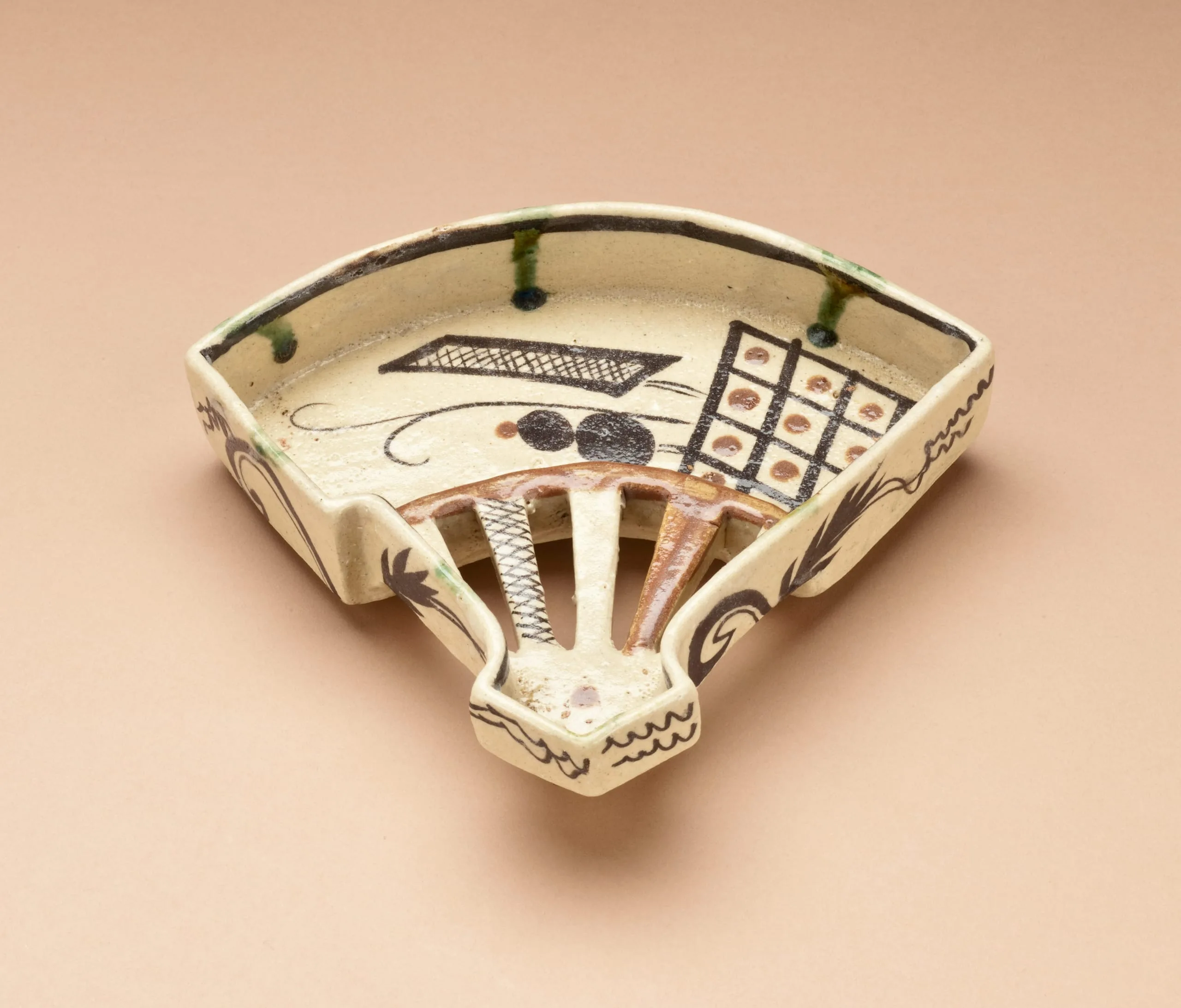
This set of five fan-shaped food vessels of Oribe Ware was made in the Momoyama period (1573-1615) for the meal served during the Tea Ceremony. Originally designed by the Tea Master Furuta Oribe (1544-1615), Oribe Ware is renowned for its original and playful forms, colors, and motifs. Together with Shino Ware, Oribe Ware is the most desirable decorated ware used for the Tea Ceremony. In typical Oribe style, these five vessels are decorated with a variety of unusual motifs: skewered dumplings, grilling nets, stylized plum flowers, grasses, and game boards.
This remarkable set of vessels is among the most well-known of all Japanese ceramics. They are published, in full-page color spreads, in the two most distinguished surveys of world and Japanese ceramics titled, respectively, Sekai Toji Zenshu (Celebrated Ceramics of the World) and Nihon no Toji (Famous Ceramics of Japan), as well as in Manno Korekushon no Senshu (Treasures of the Manno Collection) and Manno Bijutsukan no Yonjushunen Kinenten (Fortieth Anniversary Exhibition of the Manno Museum of Art). In addition, they are also published in vol. 51 of the monthly journal Nihon no Bijutsu (Japanese Art), and in the English version of that volume. The Manno Museum of Art, a highly regarded private museum in Osaka, was forced to disperse its collections due to financial problems encountered by the Manno companies, giving LACMA the rare opportunity to acquire this set of objects which are, along with the museums set of twelve plates by Ogata Kenza, the most famous ceramics ever to leave Japan. Usually broken up into individual serving dishes, a complete set of five food vessels from the Momoyama period is extremely rare, especially a set as celebrated and well-published as this one. In addition, it was discovered after their acquisition by LACMA that they originally were in the famed collection of Baron Konoike, the most distinguished private collection of the Edo period (1615-1868). From the late 17th century onward, the Konoike were bankers to the Shogun and many Daimyo.
In Japan, ceramic art is considered the equal of painting and sculpture; indeed, exhibitions of ancient and modern ceramics often outdraw painting and sculpture shows. Dozens of magazines and journals are devoted to ceramic art, and hundreds if not thousands of ceramic artists work at hundreds of kilns around the country. The importance accorded ceramic art in Japan is extraordinary.