LACMA

ShopMembershipMyLACMATickets
LACMA
Los Angeles County Museum of Art
5905 Wilshire Blvd.
Los Angeles, CA 90036
info@lacma.org
(323) 857-6000
Sign up to receive emails
Subscribe
© Museum Associates 2026
  • About LACMA
  • Jobs
  • Building LACMA
  • Host An Event
  • Unframed
  • Press
  • FAQs
  • Log in to MyLACMA
  • Privacy Policy
© Museum Associates 2026
Collections

Unknown
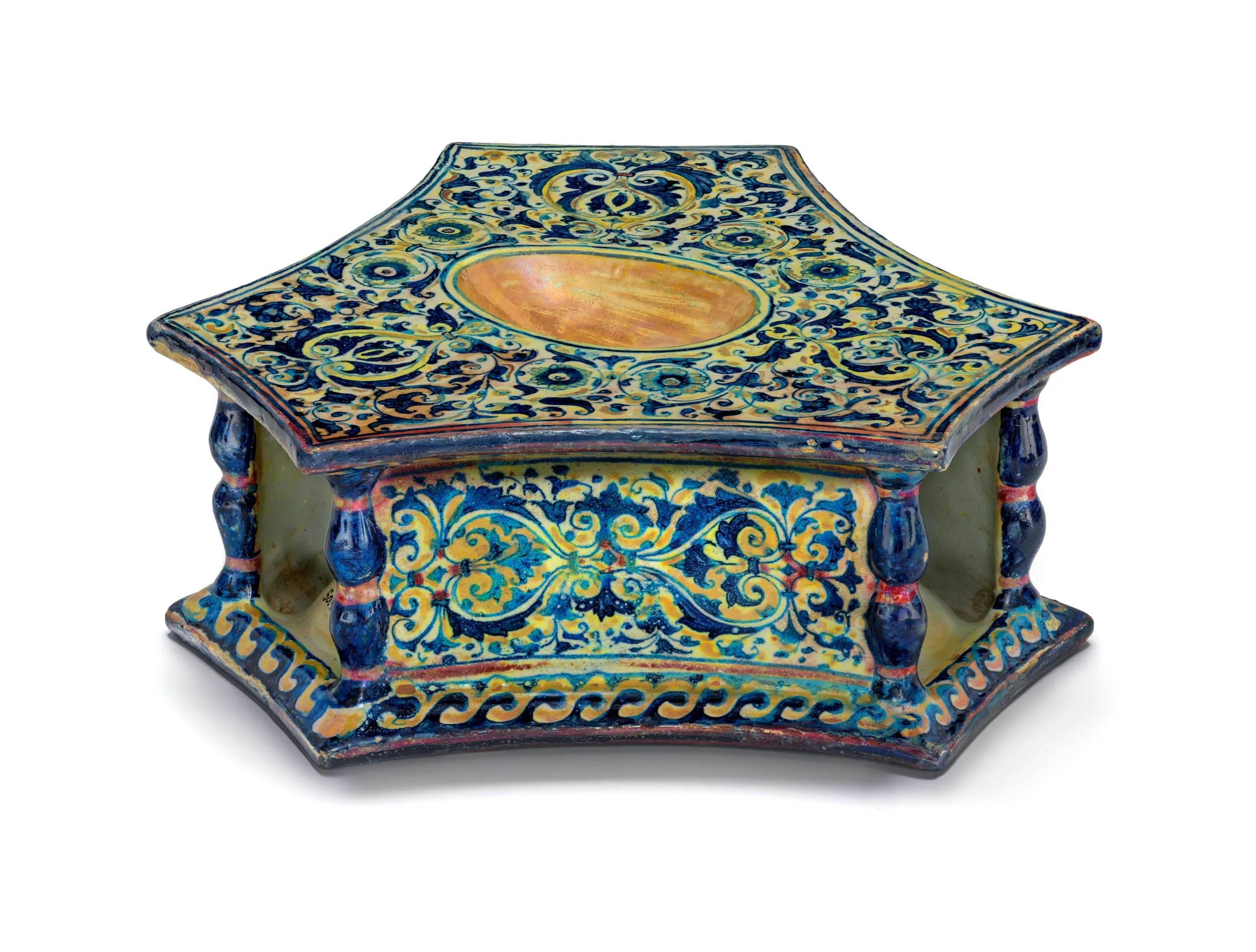
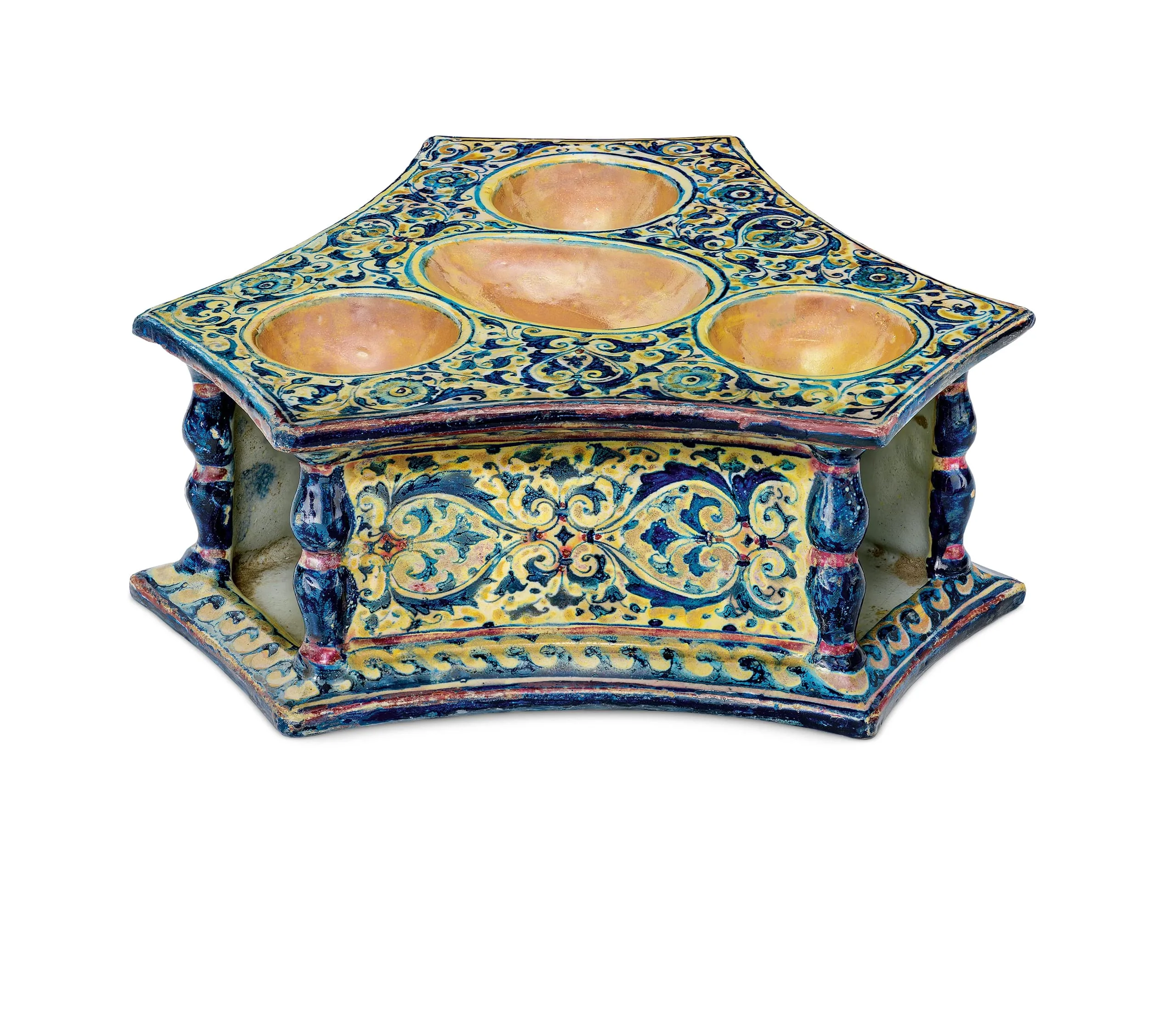
Spice Dishcirca 1560

Not on view
Glazed ceramic hexagonal stand with three salmon-toned oval depressions on top, covered in dense blue, teal, and yellow scrolling arabesques, with bulbous corner posts
Hexagonal maiolica inkstand with concave-sided lid and raised corner columns, densely painted in cobalt blue, yellow, and turquoise with scrolling foliate arabesques; central oval medallion on lid in amber lustre glaze.
Artist or Maker
Unknown
Title
Spice Dish
Place Made
Italy, Faenza
Date Made
circa 1560
Medium
Tin-glazed earthenware (maiolica)
Dimensions
2 7/8 x 7 3/4 in. (7.3 x 19.69 cm)
Credit Line
William Randolph Hearst Collection
Accession Number
50.9.1
Classification
Furnishings
Collecting Area
Decorative Arts and Design
Curatorial Notes

Beginning in the medieval period, the city-states of Italy facilitated the spread of vital elements in the fine art of dining, such as spices and ceramics, from Islamic lands into southern Europe. Within Italy itself, local elites preferred imported ceramics for their technical skill and beauty, which prior to the fourteenth century surpassed that of indigenous potters’ capabilities, and as expensive and exotic items that enhanced their owners’ prestige. Around the second half of the fourteenth century, a rise in general prosperity and purchasing power, alongside a diversification in diet among the Italian well-to-do, increased the demand for foreign imports and stimulated domestic pottery industries, leading to a proliferation of new forms of tableware. Some of these new forms were likely inspired by imports from the Islamic world. For example, this Italian dish relates to contemporaneous Syrian models through its tablelike shape, decoration, and most importantly, use in serving food or spices, pointing to shared cultural affinities, particularly around food, that developed through continuous contact around and across the Mediterranean Sea.

2025
Selected Bibliography
  • Hess, Catherine. The Arts of Fire: Islamic Influences on Glass and Ceramics of the Italian Renaissance. Los Angeles: J. Paul Getty Trust, 2004.
  • Levkoff, Mary L., ed. Hearst the collector. Exh. Cat. New York: Abrams and Los Angeles: Los Angeles County Museum of Art, 2008.
  • Komaroff, Linda, editor. Dining with the Sultan: The Fine Art of Feasting. Los Angeles: Los Angeles County Museum of Art; New York: DelMonico Books, 2023.