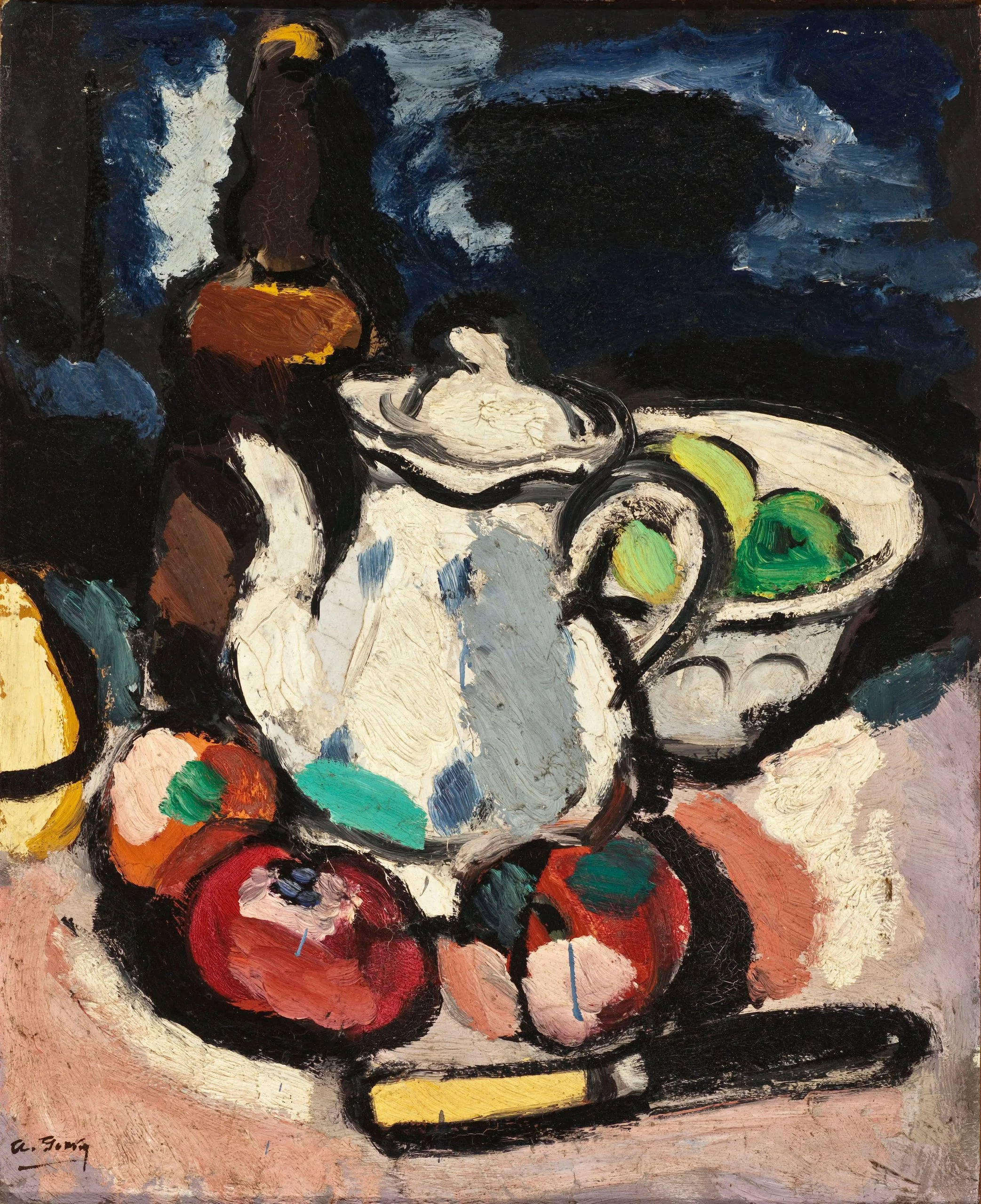
Arshile Gorky is known primarily for his canvases of the 1940s that revolutionized American painting and ultimately moved the New York School to the forefront of international trends. Lauded for his innovative mature works by such critics and authors as Harold Rosenberg, Clement Greenberg, and Robert Goldwater, Gorky underwent a long "apprenticeship" before developing his personal, transformative works of an Abstract Expressionist character. Jim Jordan, co-author of the Catalogue Raisonné of Gorky's paintings, has noted that study of the early paintings from Gorky's formative decades of the 1920s and 1930s, such as Still Life, circa 1928, "revealed a number of unities through Gorky's entire oeuvre."
Born Vosdanik Adoian in Armenia, the teenage Gorky arrived in the United States in 1920 and eventually settled in New York City in 1925, only a few years after starting to paint. The next fifteen years he virtually taught himself by experimenting and analyzing the modernist movements as espoused by Europeans during the first four decades of the twentieth century. In this respect, he was typical of many young American artists and students who looked to the Old World for inspiration. In a now often-cited 1926 New York Evening Post interview, Gorky referred to himself as a rebel protesting the provincialism of New York and praising the modern masters Cezanne, Matisse, and Picasso. He went through a series of phases quickly absorbing the concepts of these modern Masters. His Self-Portrait, circa 1928, also owned by LACMA, is a synthesis of his response to Cezanne and Matisse, while Still Life, from the same period, is more fauve in character. Gorky does seem to be indebted to Cezanne and even Manet in the still life components — round fruit and slanting table knife — but Matisse's influence is particularly strong in the composition and the use of dark contour lines. Applying paint thickly and roughly, Gorky created a sparkling rich canvas despite the simplicity of the table-top arrangement. Moreover, the intense hues of citrus greens, warm roses and pinks, and deep cobalt blues — far more dynamic than in his Self Portrait — convey his fondness for color. It also offers a fascinating comparison with a later Gorky Still Life, circa 1936-1938, that LACMA also owns, in which the artist further developed a similar table-top still life motif into an synthetic cubist painting dominated by a limited palette with flat white planes and thick black outlines.
Such modernist canvases a la Cezanne, Matisse, and Picasso, were a ritual coming of age for most American art students, working both abroad and in the United States. This Matisse-like Still Life by Gorky along with his cubist Still Life as well as similar examples by Stanton Macdonald-Wright created in Paris and by Hugh Breckenridge painted in Philadelphia exemplify in LACMA's collection the course of early modernism in the United States. View more works by Arshile Gorky in LACMA's collection.