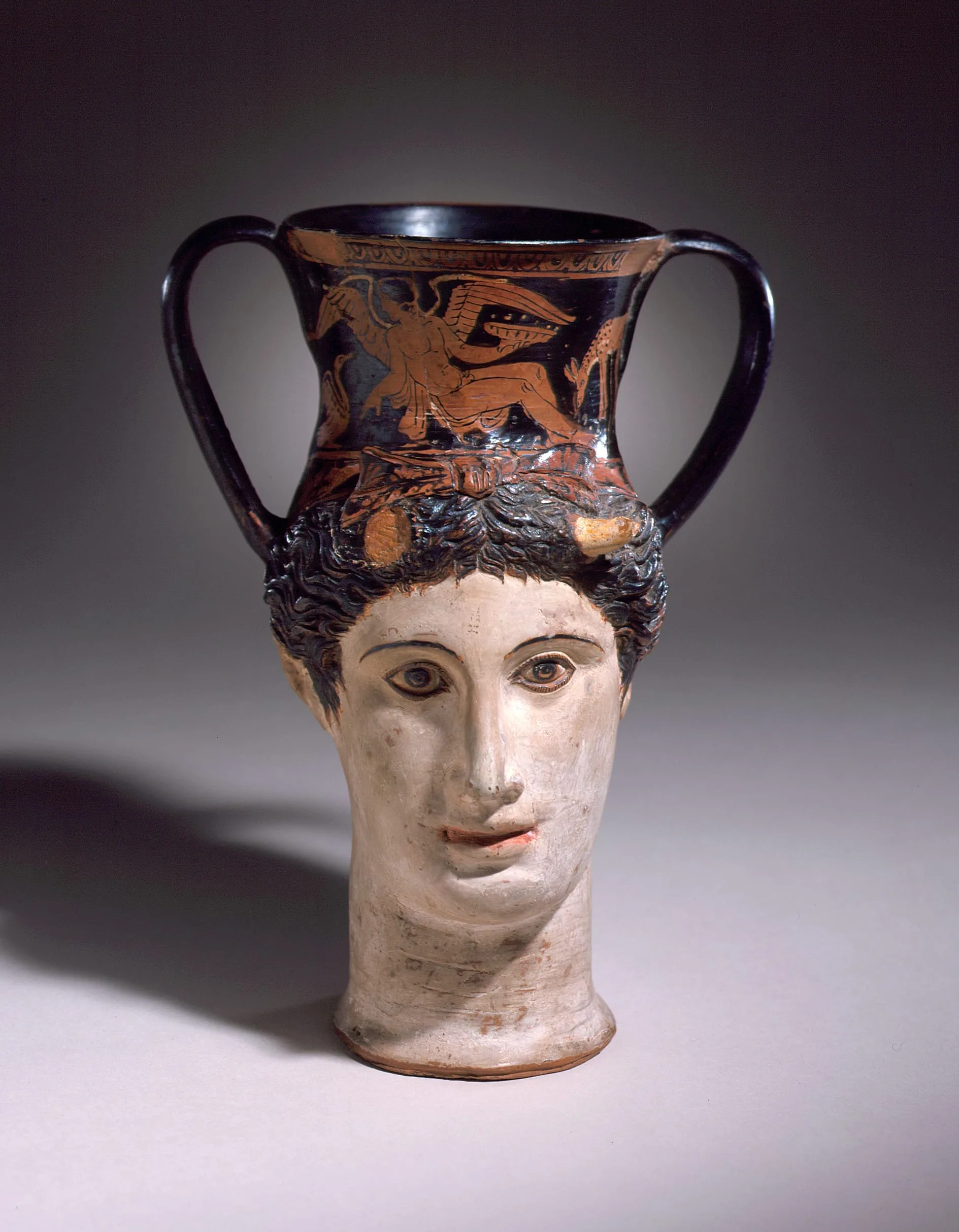
A sculpted and painted head forms the bottom of this kantharos, a two-handled cup, while a more standard neck and mouth, painted in the red-figure style, forms the top. The head can likely be identified as Io, a mortal woman loved by Zeus, by the horns peeking out of her hair. Zeus turned the girl into a cow to hide her from his jealous wife, Hera, who still discovered Io and sent a gadfly to follow and torment her. Io wandered the world, eventually reaching Egypt, where Zeus took pity on her and restored her to human form. In addition to black slip used for the red-figure portions of the vase and Io’s hair, different colors of slip (liquid clay) have been applied to create a naturalistic rendering of Io, including a white slip for her flesh and horns and pinkish red for her lips. Most of her curly hair is wrapped in an intricately decorated sakkos, a head covering typically made of coarse material, tied into a bow at the front of her head.
The neck is decorated in the red-figure technique, where slip that turned black during firing was applied to the background and outlines of figures, while the figures themselves were left in the natural red-orange color of the clay. On the front, Eros, the young god of love, reclines in the company of a goose and a fawn. On the reverse, a seated woman plays a harplike instrument (sambuca?). LACMA’s collection also includes another work by the Iliupersis Painter (M.81.256.15), a prolific artist from Apulia in southern Italy who introduced new motifs and techniques to the Apulian vase-painting tradition.