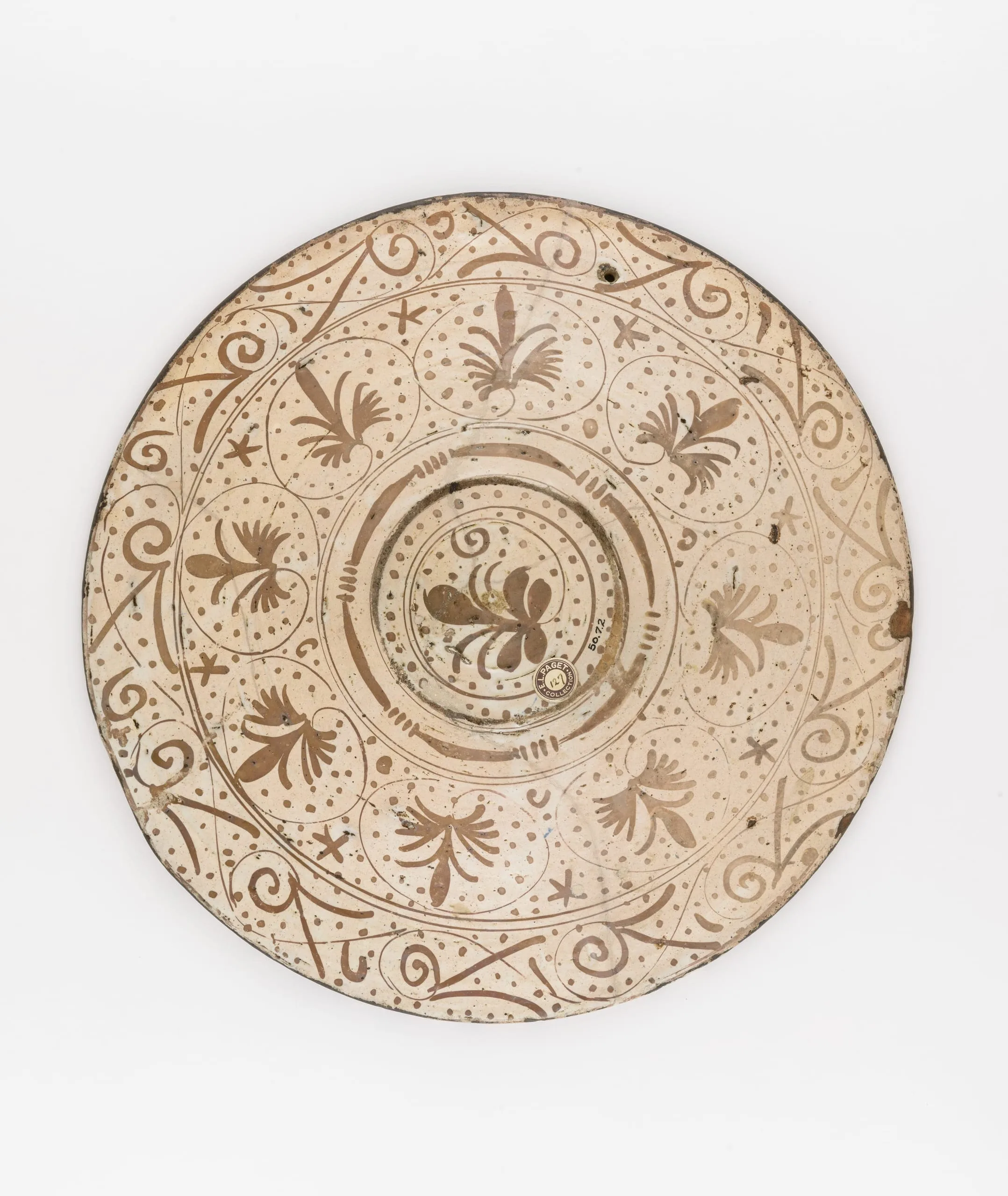
The areas of the Iberian Peninsula that were under Muslim rule between 711 and 1492 were known collectively as Al-Andalus. Given its long history of Arab and Berber ascendancy, it is not surprising that cuisine, dining customs, and especially the newly introduced taste for glazed ceramic serving dishes were fashionable even beyond the Christian Reconquest. Valencia became a Christian-ruled kingdom in 1238, but it nonetheless emerged as a key center for the production of lusterware, focused on the town of Manises, by the fifteenth century, through the immigration of Muslim potters.
Made in Manises, this charming luster and cobalt dish with a parrotlike bird at its center shows the mixing of Islamic and European designs typical of this period, as in the use of Gothic-style disk flowers, Islamic-inspired vines that closely resemble those of a ninth-century luster dish from Iraq (see M.73.5.238), and the speckled background. Such Spanish luster tableware was widely exported elsewhere in Europe, especially to Italy, where it helped to inspire the creation of the colorful maiolica ware used for both dining and display (see 46.16.3).
2025