LACMA

ShopMembershipMyLACMATickets
LACMA
Los Angeles County Museum of Art
5905 Wilshire Blvd.
Los Angeles, CA 90036
info@lacma.org
(323) 857-6000
Sign up to receive emails
Subscribe
© Museum Associates 2025

Museum Hours

Monday

11 am–6 pm

Tuesday

11 am–6 pm

Wednesday

Closed

Thursday

11 am–6 pm

Friday

11 am–8 pm

Saturday

10 am–7 pm

Sunday

10 am–7 pm


  • About LACMA
  • Jobs
  • Building LACMA
  • Host An Event
  • Unframed
  • Press
  • FAQs
  • Log in to MyLACMA
  • Privacy Policy
© Museum Associates 2025
Collections

Matta (Roberto Sebastián Antonio Matta Echaurren)
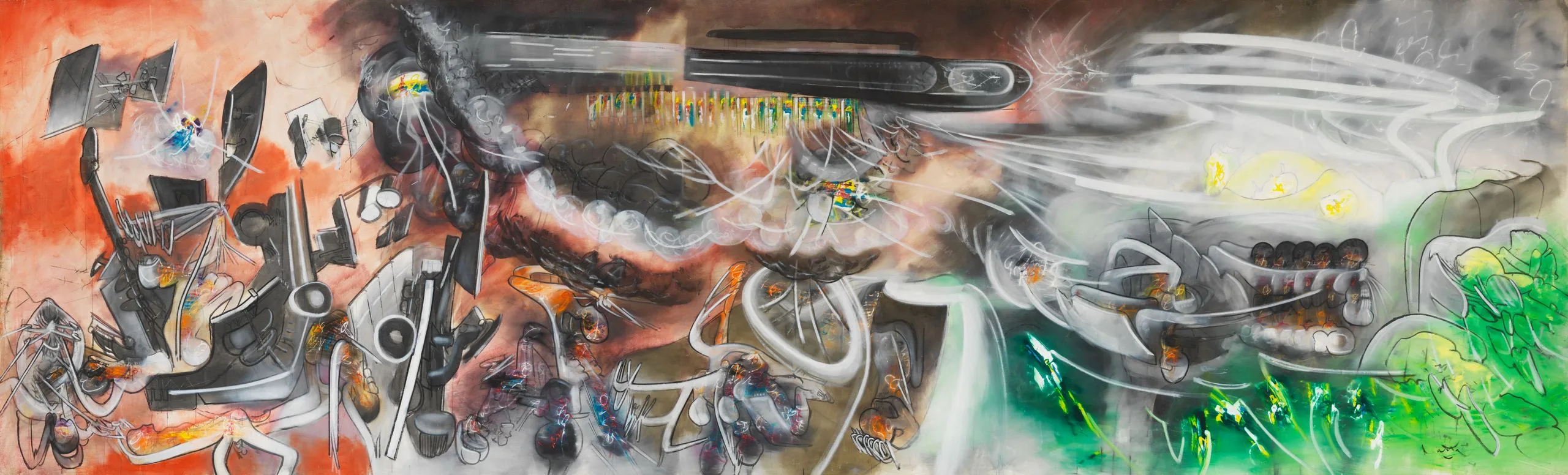
Burn, Baby, Burn (L'escalade)1965-1966

On view:
Broad Contemporary Art Museum, floor 3
Wide panoramic abstract painting with tangled black mechanical forms over coral-orange at left, billowing gray at center with glowing yellow accents, and sweeping white loops over green at right
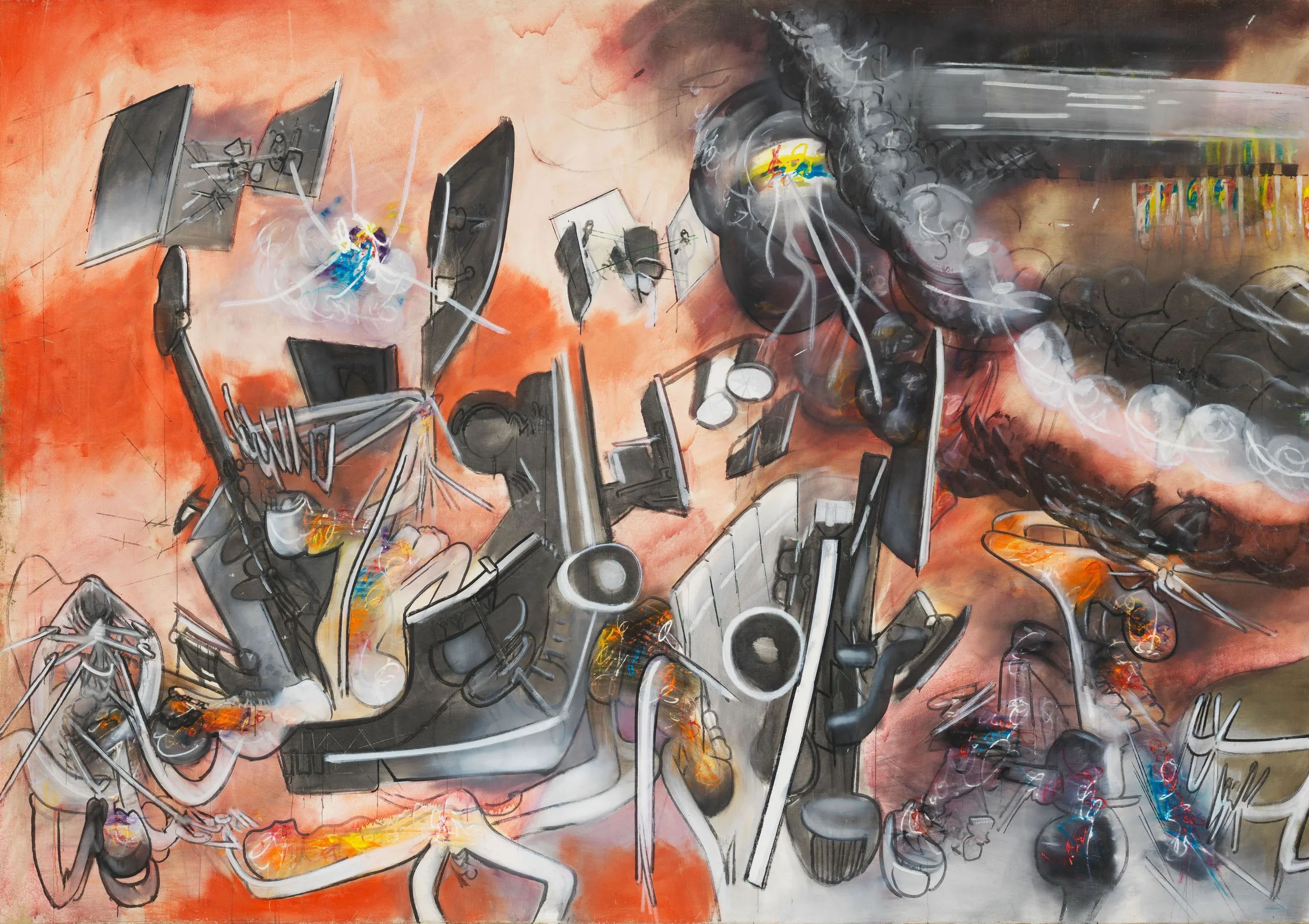
Large-scale mixed-media work on paper with energetic, chaotic composition; fragmented mechanical and electronic forms in black and gray scatter across a vivid red-orange ground, with bursts of white smoke-like marks and small flashes of blue, yellow, and green; gestural line work and layered washes throughout.
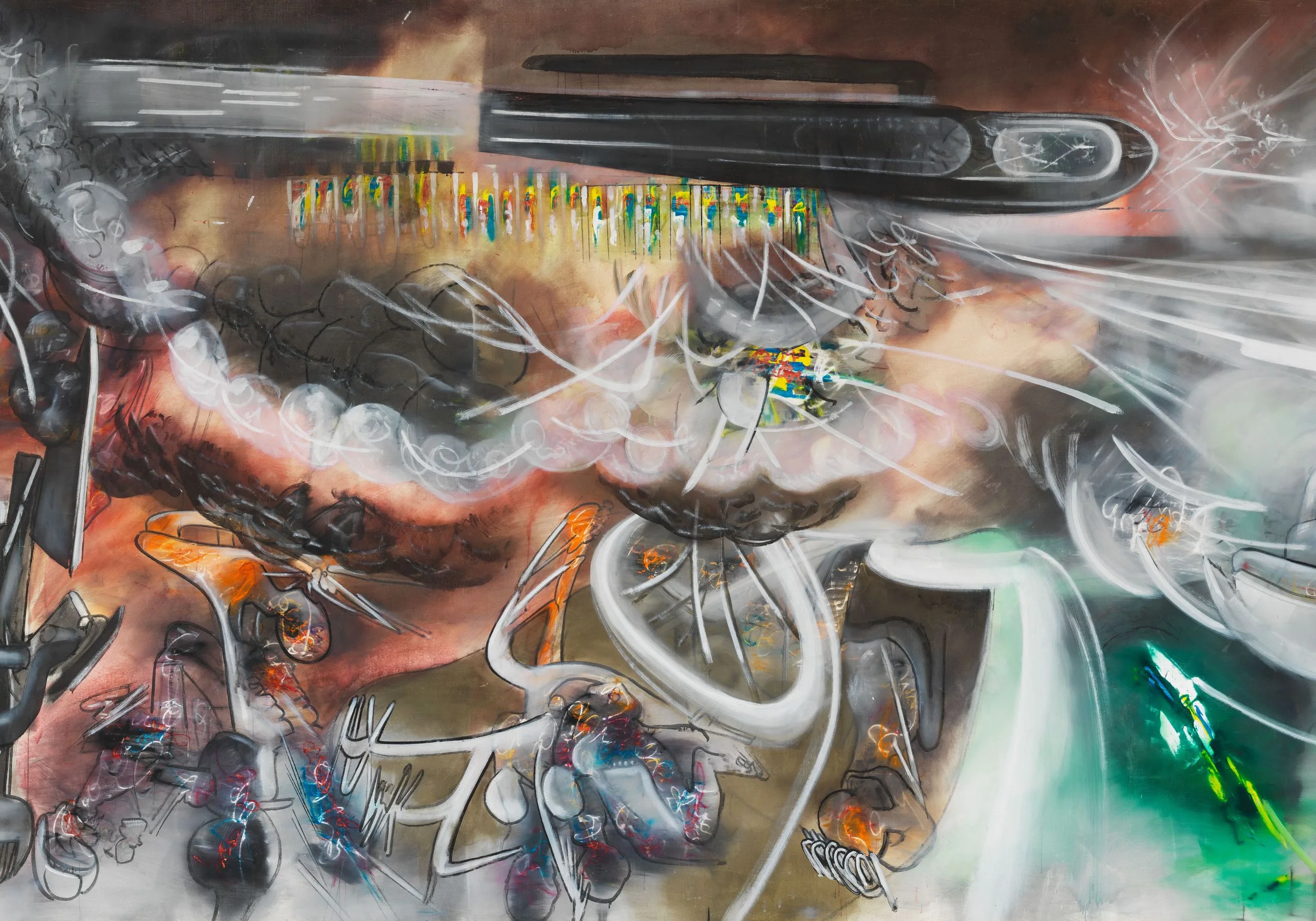
Large-scale mixed-media painting with dynamic, swirling composition in brown, grey, white, and orange tones; a elongated black form spans the upper edge above dripping multicolored marks, while looping white lines and smoky washes weave through clustered abstract and semi-mechanical forms across the canvas.
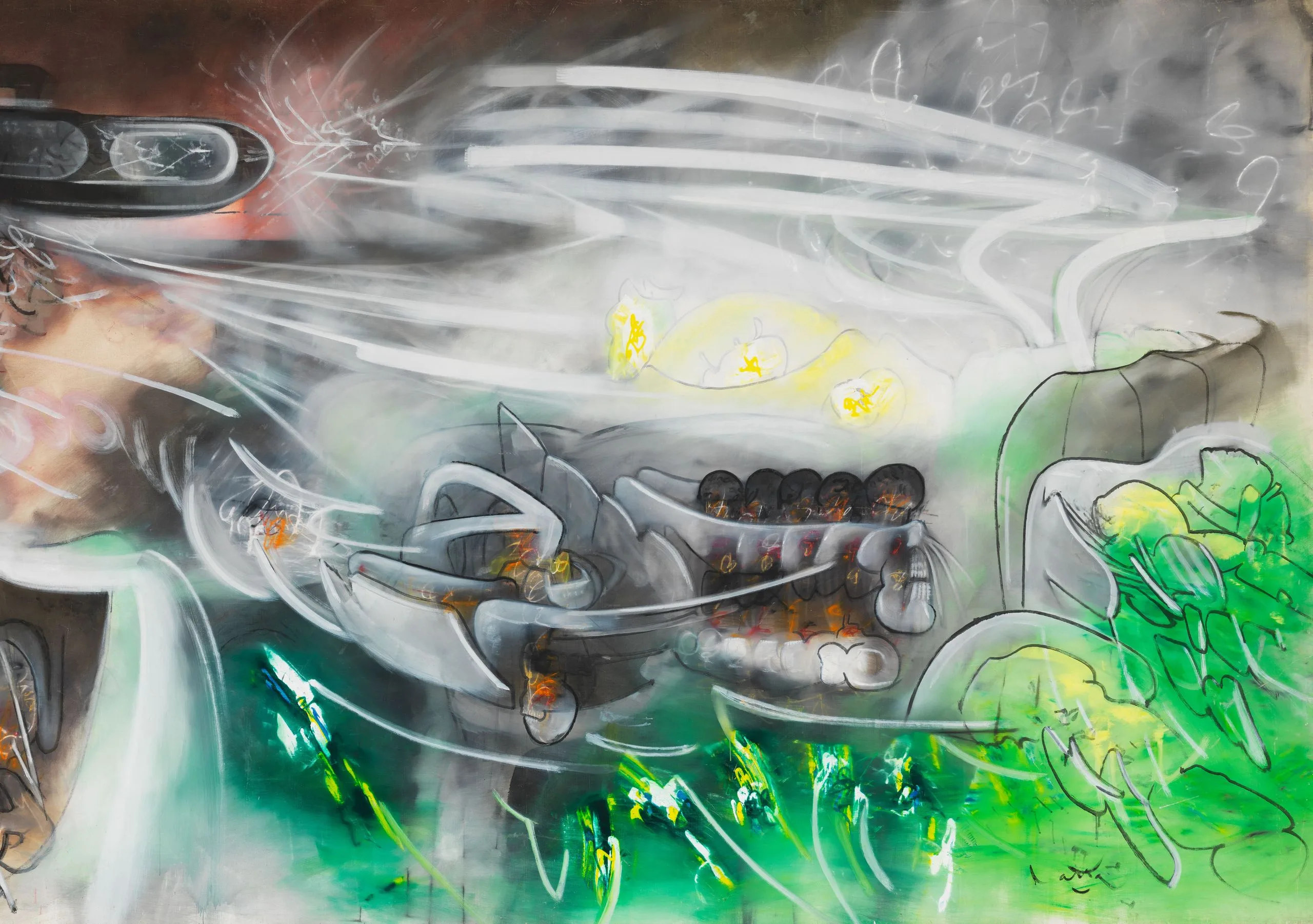
Large-scale painting with gestural brushwork depicting a fragmented automobile grille and headlights emerging from swirling gray and white forms, with vivid green and yellow passages in the lower half.
Artist or Maker
Matta (Roberto Sebastián Antonio Matta Echaurren)
Chile, active France, Italy, Mexico, and the United States, 1911-2002
Title
Burn, Baby, Burn (L'escalade)
Date Made
1965-1966
Medium
FM.2Oil on canvas
Dimensions
117 5/16 × 386 1/4 × 2 in. (298 × 981 × 5.08 cm)
Credit Line
Gift of the 2009 Collectors Committee with additional funds provided by the Bernard and Edith Lewin Collection of Mexican Art Deaccession Fund
Accession Number
M.2009.42
Classification
Paintings
Collecting Area
Latin American Art
Curatorial Notes
Burn, Baby, Burn is an iconic painting by one of Latin America's greatest masters. Although Matta was born in Chile, he is the quintessential peripatetic artist. Trained in architecture, from 1935 to 1937 Matta worked with Le Corbusier in Paris. In 1937 he traveled to Spain, where he met Salvador Dalí and André Breton officially joining the Surrealist movement that year.
Fleeing World War II, Matta moved to New York in 1939, where he met other Surrealist expatriates. While in New York, he organized studio sessions focused on automatist experiments that were attended by Motherwell, Pollok, and Gorky among others. His unique way of abstracting experience had a huge impact among the young circle of American artists. Matta has rightfully been credited for being a catalyst in the development of Abstract Expressionism.


Soon after Matta took up painting in the late 1930s, he developed his signature style of webs of lines and changing forms that give his compositions atmospheric depth. He coined the terms "psychological morphologies" and "inscapes" to describe these images. In the 1950s and 1960s Matta's work took a new direction, as he became increasingly aware of the atrocities of war, racial discrimination, and man's destructive potential. Burn, Baby, Burn is among his most powerful works, reflecting this shift from his more introspective, Surrealist "morphologies" of the 1930s and 1940s to his acute interest, as an artiste engagé, in the human condition.


Burn, Baby, Burn work was initially inspired by the horrific attacks of the Vietnam War. In 1965 the Watts riots erupted in Los Angeles when a California Highway Patrol motorcycle officer pulled over a black man on charges of drunk driving. Soon after, thousands of people began protesting the deepest discriminatory practices of the LAPD, reflecting the profound racial divisiveness of the city. Matta saw the Vietnam War and the Watts riots as connected. The cry "Burn, Baby! Burn!" was coined by the charismatic local radio giant Magnificent Montague, who would shout the phrase every time a piece of soul music got him excited. Listeners in Los Angeles appropriated the cry for the arson that marked the riots.


In Burn, Baby, Burn the viewer's eye moves incessantly from one point to another, echoing the bold dynamic and rhythmic sense of this quasi-galactic, futuristic composition. There is an electric, almost cinematic quality to the picture. Through a powerful turbo-like shorthand, Matta conveys a sense of speed and dislocation. Signs are scattered throughout the surface: imploding satellites to the left, suggesting the velocity with which news travels, a bolting vehicle at the top speeding across a freeway, and a group of black heads in a vertiginous vortex to the right. The phosphorescent, pungent green at the bottom right of the composition suggests hope, a verdant future. Like Picasso's Guernica (1937)-a work that Matta greatly admired and which he helped install in the Paris 1937 Universal Exposition-Burn, Baby, Burn is a bold indictment of the destructiveness of mankind and a manifesto for peace.


The painting remained in Matta's collection until his death in 2002—a sign of the significance Matta attached to it. The accession of this monumental, mural-sized canvas marks an important moment in the development of our collection, one that is directly related to the history of Los Angeles. View more works by Matta in LACMA's collection.

Ilona Katzew, 2009
Selected Bibliography
  • Matta: Five Decades of Painting: Works from the Collections of Federica Matta and Ramuntcho Matta. New York: PaceWildenstein, 2009.