Hermann Glöckner participated in progressive artist associations such as the Dresden Secession and Deutsche Künstlerbund (Association of German Artists) in the aftermath of World War I, and cultivated a mostly abstract visual language through his Tafelwerke (“panel works”) during the 1930s. These works systematically examined basic forms and materials of painting on double-sided wooden panels, but the Nazi vilification of abstract art as “degenerate” forced the artist to transform his practice into an entirely private affair. During these years Glöckner and his wife earned their living by working as contractors specializing in wall ornamentation. However, after World War II, the newly founded socialist republic in East Germany likewise proved an inhospitable environment for Glöckner’s art until state cultural policies began to soften in the late 1960s. Professionally marginalized, Glöckner supported himself by painting decorations and carving on building façades.
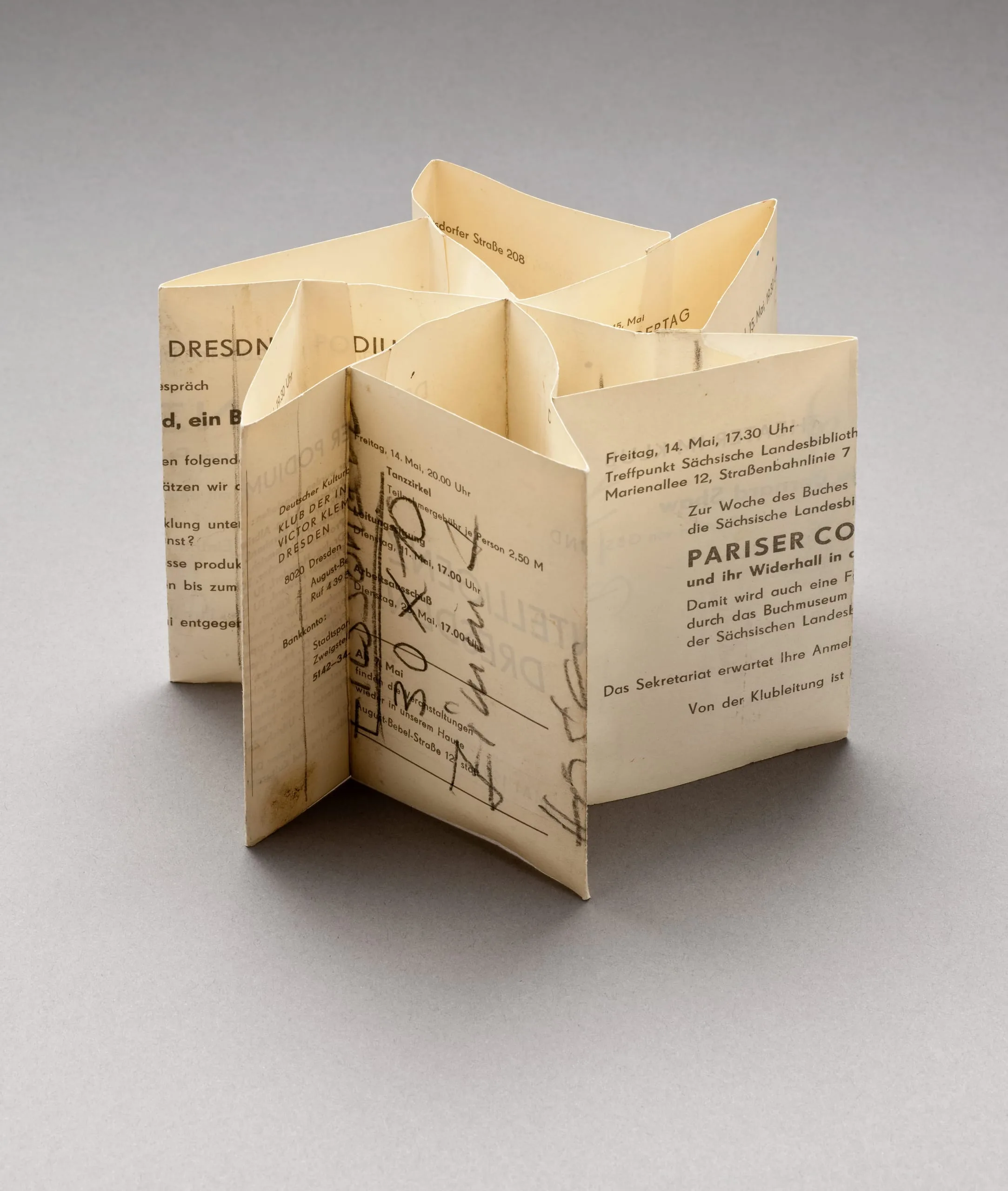
Three-Dimensionally Folded Star-Shaped Form is one of his miniature sculptures called modelli (“models”), for which Glöckner manipulated materials from his household to create unique, intimate objects that he kept private, rarely exhibiting them during his lifetime. In Three-Dimensionally Folded Star-Shaped Form , the monthly program of a “club of intelligence” (an officially sanctioned, interdisciplinary society for artists and intellectuals in East Germany) is folded into a star-shape: here, the lofty questions and topics on the program contrast with the handwritten list, partially obscured by the folds. Words like “cinnamon,” “shoes,” “bunch of flowers,” “stockings,” and “woodturner” proliferate across the sides of the star, suggesting that the role envisioned for artists in a socialist utopia cannot be easily reconciled with the daily realities of East German life.