- Title
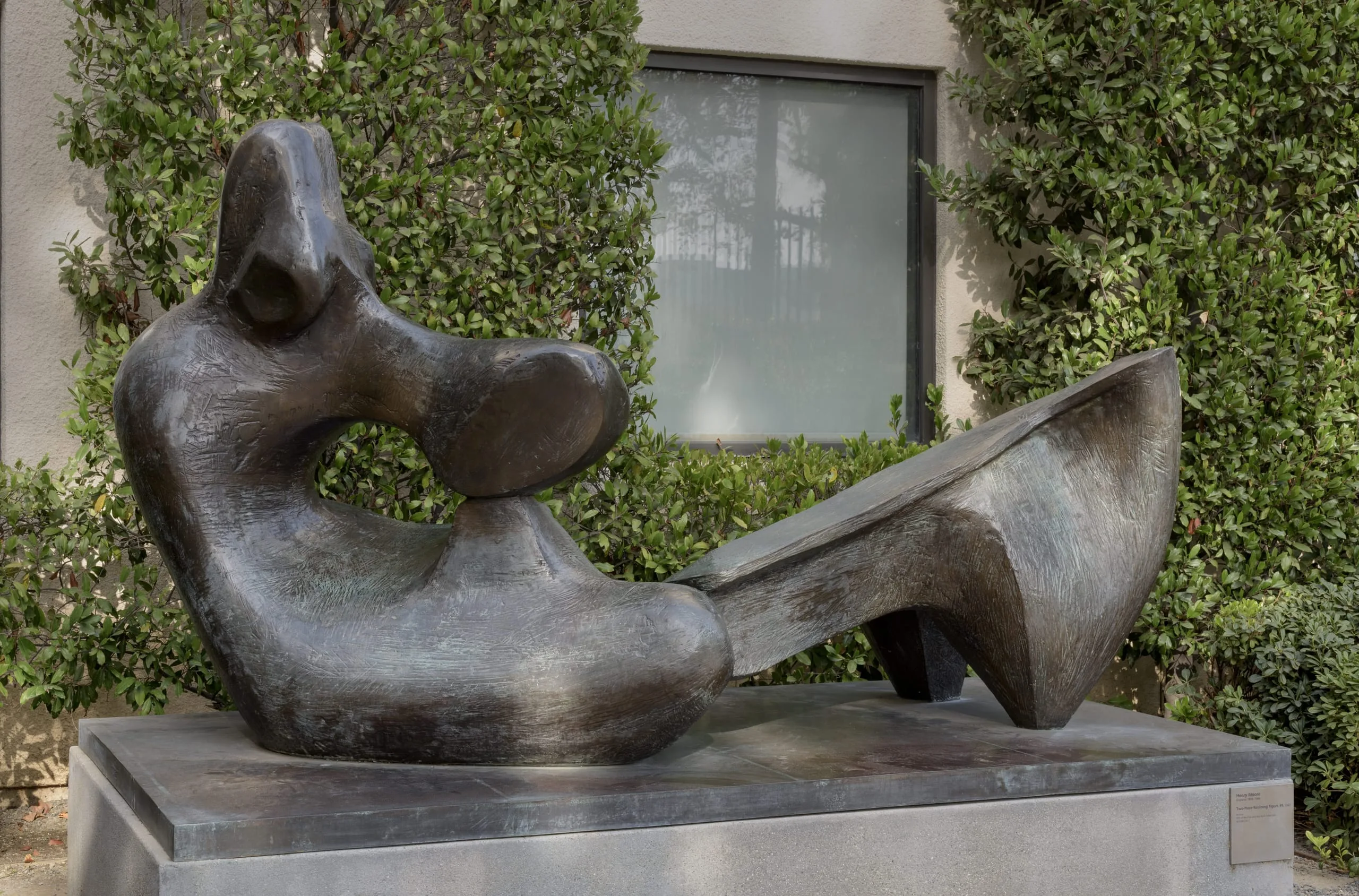
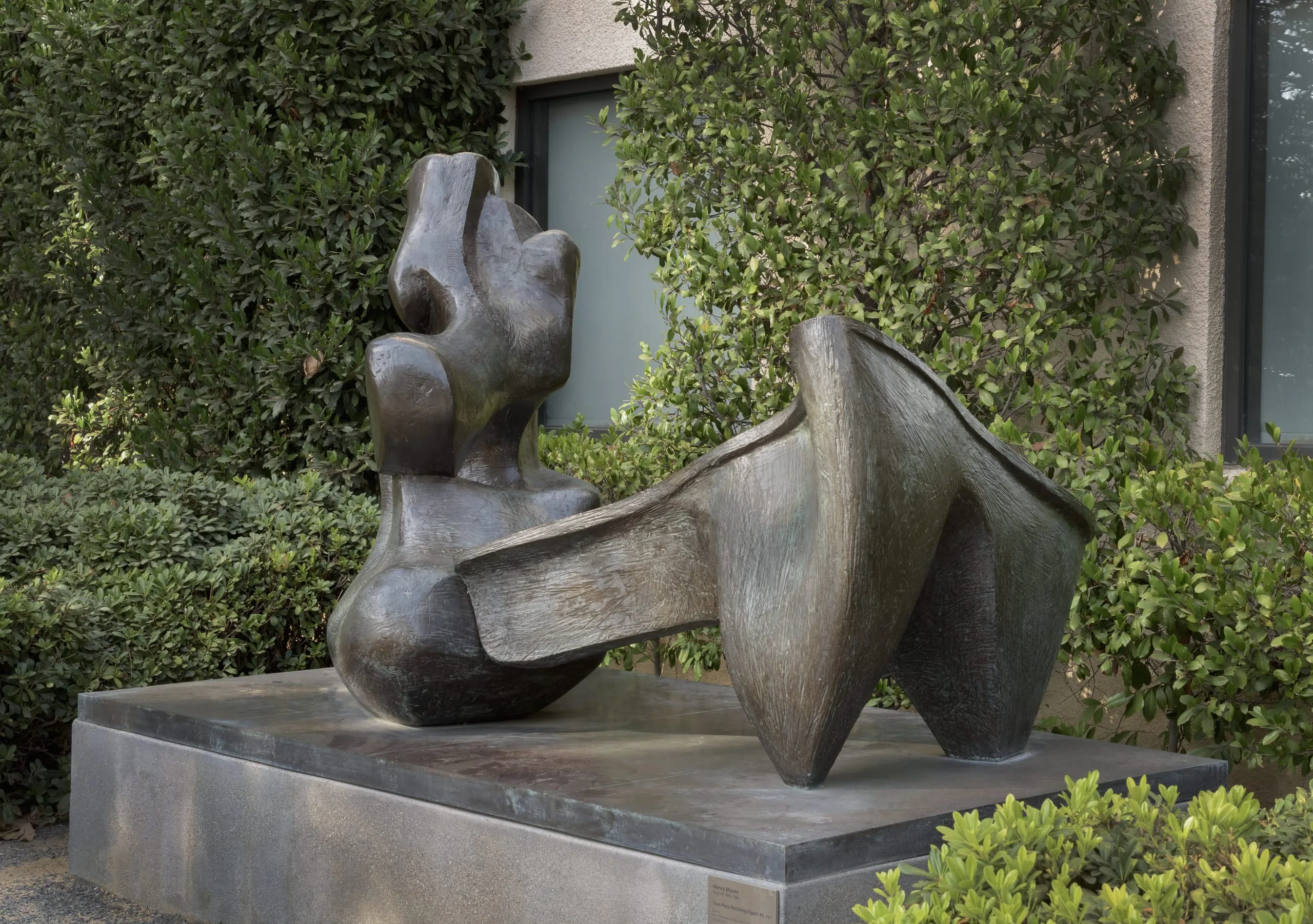
- Two Piece Reclining Figure #9
- Date Made
- 1967
- Medium
- Bronze
- Dimensions
- Length (Overall Dimensions): 98 × 56 × 52 in. (248.92 × 142.24 × 132.08 cm)
Weight (LE Inventory): 1430 lb. (648.6 kg)
- Accession Number
- M.2008.230.1
- Curatorial Notes
Reclining figures regularly appear in Henry Moore’s work as early as the 1920s and, by 1968, comprised two-thirds of his life-size sculptures. Moore’s approach to the genre—as well as his overall sculptural language—was particularly influenced by his encounters around 1929-1930 with Meso-American, chacmool-type, carved figures at the British Museum . Often used to depict Tlaloc—the god of rain—by the Aztecs, chacmool figures recline on their back instead of resting on their sides like most of their Greco-Roman counterparts. This formal aspect was attractive to Moore because of the compositional and spatial freedom it offered, but for him chacmool statuary also conveyed greater “truth to material” by accentuating qualities inherent to the medium—in this case, the “stoniness” of carved stone.
Two Piece Reclining Figure #9 further reflects important later shifts in Moore’s practice, such as his enthusiastic adoption of modeling in plaster and casting in bronze after WWII and the introduction of two-piece compositions starting in 1959. Here, the Surrealist-inspired distortion and abstraction of the human body is pushed to its limits, and the experience of curvilinear contours is heightened through the presence of flattened surfaces and sharp edges. Moore’s careful balancing of volumes and voids extends laterally in space, inviting the surrounding landscape to become part of the viewer’s experience of the work. The artist frequently found inspiration in nature, including for some of his most abstract works, and Two Piece Reclining Figure #9 is a testament to Moore upholding this challenging duality, creating works that are—as one critic described them—“otherworldly and yet at times almost clumsily worldly.”
- Copyright
- © The Henry Moore Foundation. All Rights Reserved. / ARS, New York / DACS, London